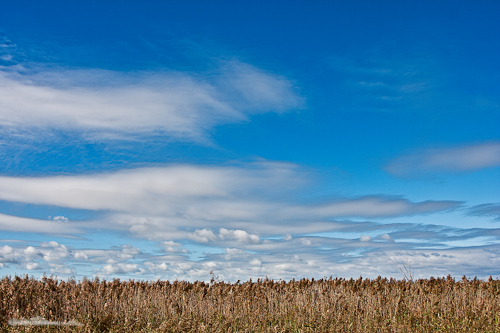
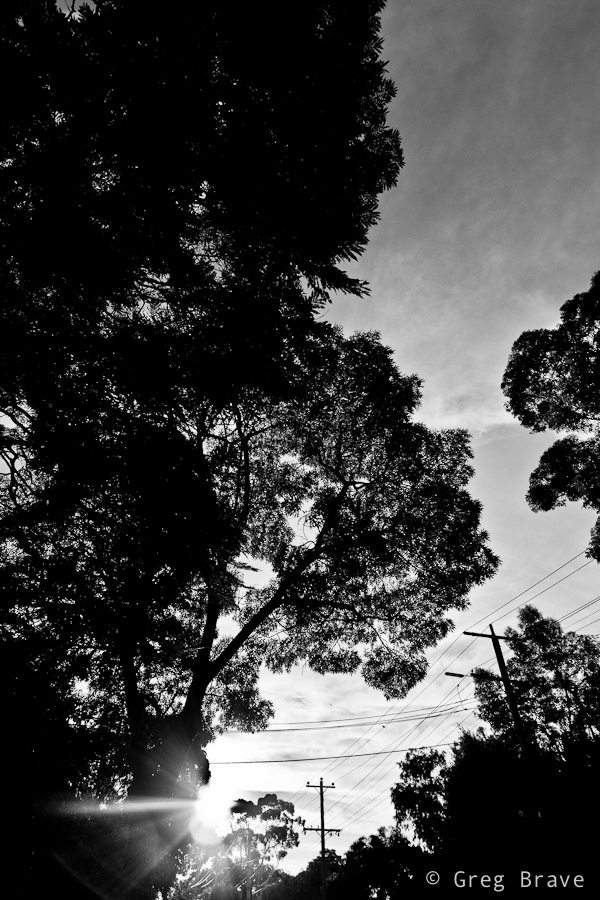
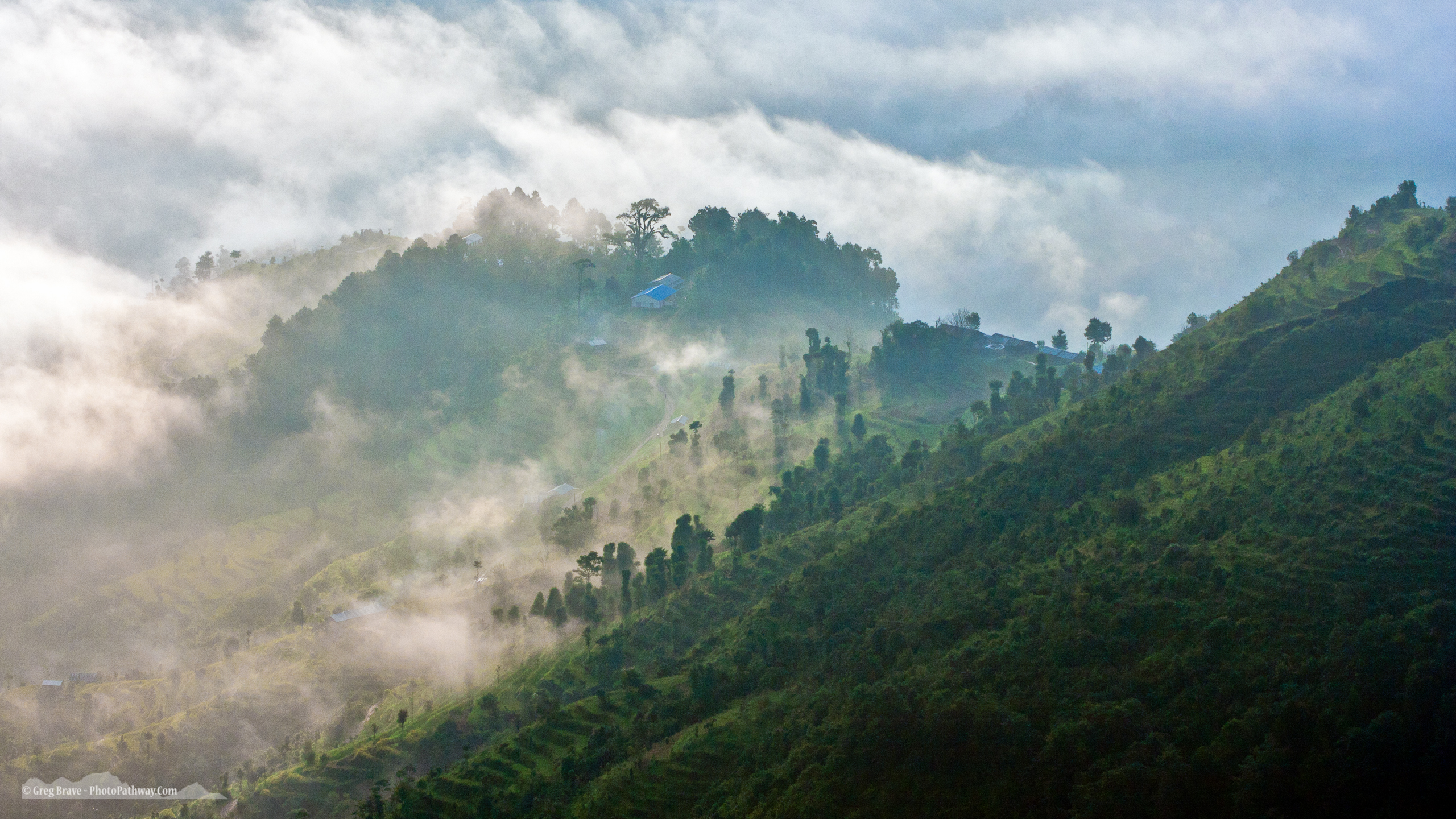
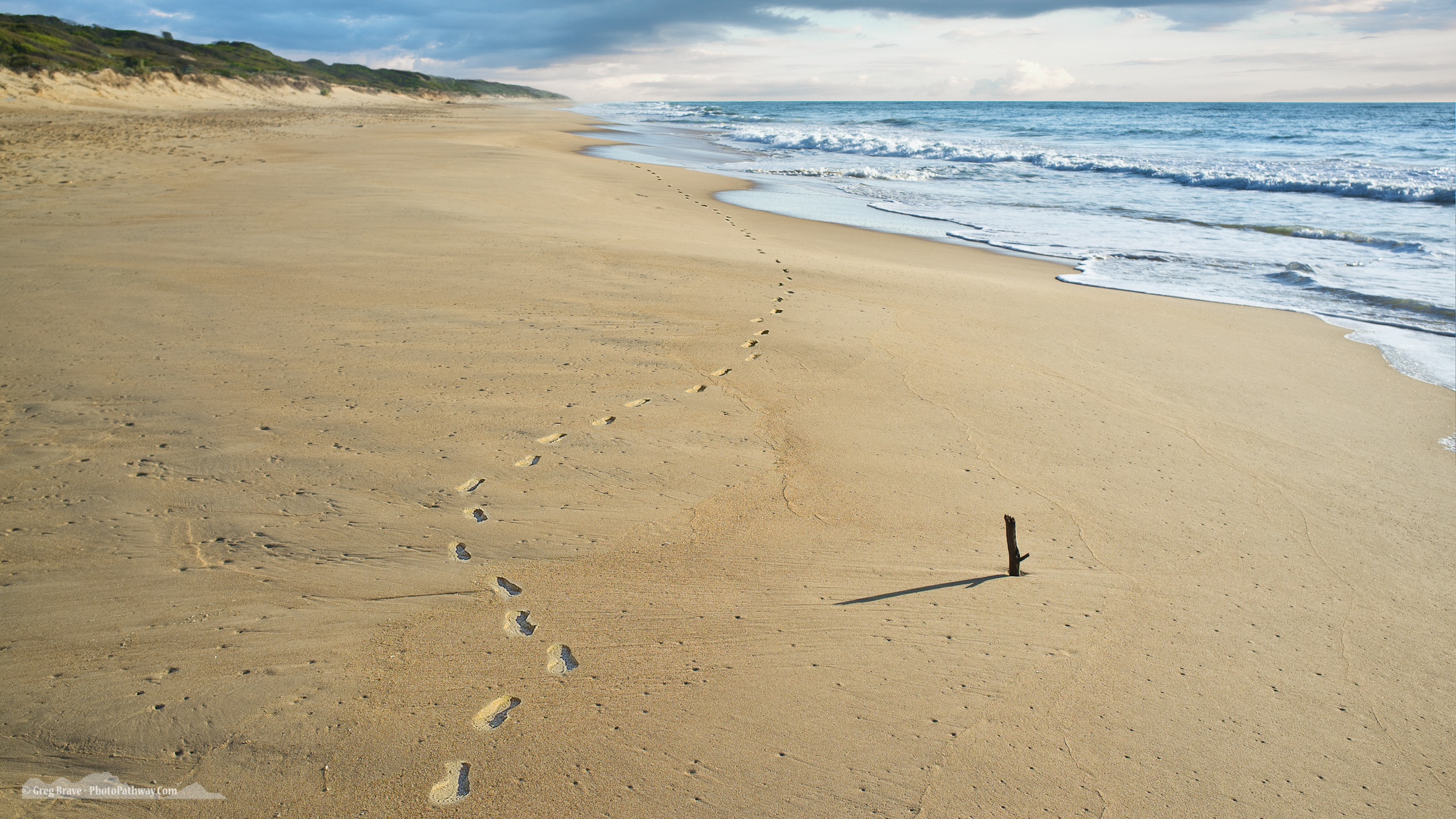
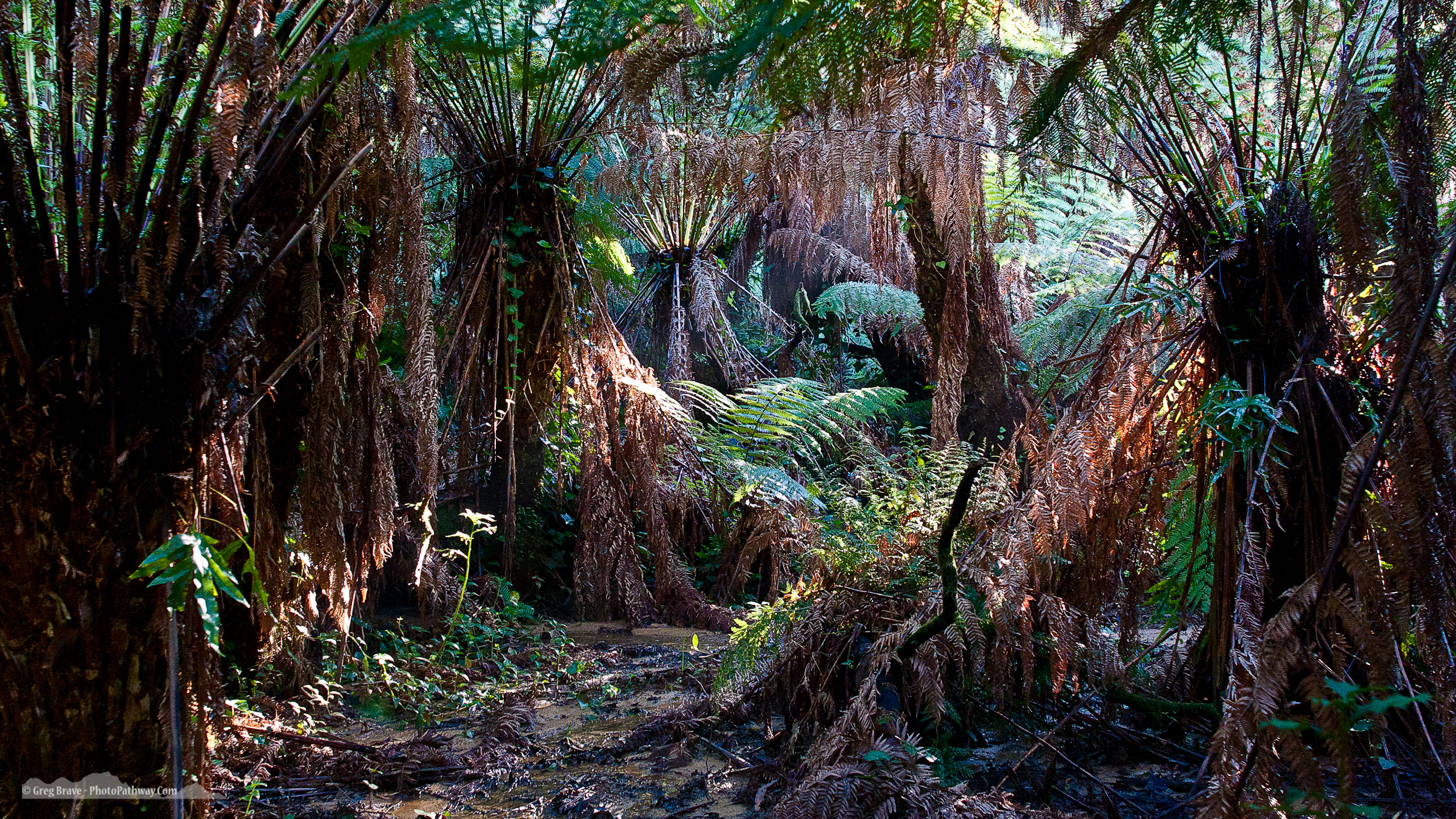
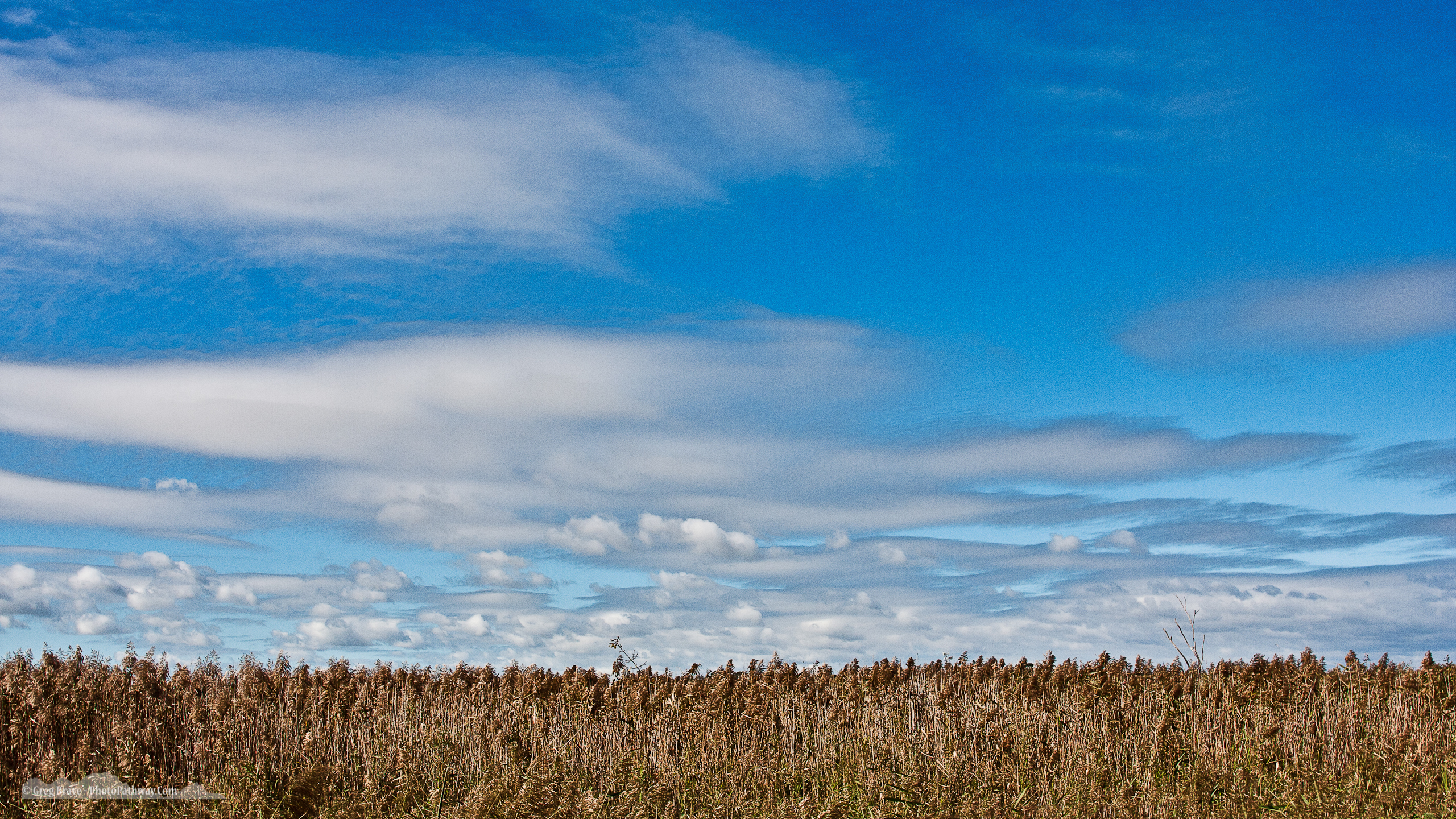
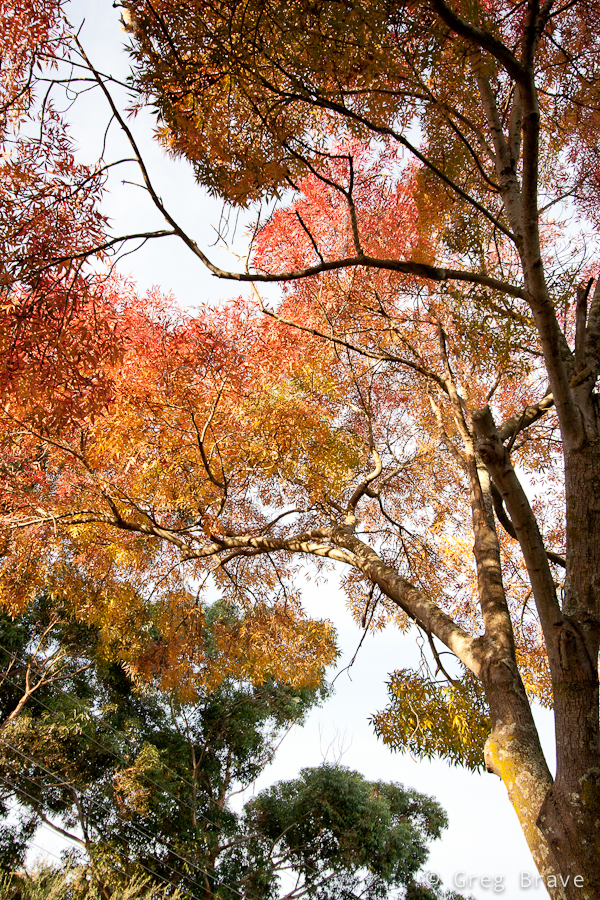
Alfred Nicholas Gardens are usually visited by photographers when Fall comes, and that’s what I wanted to do. However this year I arrived a little early and everything was still green. But it didn’t stop me from taking a few photos. Enjoy!
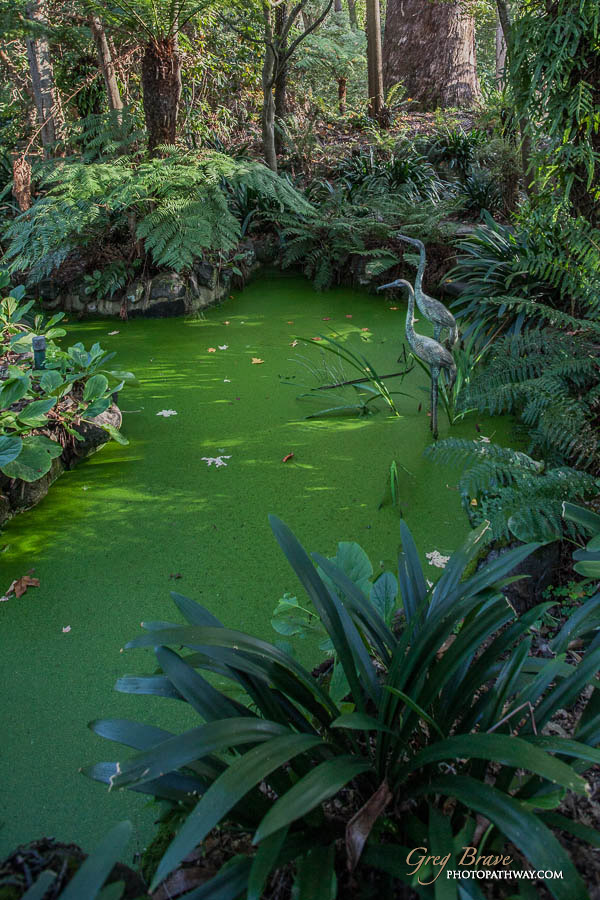
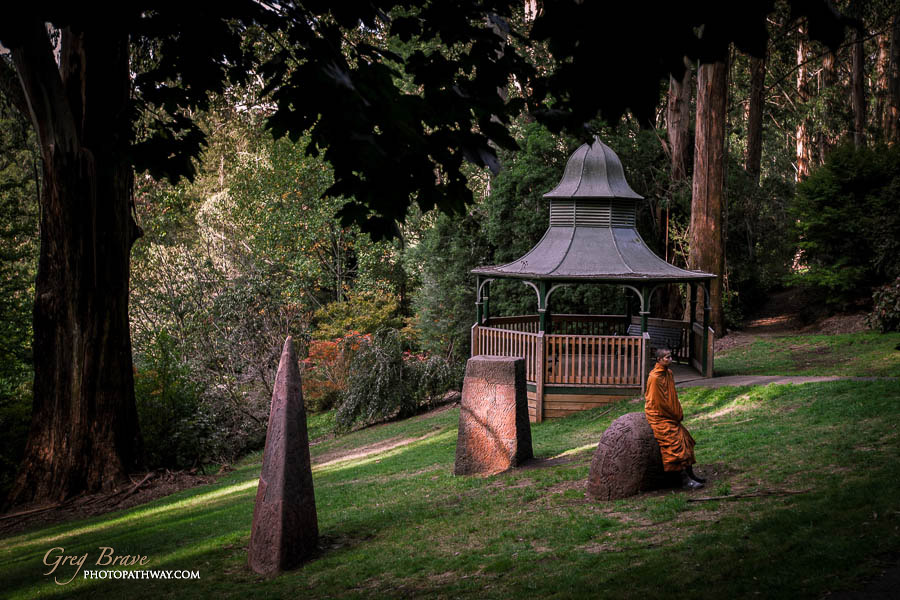
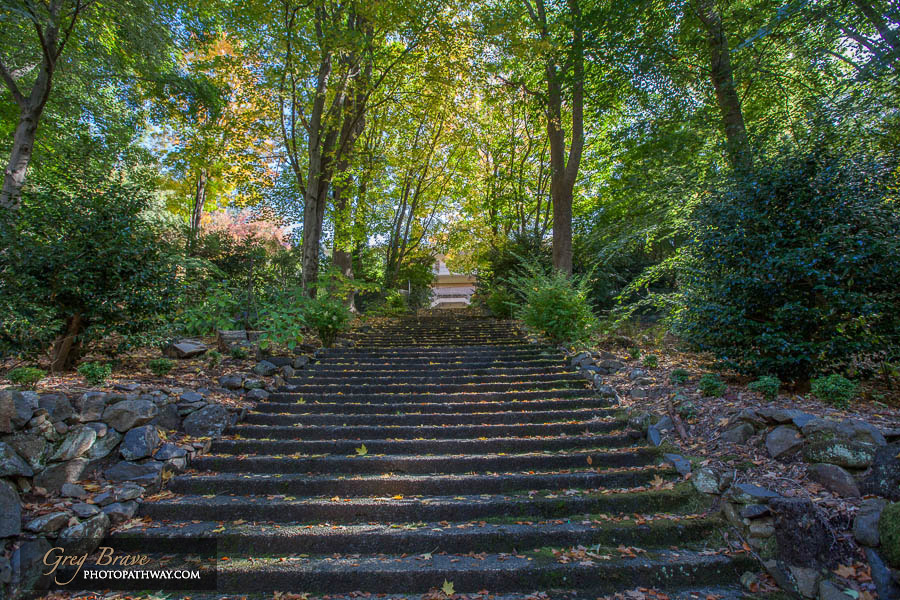
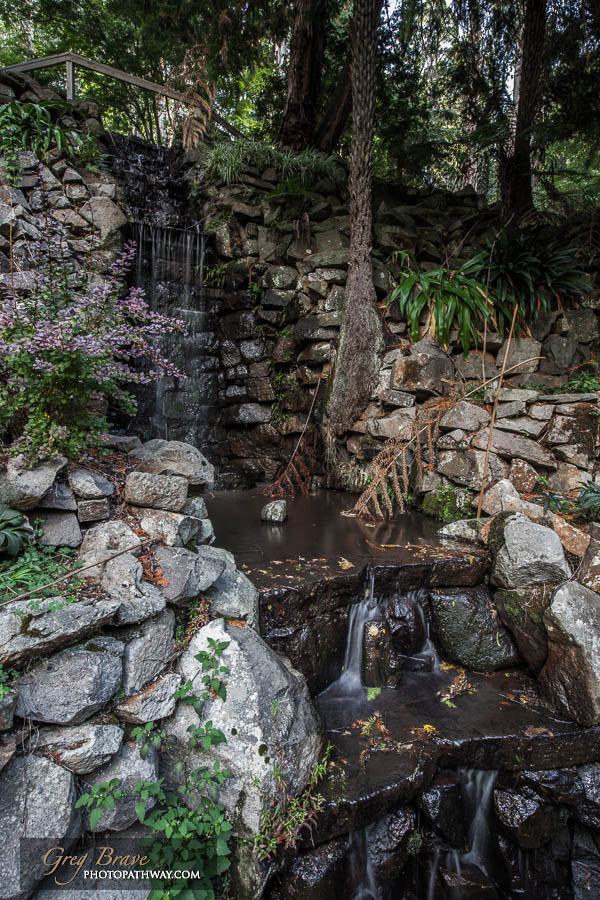
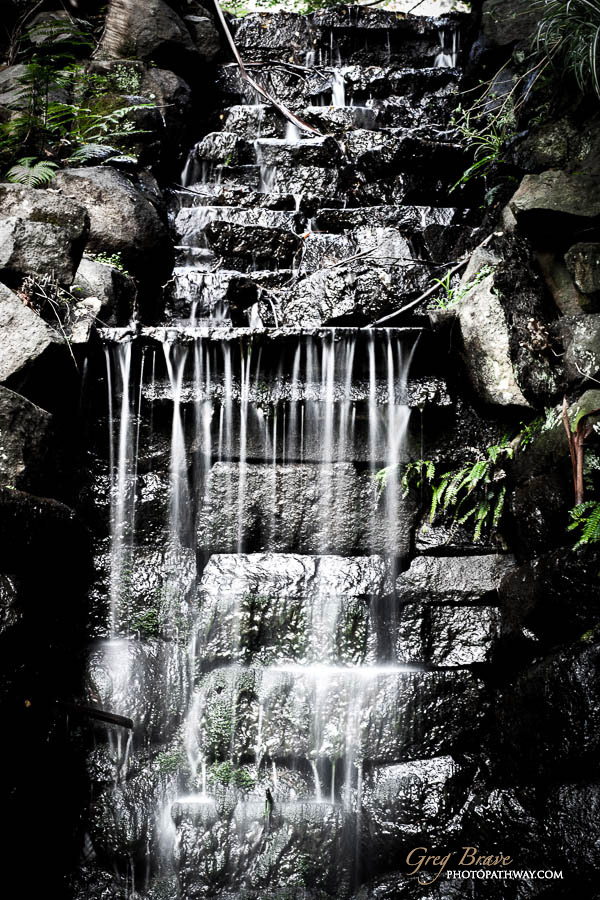
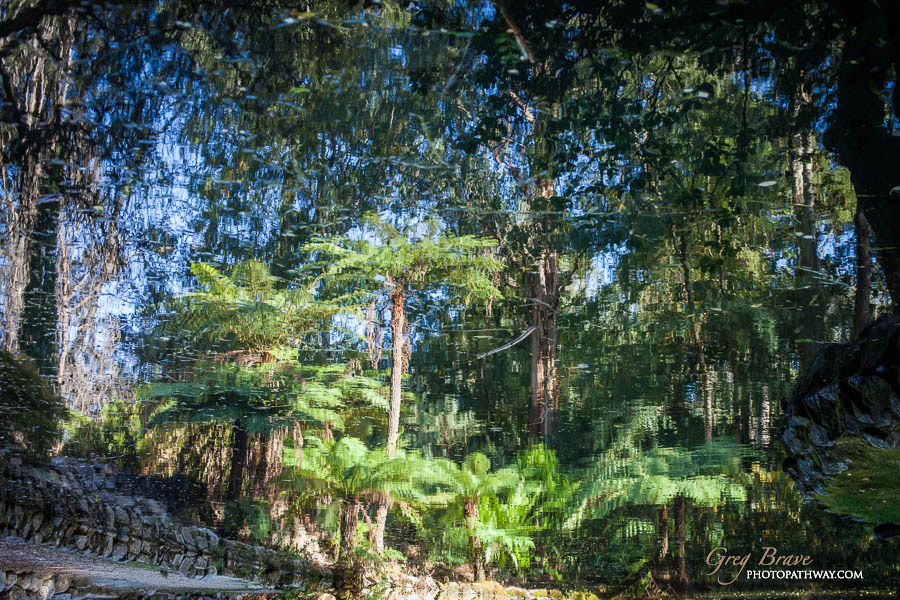
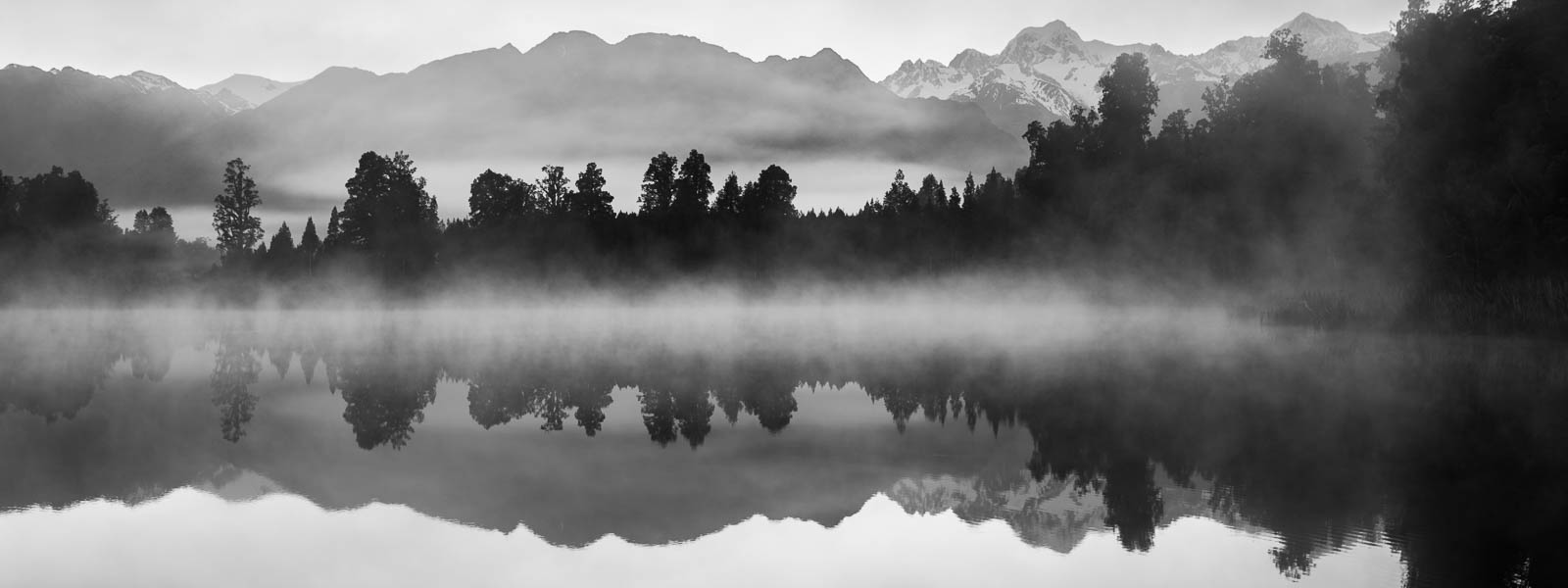
Alfred Nicholas Gardens are usually visited by photographers when Fall comes, and that’s what I wanted to do. However this year I arrived a little early and everything was still green. But it didn’t stop me from taking a few photos. Enjoy!
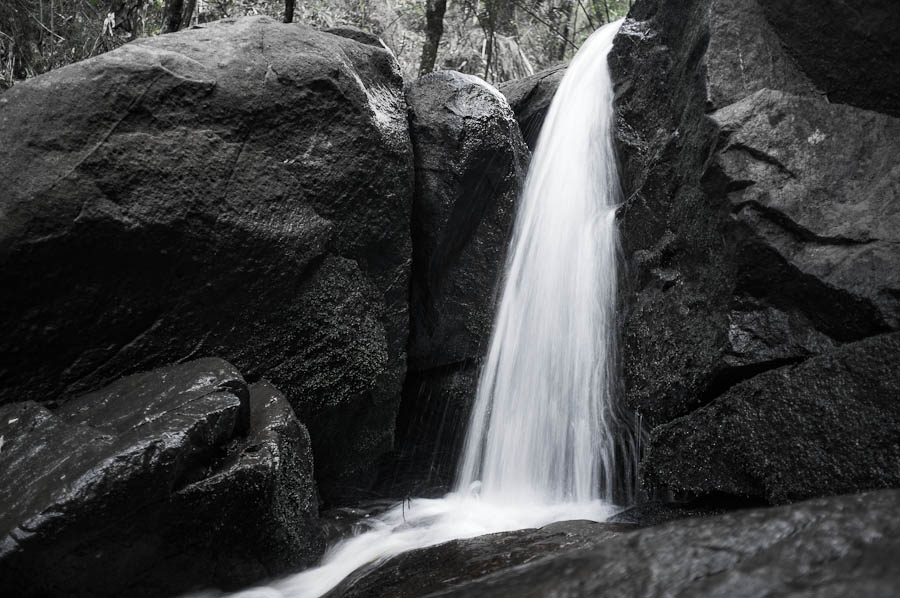
This weekend I took my family to a nice place in Dandenong Ranges here in Victoria – Olinda Falls. Thinking of it I love everything about the Dandenong Ranges forest, it is just beautiful. Having a creek with a few nice little falls is just a bonus. In short, it is a short trek leading from the car park through the forest to the Olinda creek and its falls.
We arrived there at rather late afternoon, sun was getting lower in the sky, there was humidity in the air as the creek was nearby. This perfect combination led to the photo below.
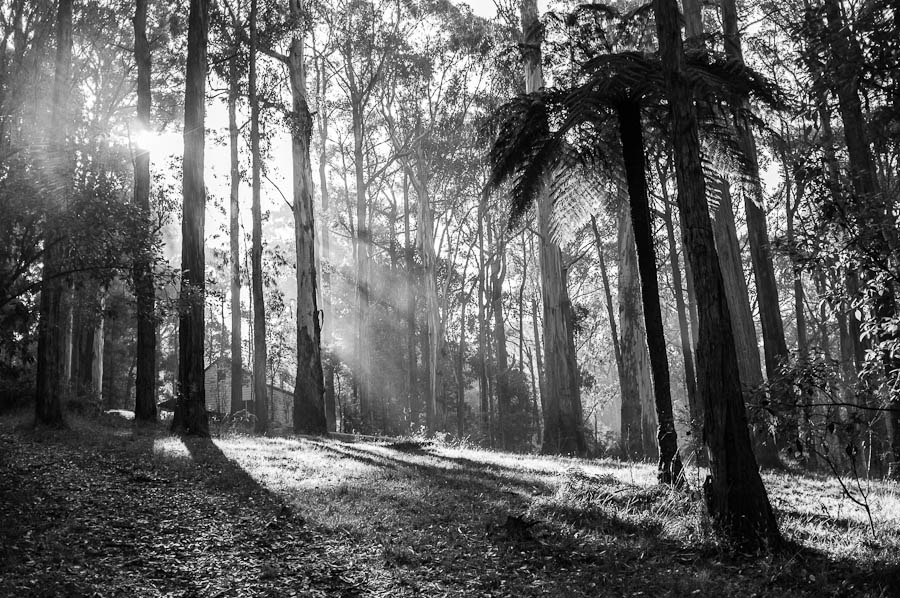
Near Olinda Falls, Victoria, Australia
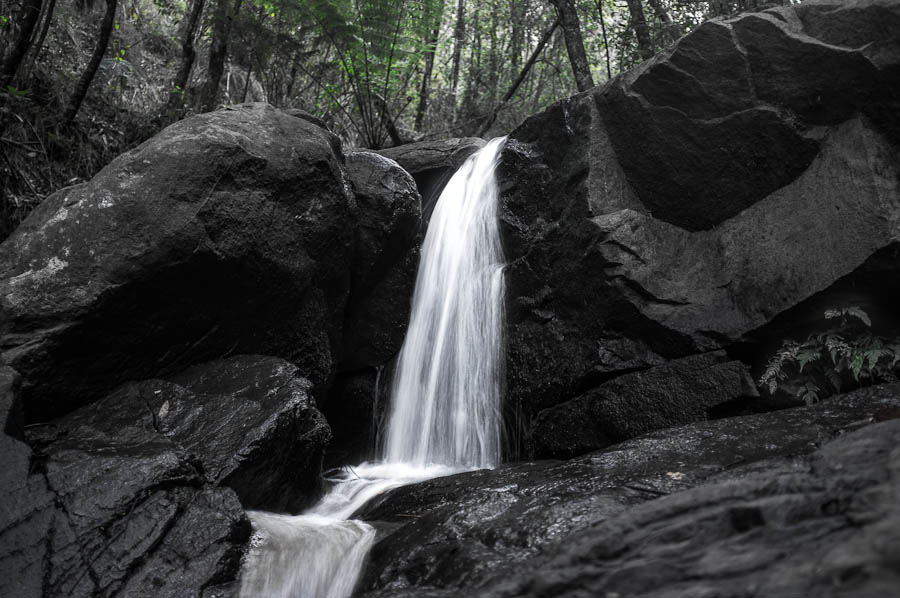
Olinda Falls 1, Victoria, Australia
Olinda Falls 2, Victoria, Australia
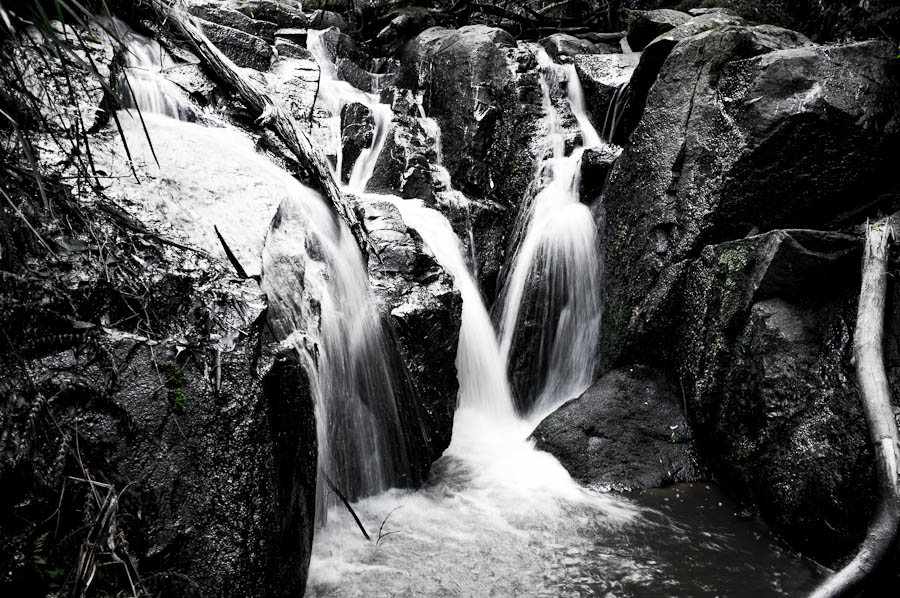
Olinda Falls 3, Victoria, Australia
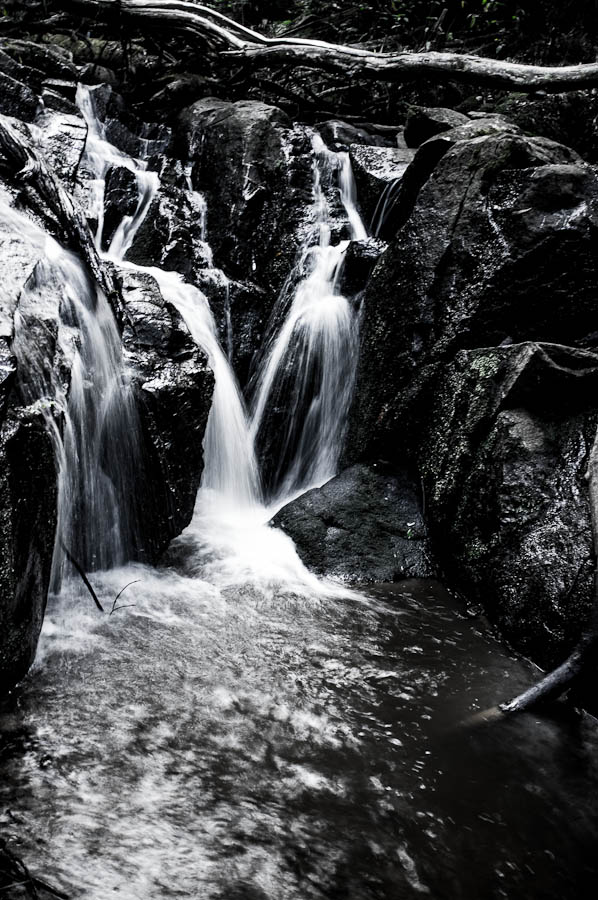
Olinda Falls 4, Victoria, Australia
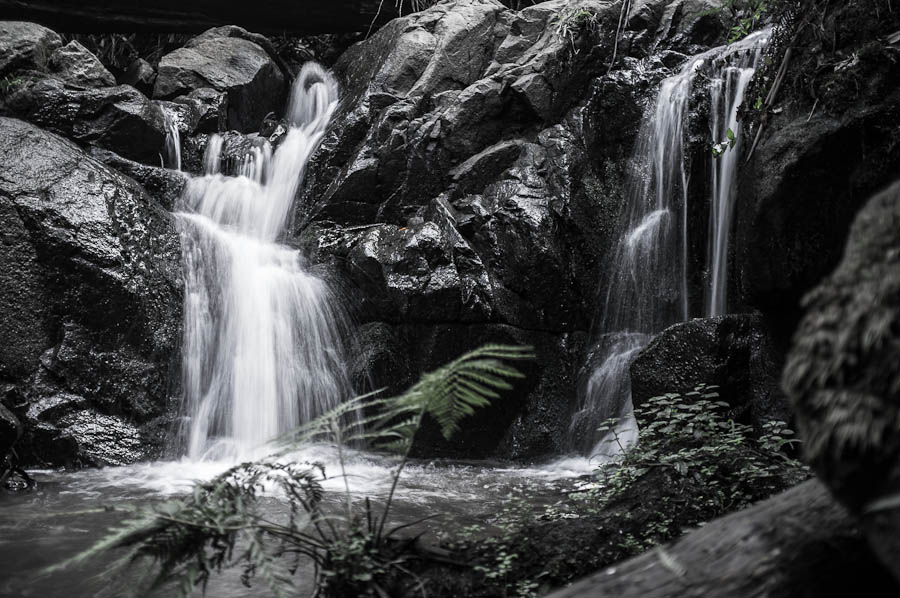
Olinda Falls 5, Victoria, Australia
Coolart historic area is located near Somers, a small town approximately 72 km south-east of Melbourne, Victoria, located in the south-eastern corner of the Mornington peninsula. The area includes Coolart historic homestead, nice gardens, and lengthy walks around swamps, inhabited by various birds species.
Last weekend all three of us took a walk there, and it was a great way to spend time! I won’t go into historic details, I just want to show it to you through my lens.
Walking through the wetlands, depending on time of the day and the year you can see many different bird species. Here is what we saw.
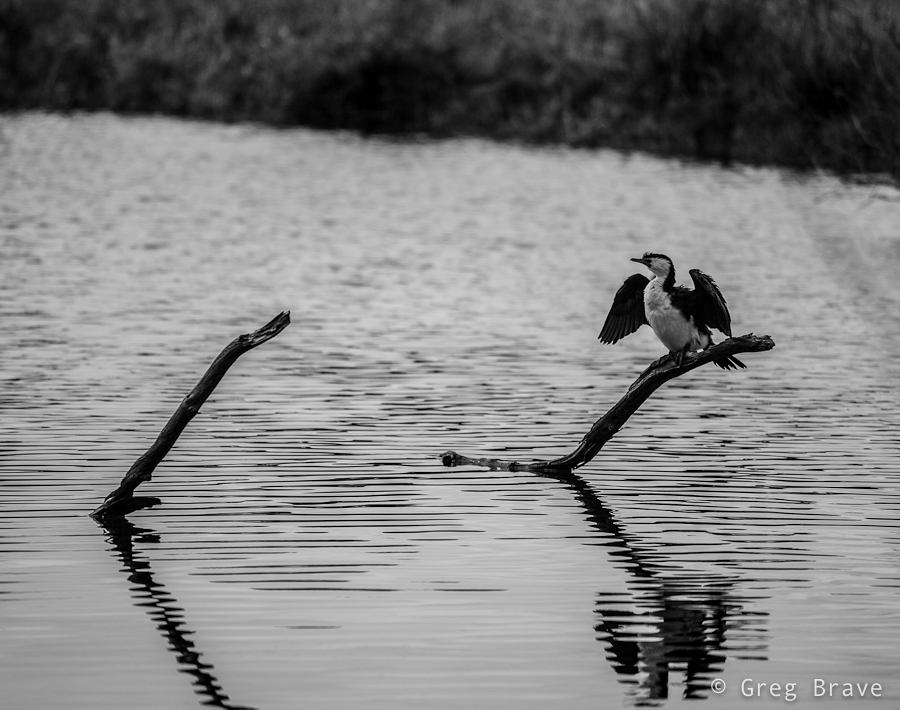
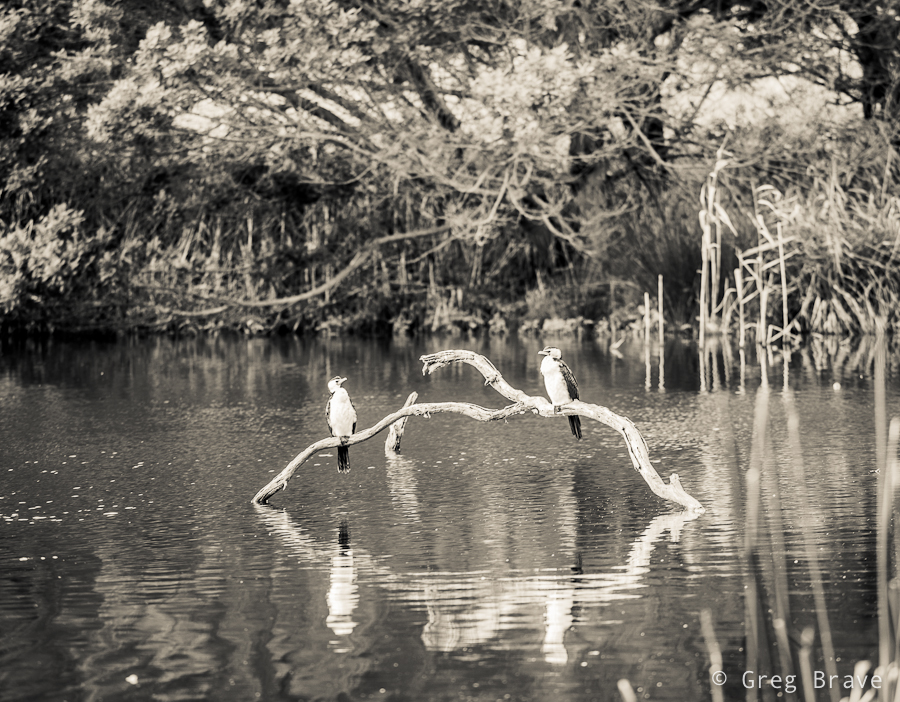
Click on the photos to enlarge.
We also had nice views of the wetlands and surrounding areas.
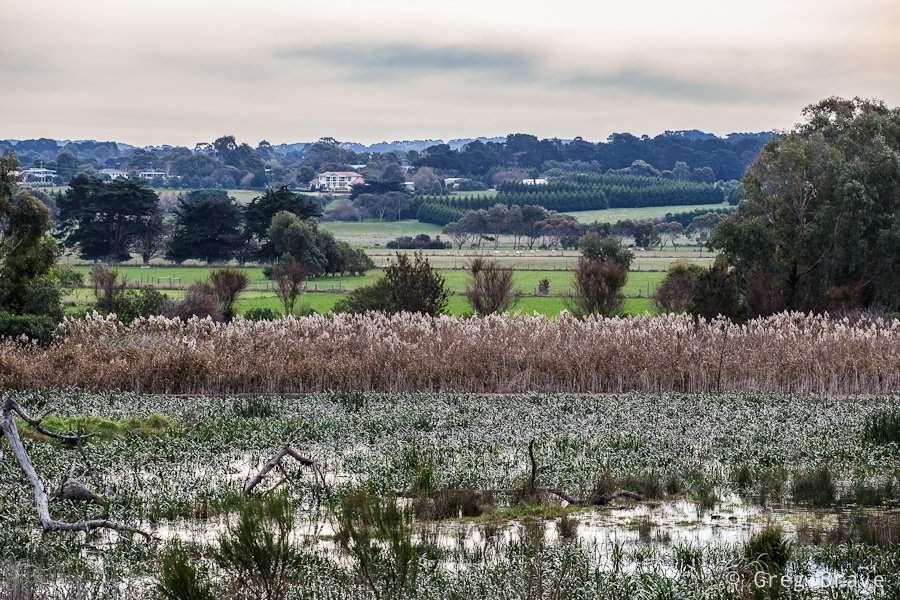
Click on the photo to enlarge.
The Coolart Mansion looks very interesting. Parks Victoria have done a good job preserving it.
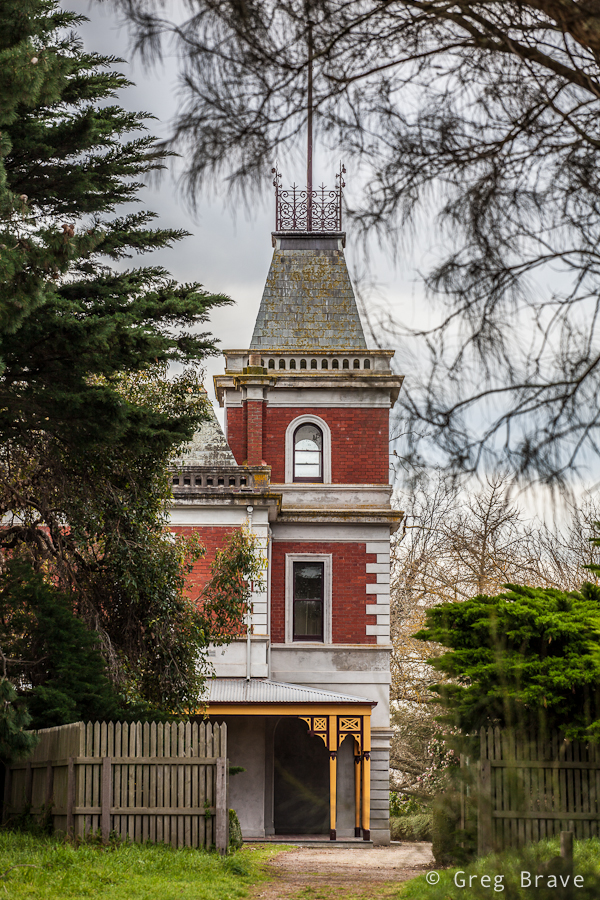
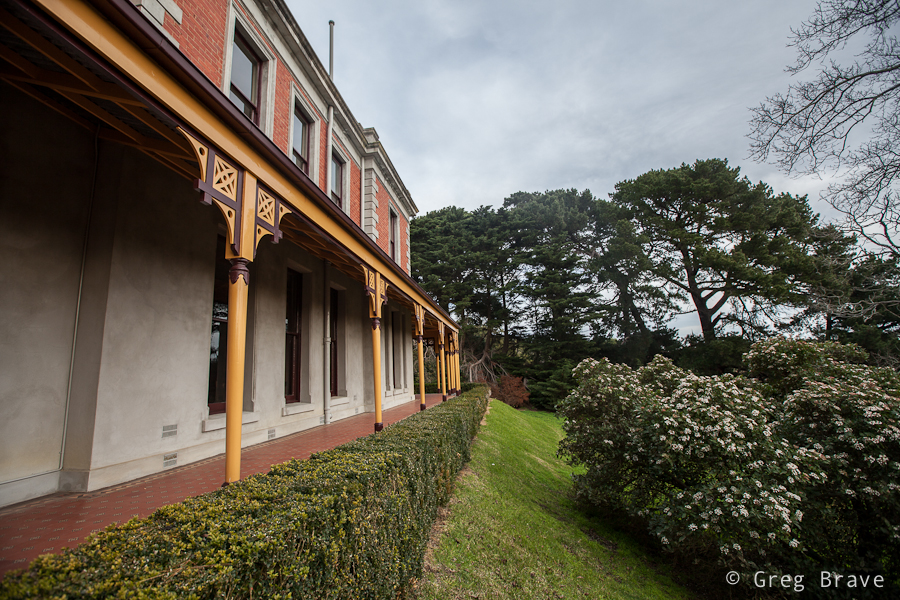
Click on the photos to enlarge.
Both from outside and inside.
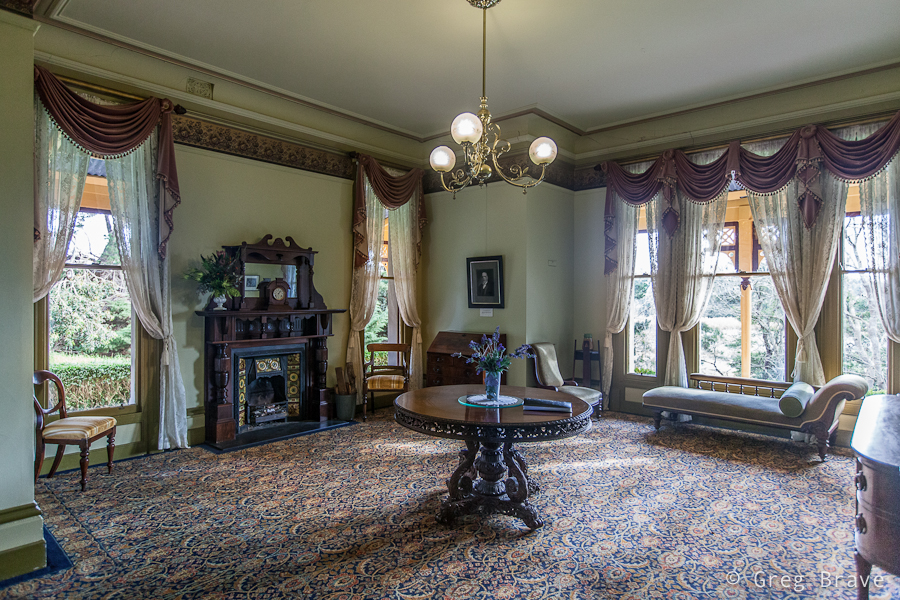
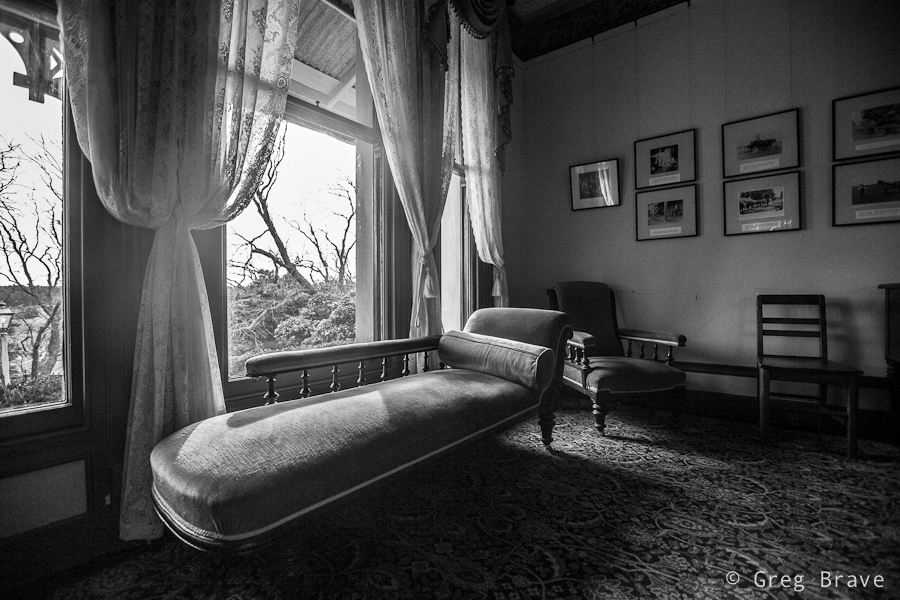
Click on the photos to enlarge.
Here are some more interior details. I had a feeling that b&w suits them.
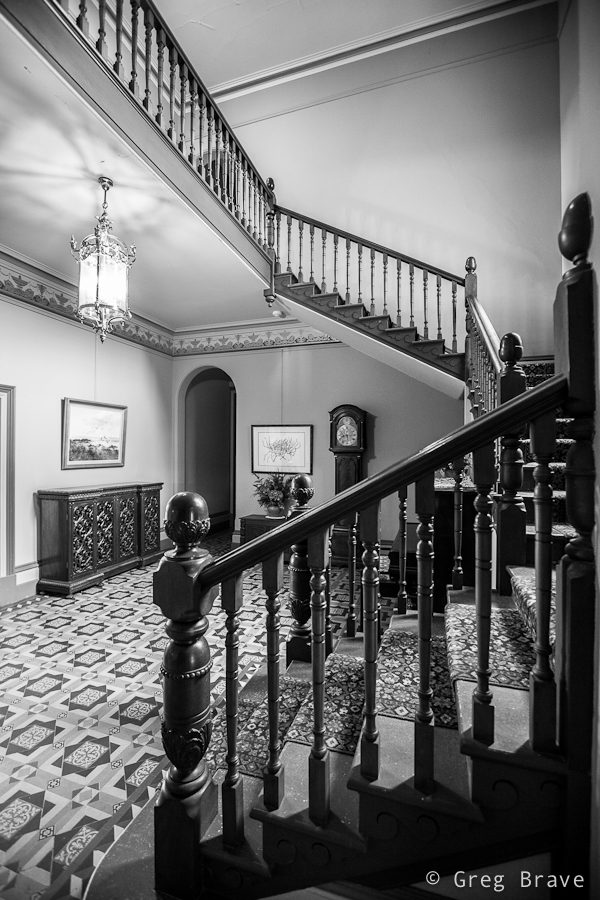
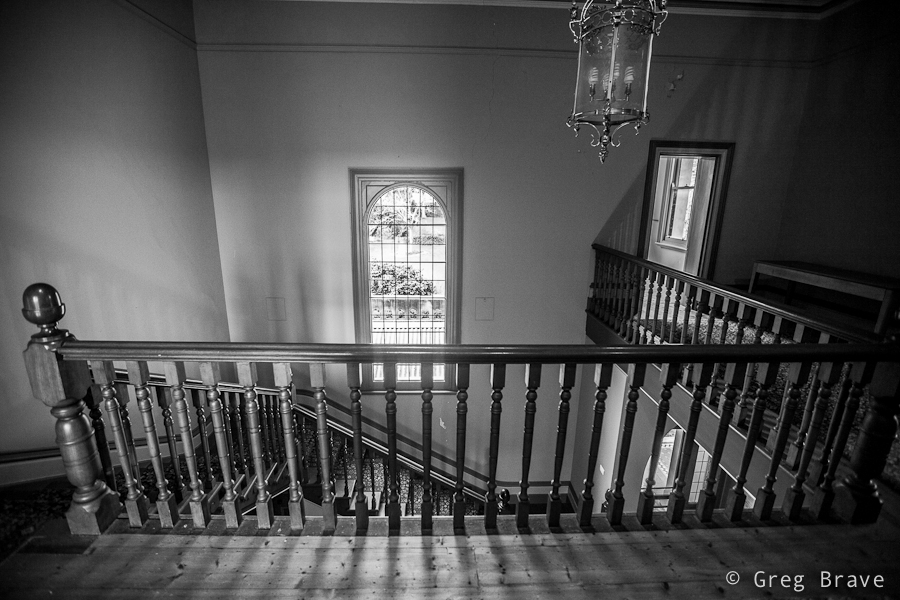
Click on the photo to enlarge.
And finally a view of the mansion from the gardens surrounding it.
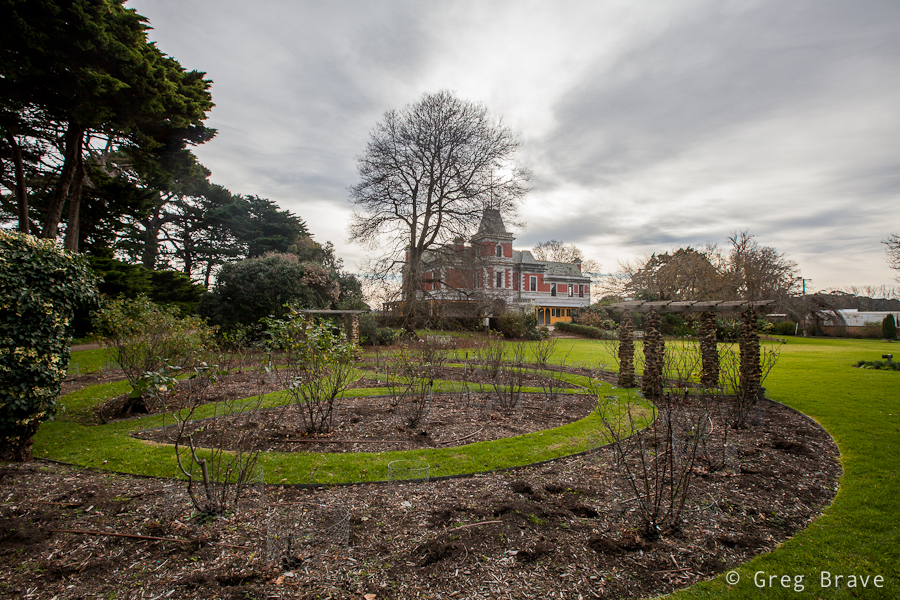
Click on the photo to enlarge.
I hope you enjoyed this little virtual trip and will be happy to hear about it in the comments section below 🙂
In the summer, here in Australia, Red-flowered gum trees start to blossom. This is a very beautiful sight! The whole tree is covered by marvelous, red-colored flowers. These trees have various hues of red, and when you have the whole street planted with them, the view is stunning!
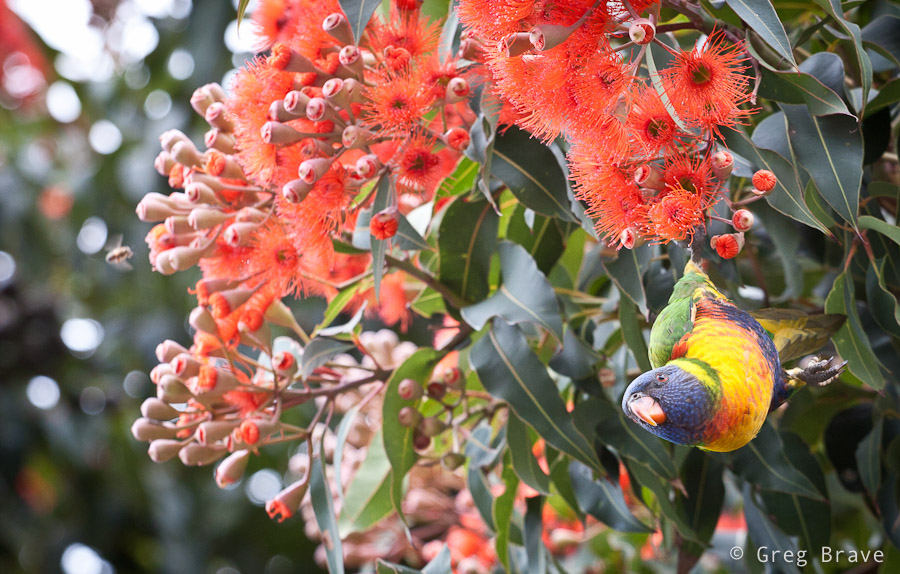
Click on the photo to enlarge.
But merely this fact wasn’t enough for me to set aside some time on weekend and go photograph them. There was one more thing – early in the morning starting about at 7 o’clock and until about 9 the Rainbow Lorikeets (beautiful little parrots) come to feed on these trees. Most of the chances that you won’t see them later in the day there, but in the morning the blossoming trees are filled with these brightly colored little birds. It is quite simply a celebration of colors!
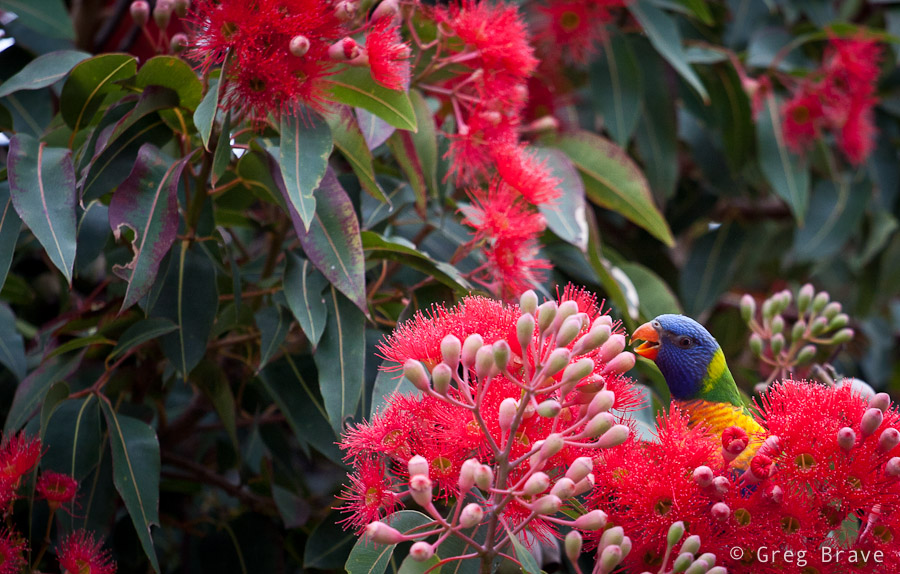
Click on the photo to enlarge.
I couldn’t miss this event, took my 70-200mm lens, and set out early in the morning to capture the nature at its best :). You can see what came out of that photo session in this post.
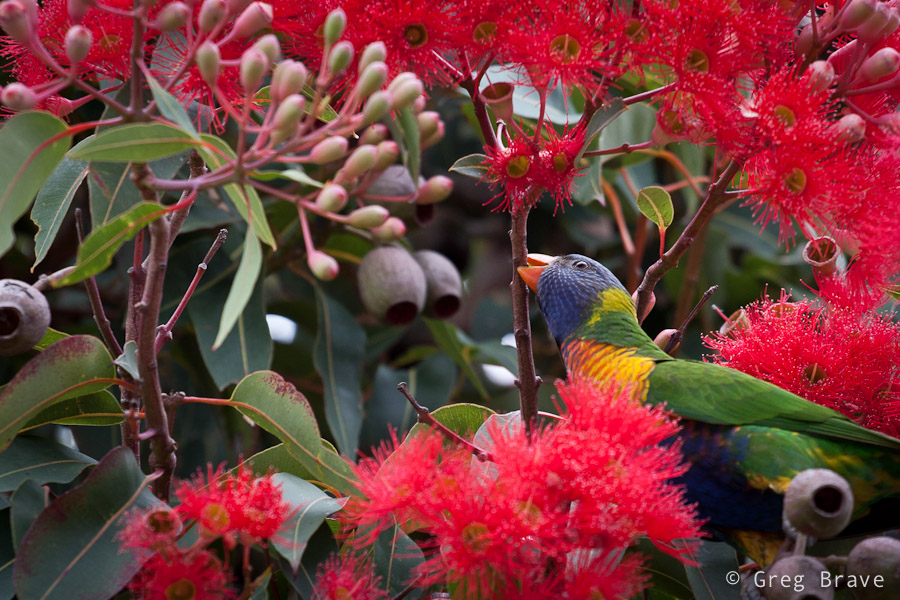
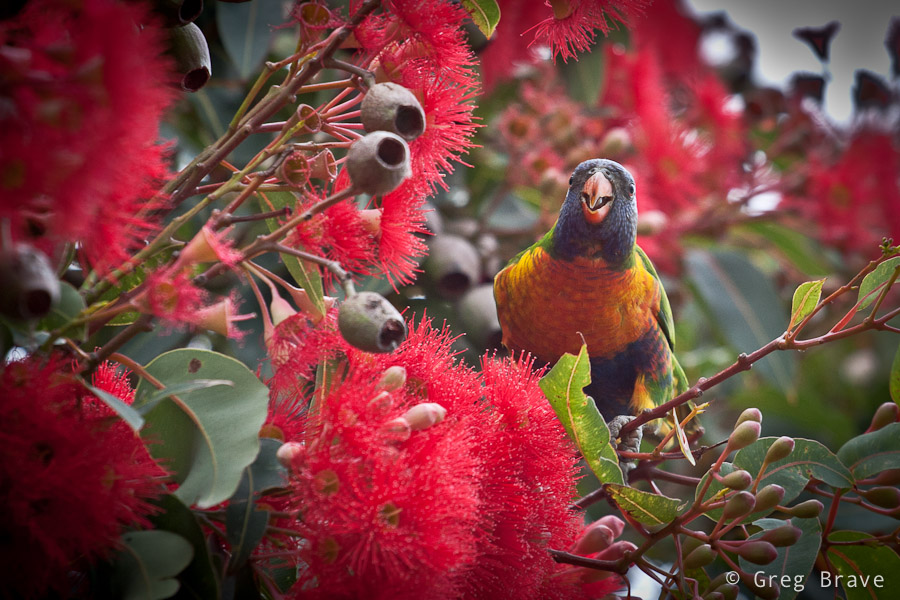
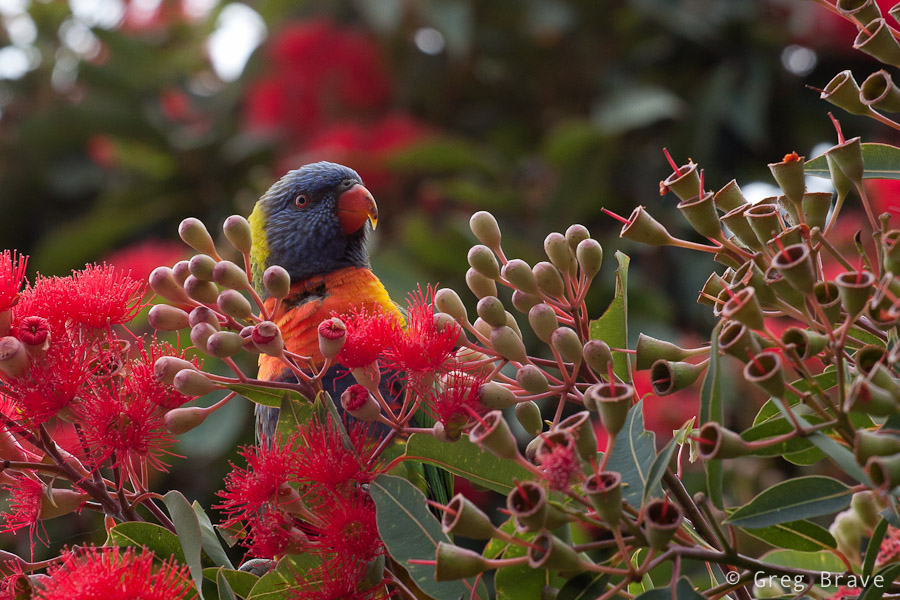
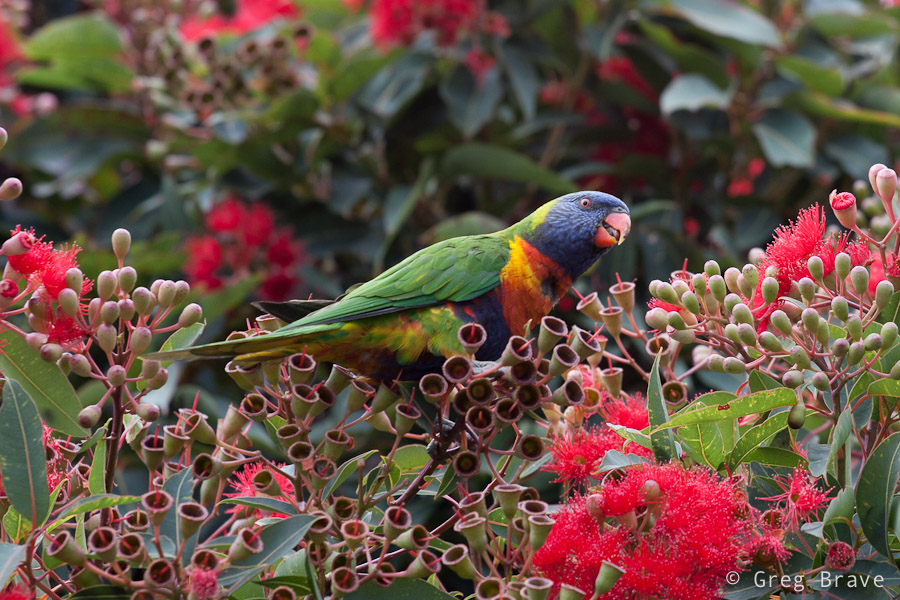
Click on the photos to enlarge.
I needed to have quite a lot of patience as the parrots were restless, kept moving all the time coming out and disappearing in the foliage, but I managed to get a few nice images. Hope you enjoy them!
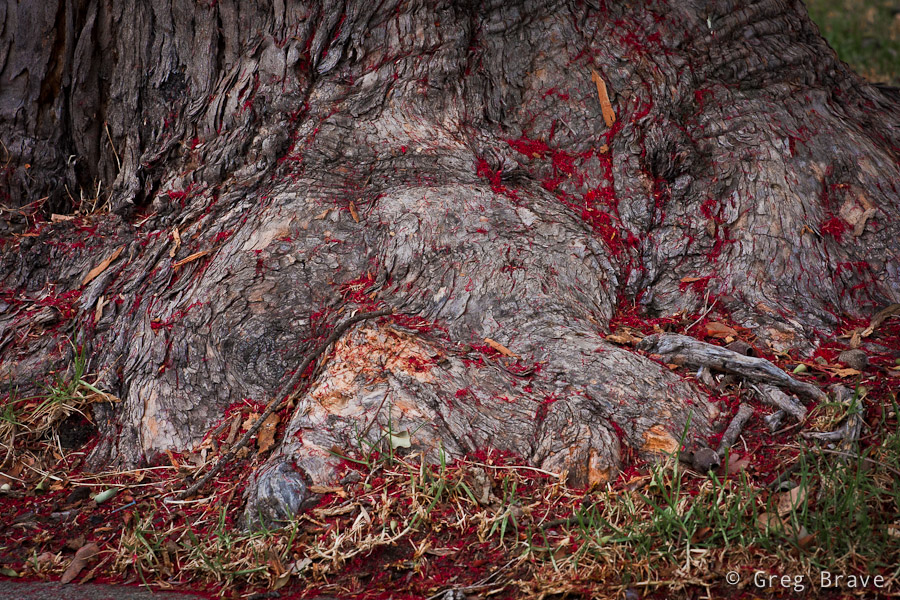
Click on the photo to enlarge.
Lately I haven’t made much noteworthy photographs… either that or my understanding of what “good photograph” is has changed. Either way I don’t like almost anything that comes out of my camera. And what’s more important, I don’t know how to improve.
I guess I’m just searching now for something… another point of view on the world maybe. This is really confusing for me – to search for something not knowing what it is.
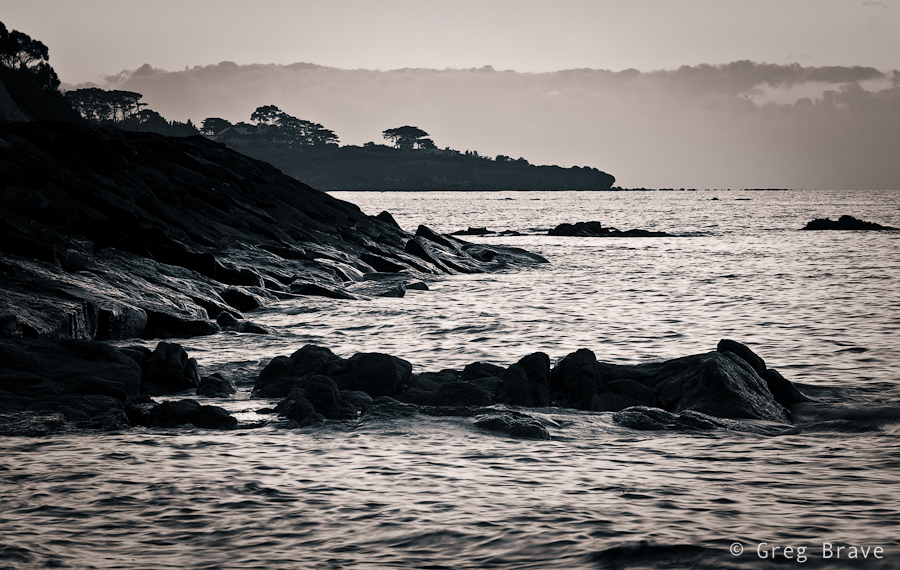
Click on the photo to enlarge.
Nevertheless I keep on shooting and analyzing my work, most of which you will never see here on my blog because I don’t think it is worthy. The photos I included in this post are nice, I like them, but I also think that they are nothing special, just another bunch of seascapes among thousands.
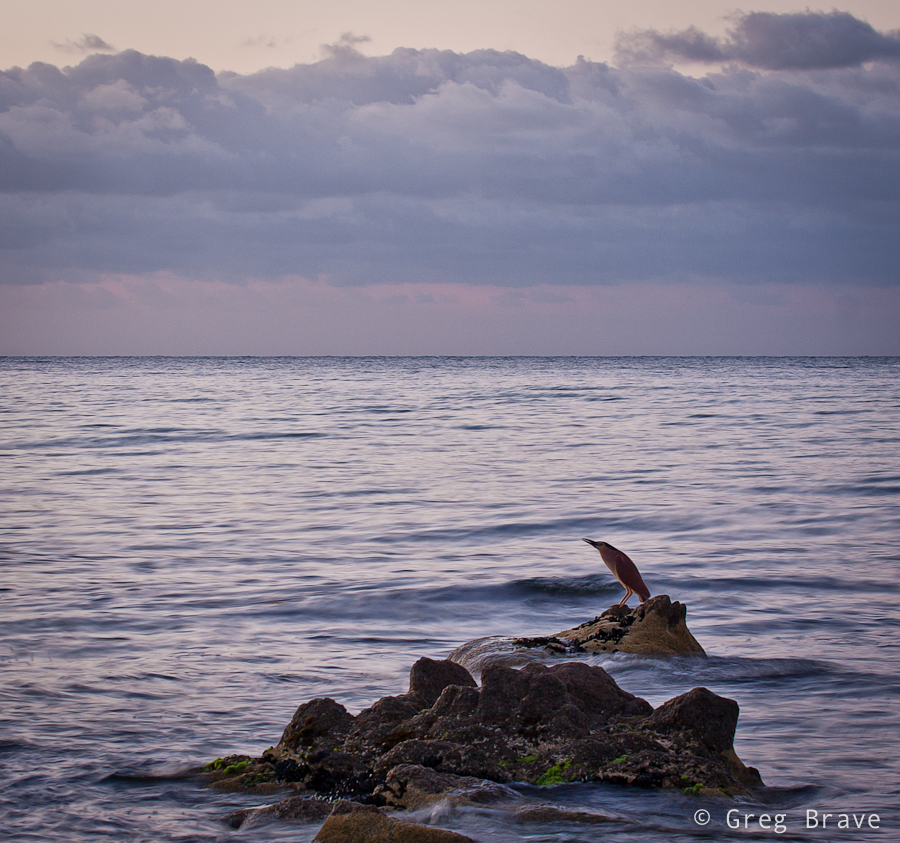
Click on the photo to enlarge.
One of the things that I changed about my photography is that I take much less pictures, and before taking one I stop and think about the composition, about what I want to say with this photograph, what emotions I want my photo to express. And later, when viewing the photo on my computer I try to understand whether I achieved what I wanted or not. Most of the times I don’t.
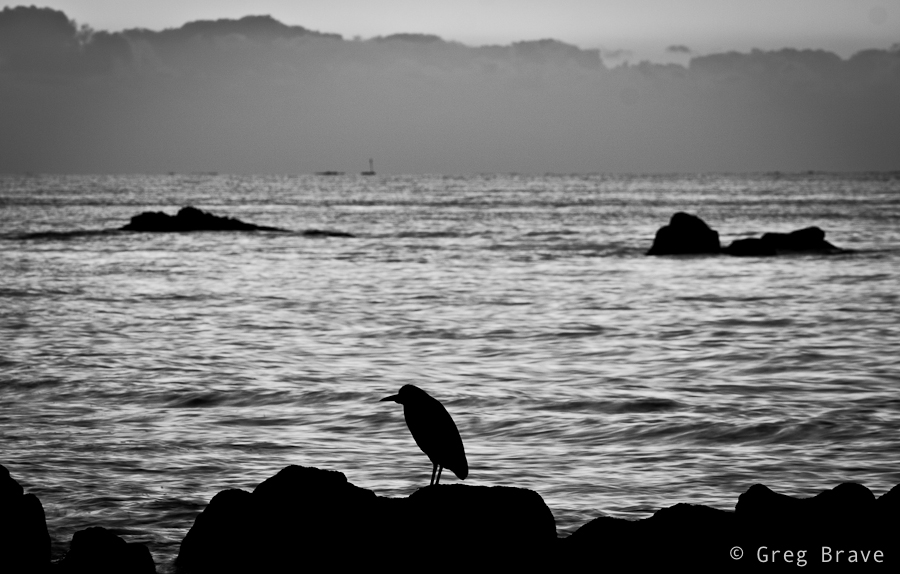
Click on the photo to enlarge.
Long exposures of the sea and sunsets (just like the one below) simply don’t cut it for me anymore.
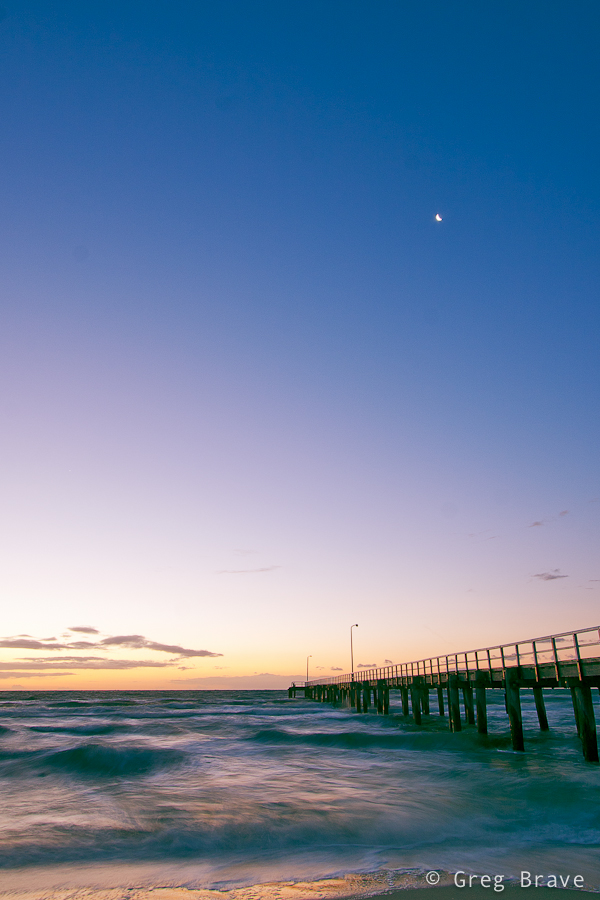
Click on the photo to enlarge.
If you have or had similar issues, and have any suggestions, I would be more than happy to hear them.
Hi everyone,
Just a quick note – I updated my portfolio with more photos from Nepal.
You can check them out HERE
I am not a believer in the “straight out of camera” philosophy. You know, the photographers who don’t do post processing at all and sometimes shoot in plain JPEGs. Anything in addition to that, would be “distorting the reality” they claim. My opinion on this subject is that there is no such thing as objective reality. Everyone sees what he sees through his own eyes and his own perspective. Your previous life experience also alters your perception of everything that you see around you. Even when you simply point your camera at a scene and shoot, the light goes through the lens, hits the sensor, gets transferred into electronic signals, then is processed by your digital camera’s own processor, and undergoes even more transformations until you see the photo on your computer screen. I don’t think I need to go further.
So, when I work on a photo, first I usually perform basic adjustments in Lightroom such as brightness and contrast and then, if I feel that it is not enough, first I try to understand why I feel that way. Is it the composition? If it is the composition then there’s nothing much can be done in post processing, and I will probably discard that photograph. But if the composition feels right then I continue my exploration. Are the shadows too shallow or too deep? Can the colors be improved?
Next, I open the photo in Photoshop and start playing with it, changing color palette, increasing/decreasing lights and darks, and other adjustments. Usually I come up with several versions of processed image, which look good to me, then I compare them and choose the one that I like the most.
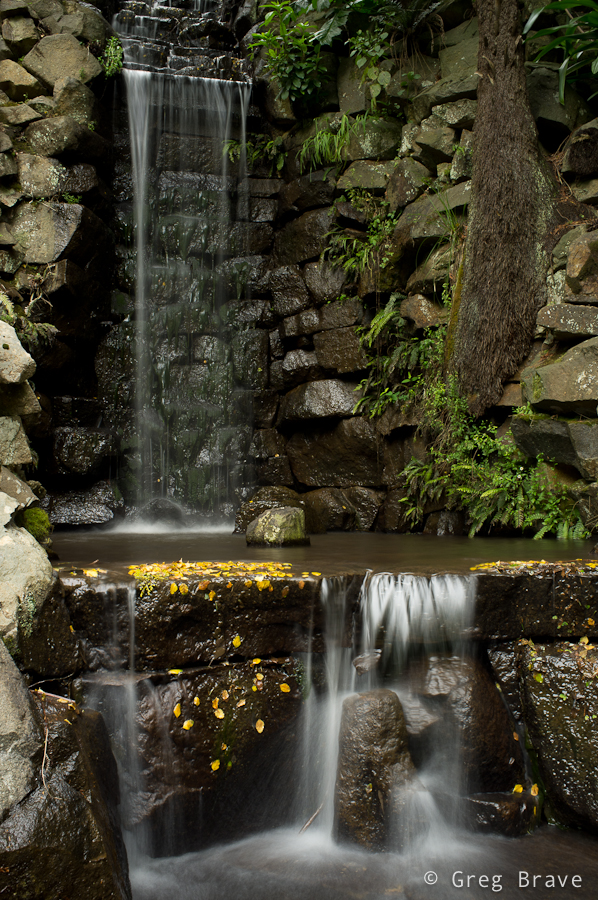
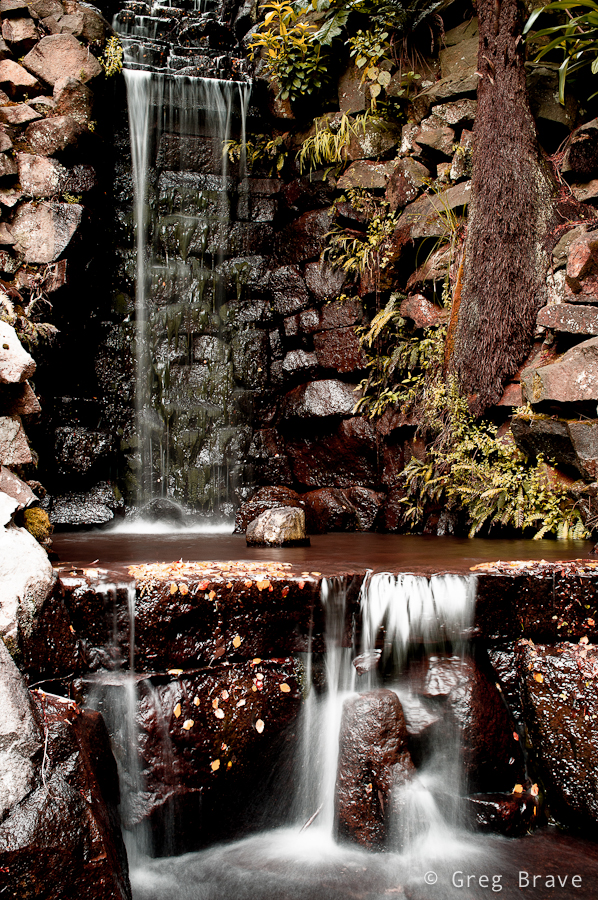
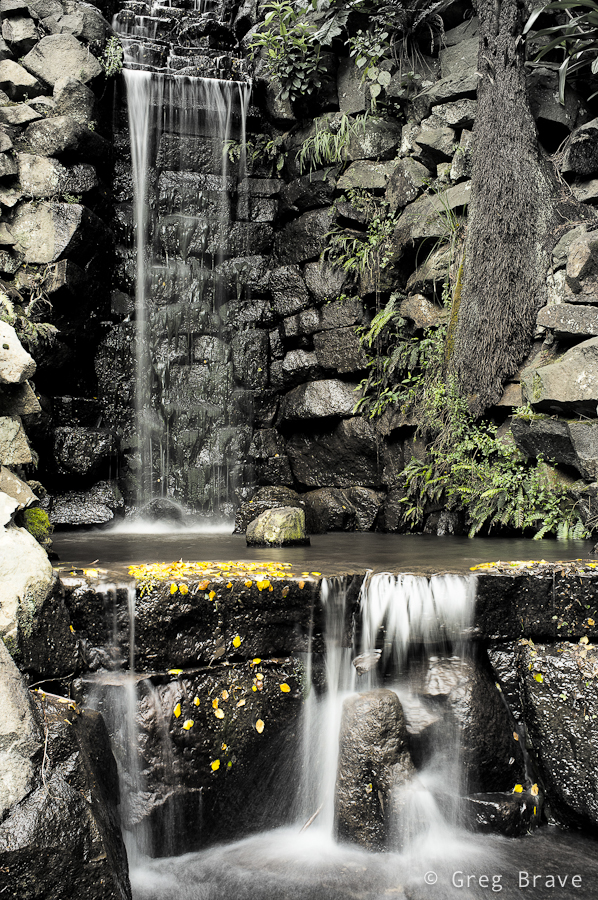
Below I have three versions of the same photo, but the thing is that I can’t choose the one that I like the most. Each version has its own mood, and I have trouble choosing.
The first image below is the original version with only minor brightness adjustments.
Click on the photo to enlarge.
The second version received quite a bit of processing, and has a warm autumnal feeling to it. I like the purplish glow and how it contrasts with the white of the water.
Click on the photo to enlarge.
In the third version I used the original photo as the base, substantially decreasing color saturation, of all the colors except the yellow of the leaves in the water. I also happen to like this version a lot.
Click on the photo to enlarge.
Which version did you like? Please help me choose, but I also need to know the reason for your choice, and this is what the comment section below is for! You can also leave your comments on my Facebook page – http://www.facebook.com/photopathway
As I promised, in the next posts I will write about my photographic experience in Nepal. To get everyone up to date – recently I took a rather long vacation of almost one month and went with my life partner Ira and one good friend to a trekking trip in Nepal. As always my camera was with me, but since we didn’t hire a porter (or a guide) I couldn’t take just any photo equipment that I wanted.
I was facing a hard decision – which lenses can I take with me and not add too much weight to my already heavy backpack? And here’s the list of the photo equipment that I took:
Let me explain my choice of lenses. Even though I have two Canon L-series lenses (70-200 f4 and 24-70 f2.8) I didn’t take them with me for one simple reason – they weigh too much. Instead I decided to go mostly with prime lenses, which are much smaller and lighter but still produce very good quality photographs even though they are not from L-series. Canon 100mm f2.8 macro lens is known for its superb quality, and after shooting with Sigma 28mm f1.8 for a while I saw that it is also a very good lens though it has some minor issues with lens flare. In addition I took the Canon EF-S 10-22mm, which is known for its good quality-to-price ratio. In this case I didn’t have much of a choice since it is the only wide angle lens I have, and you can’t go trekking in Himalayas without a wide angle lens, can you?
The only thing I could’ve taken less of were the batteries. I found out that for a nine day trek I only need two batteries. But I must say that I didn’t use the live view, which is known for its ability to drain power quickly.
Our first trek was the famous Annapurna Base Camp (ABC) trek. In order to get to its beginning, we had to fly from Kathmandu to Pokhara (second largest city in Nepal) and then take taxi (~1h drive) to Phedi. Phedi is a small village, in which ABC trek starts with a long climb via stone stairs.
Before setting off to the ABC trek we had a rest day in Pokhara. One of the main attractions of this town is Pokhara Lake. For 300 Nepalese rupees you can take one of the boats below for a 1-hour sail. Add 50 more rupees and you’ll also get a boats-man.
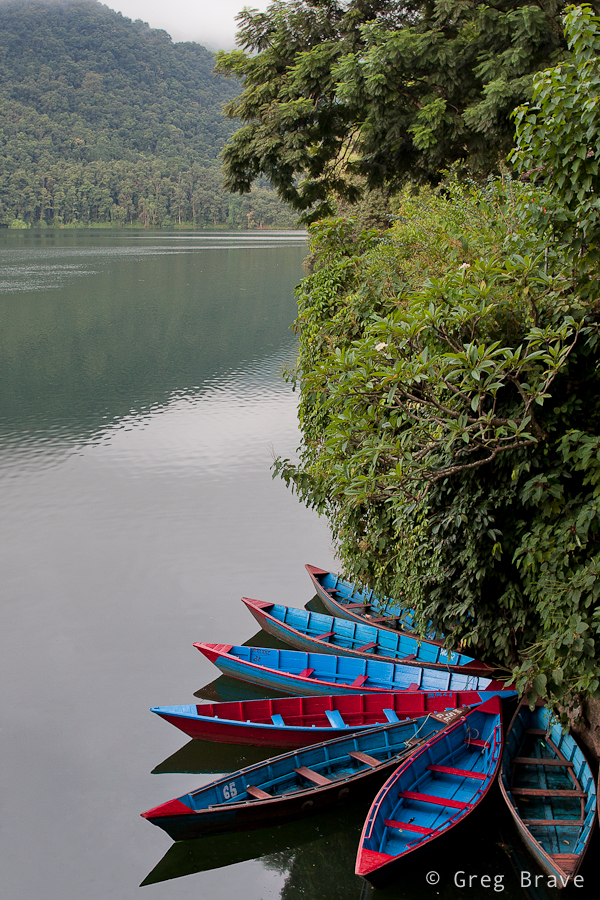
1/60sec at f5.6, 28mm | Click on the photo to enlarge.
The next photo happened almost by accident. It was raining all morning that day, and we got completely wet, walking carefully not to slip on wet rocks. The heavy backpacks made it that much harder to keep balance, and we seldom shifted our eyes from the ground. It was a hard climb, and while we were getting near its ending, the skies suddenly cleared, and then we reached this house. I saw the mountain and the dog, which was laying calmly. My hand instinctively reached for the camera, suddenly a man appeared from the house adding final touch to this photo.

1/200sec at f9, 28mm | Click on the photo to enlarge.
On our ABC trek, as a general rule the weather was at its best early in the morning, 5 – 6am, sometimes until 8, then gradually clouds came in and covered everything. And then again weather would improve at about 4 – 5pm. Of course it was only usually like that, and different variations were possible, but our most certain bet would be to get up as early as we could. If we wanted to have clear view of the peaks that is. And as you can imagine – I really, and I mean REALLY wanted to see the peaks!
The next shot was taken early in the morning and the mountain peak that you can see on the right called “Fish Tail”. Locals call it Machapuchare, and revere it as very sacred to the god Shiva. This makes Fish Tail forbidden for climbing.
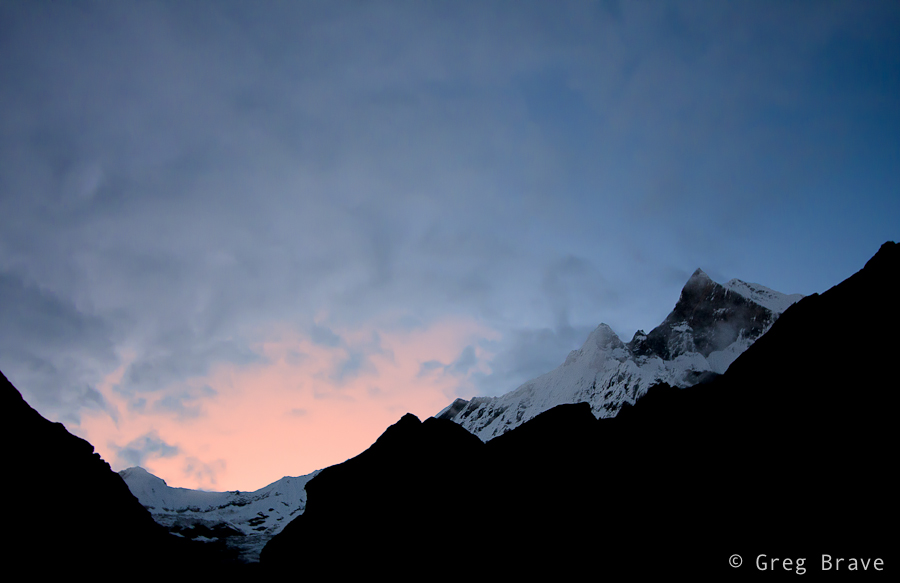
Click on the photo to enlarge.
Unfortunately, good colorful sunsets were rare because at sunset time the skies were usually covered with clouds, and the next photo is one of the very few I made during sunset time. But that particular sunset was marvelous! The orange colors changed hues constantly, and I made a dozen photos trying to capture them. I only wish there would be slightly less clouds so that more of the snowed mountains were visible.
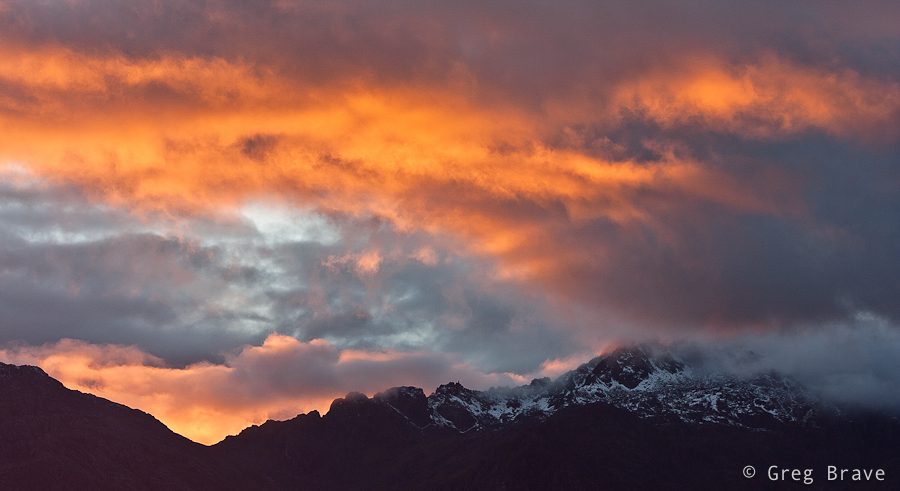
Click on the photo to enlarge.
While two photos above were taken looking up at the mountain peaks, they are not the only attraction in Himalayas. When you are at high altitude, looking down can take your breath away as easily as looking up. The next photo was taken in the morning looking down on the “small” hills of Annapurna National Park. Some of these hills are higher than the highest mountains in Europe (let alone Australia), but they still look tiny in this vast landscape.
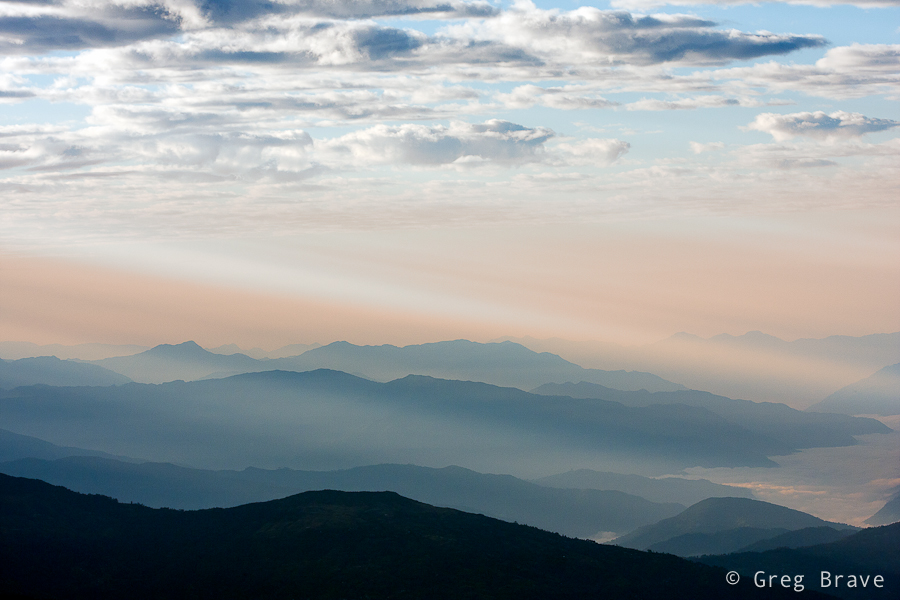
Click on the photo to enlarge.
This is it for my first post in the Nepali series, and I hope you enjoyed it.
Let me know what you think, and what photographs and information would you like to see in my next posts on Nepal. This is what the comments are for!
I first saw Yan Zhang’s photos on 1x.com and I loved them. Then I followed the link to his own website. Needless to say – I wasn’t disappointed. Yan is a very talented and passionate nature photographer. Luckily for me and you, my readers, he kindly agreed to an interview for Photopathway.
Ladies and gentlemen please welcome Yan Zhang !
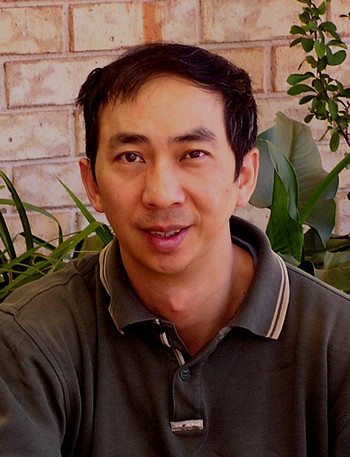
Click on the photo to enlarge.
Tell a little about yourself. What do you do for a living?
I am a computer scientist, currently working as a professor in University of Western Sydney. I have been in academia in last 16 years.
How did you get involved with photography?
Well, this is an interesting question. I had a manual SLR camera before 2007, but only used it when I travelled. In 2007 I noticed that digital SLR cameras had become more and more popular, and I decided to buy one as well. I just went to a camera shop and asked which camera was good. The shop owner showed me Canon 400D, and said this was the best camera so far. So I bought it :).
Since I had my Canon 400D, I started to shoot around and during traveling. Sometime around 2008, I developed a deep interest in landscape photography, and since then, landscape photography has become my unique focus in photography.
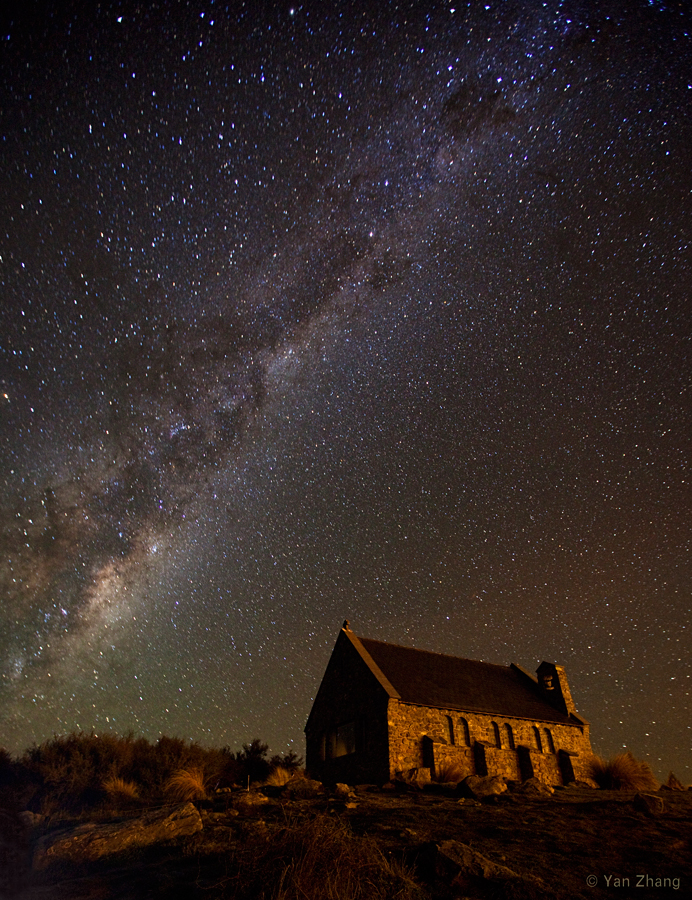
Photo by Yan Zhang. Click on the photo to enlarge.
Your landscapes are magnificent. How do you choose your locations?
I think locations for landscape photography are not as hard to find as people usually think, except for those extreme places. In fact, some of my landscape photos were taken just around my home or my work place. For instance, the following photo (Reeds) was the first photo I sold since I had my first digital SLR camera in 2007 and it was taken at an unnamed small pond near my home. The next photo (The Touch) was taken in my university campus this July.
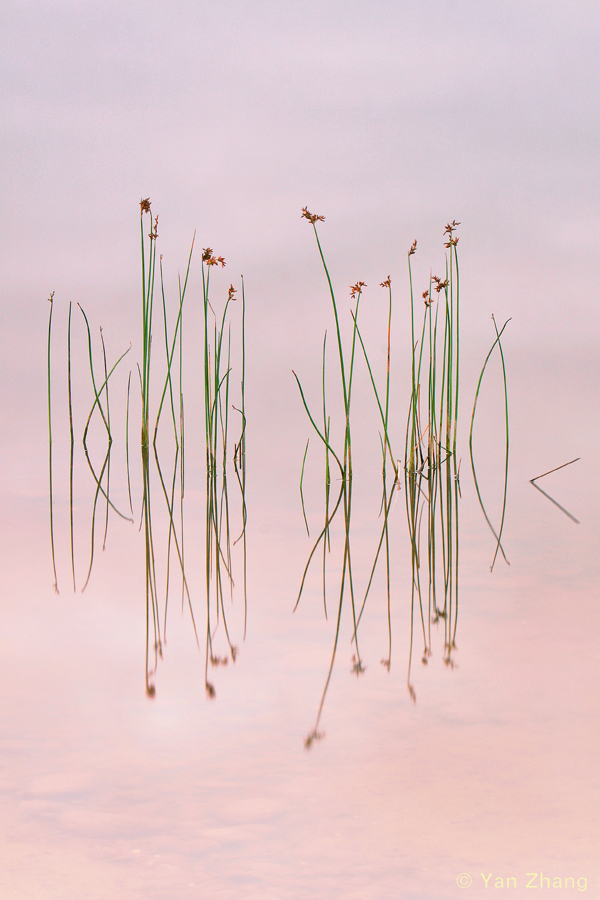
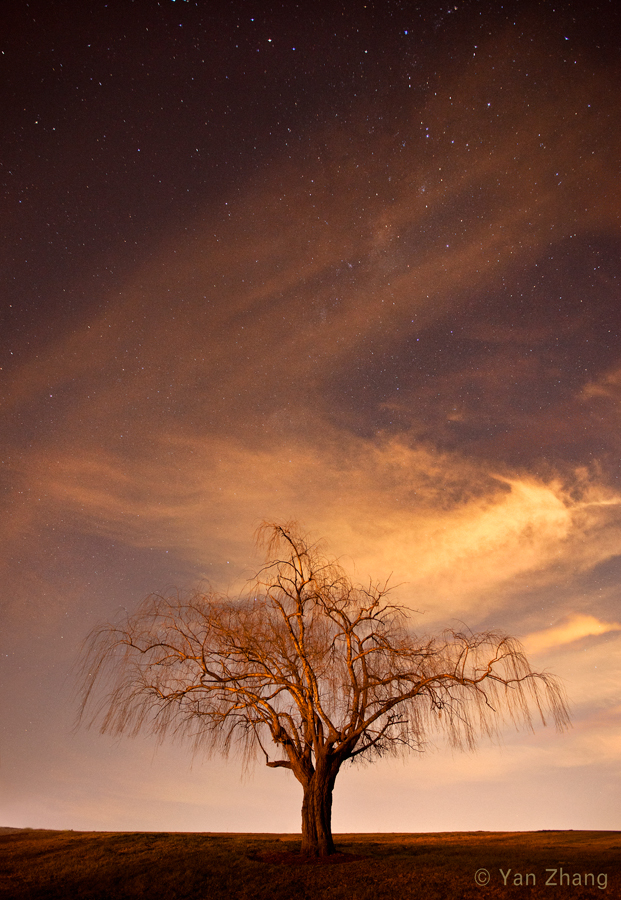
Photos by Yan Zhang. Click on the photo to enlarge.
In general, I always pay special attention to subjects that have certain characteristics. Once I found something attracting me, I then imagine whether it would look interesting under suitable light and weather conditions. Photograph “The Touch” was made this way: In order to capture the best light and sky, I went to this location more than 30 times within 3 months.
Since I am living in Sydney, I think I am very lucky to have the access to beautiful coast areas near Sydney. The following images were made on the East Coast of Sydney this year:
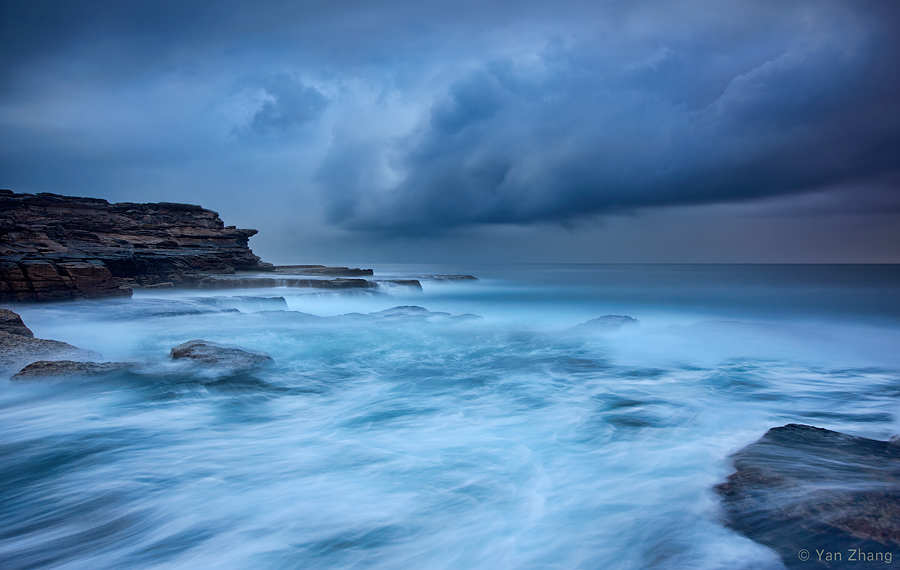
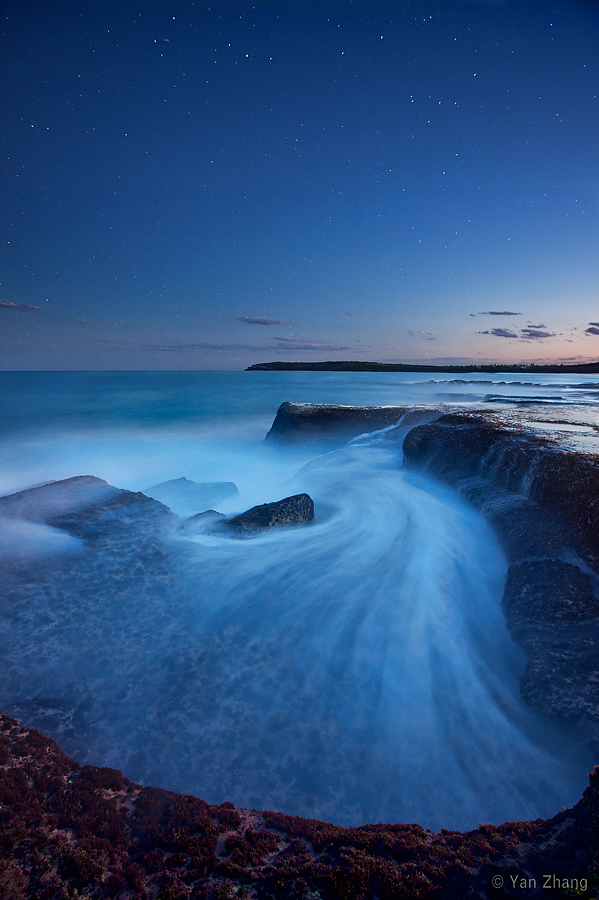
Photos by Yan Zhang. Click on the photo to enlarge.
Nevertheless, most landscape photographers believe that travelling to those unique places probably is essential to make original and stunning photographs. In recent years, I have travelled a lot to several places overseas to make photographs. China and New Zealand are the two special countries that I go for my landscape photography, because these two countries have many unique landscape locations and are relatively easy for me to travel to.
When you are planning your trip abroad, to the place you’ve never been before, how do you decide on your photographic locations?
This is a hard task indeed. Usually, I do a lot of research before I go. Looking at other photographers’ works on those candidate locations is very helpful. Traveller’s guide is also another information source. However, sometimes I think it is more important to discover some places that haven’t been considered by other photographers. In that case, it takes me a lot of time to find such interesting places abroad. However, once I found one, I would come back again and again to make good photographs.
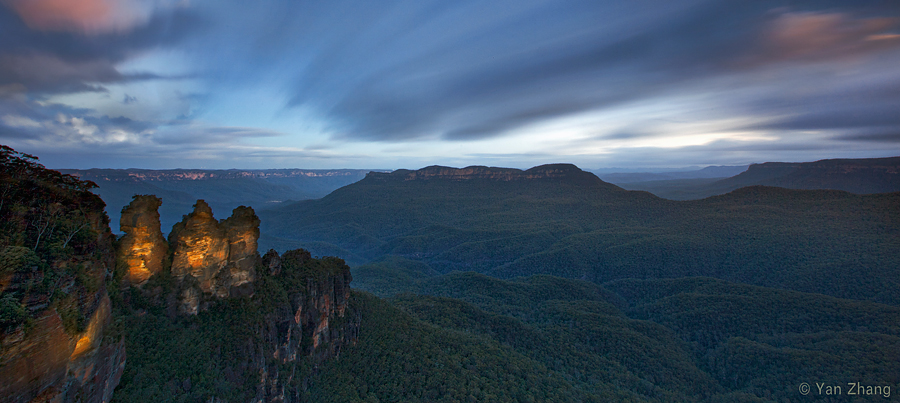
Photo by Yan Zhang. Click on the photo to enlarge.
Where do you draw your inspiration? What motivates you?
I have a deep passion for the nature, which always motivates me to experience such a pure beauty only existing in the nature’s wilderness. For a very long time, I knew that I was so passionate about the nature, but somehow I did not know how to express that until I started landscape photography in 2007. For me, I think photography probably is the most effective way to get close to the nature.
Do you hike and photograph alone, or you have a partner?
Most of the time, I travel only with my camera and make photographs alone. However, since I’m living relatively close to Blue Mountains area of Sydney, almost every weekend, my wife and I spend one day hiking in the Blue Mountains. Sometimes I take my camera gear with me on our hike.
What photographic equipment do you use?
As I mentioned earlier, I started with Canon 400D, then in 2008 I bought my Canon 5D Mark II full frame digital SLR camera. Now I am still using it. Since I only focus on landscape photography, filters are critical to my photography. I use both Lee and Singh Ray graduated ND (Neutral Density) reserve and graduated ND filters. I also use CPL (Circular Polarizer) filter sometimes for certain subjects such as waterfalls.
For landscape photography, I think that having a complete filter system and mastering it in practice are very critical to achieve high standard landscape photographs. A stable tripod is also essential.
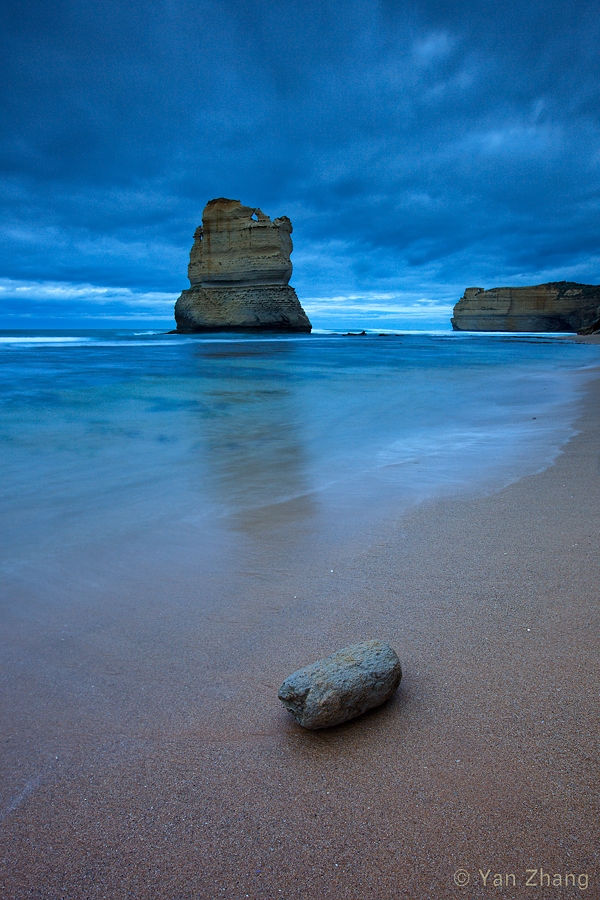
Photo by Yan Zhang. Click on the photo to enlarge.
How do you post process your photos? What software do you use, and what are the main adjustments that you perform?
I believe in the principle of “getting it right in camera in the first place” in my photography practice. During the process, I always put great efforts in the field to make proper shots. Nevertheless, post process is an unavoidable procedure in current digital photography. I always shoot in RAW format and process in Photoshop CS 5.
Generally speaking, my approach to photo adjustments in CS 5 is quite standard: first open raw file in Adobe Camera Raw, perform necessary adjustments there, then load it to CS 5 to perform further adjustments, such as using layer masks, curves, contrast, etc., to adjust the photo to meet my vision.
However, from time to time, I apply a specific Photoshop technique to do a certain adjustment. It is called Tony Kuper (TK) Luminosity Mask technique (http://goodlight.us). It is a very powerful technique allowing you to do some very subtle adjustments on certain pixels to increase/decrease their brightness, and so on.
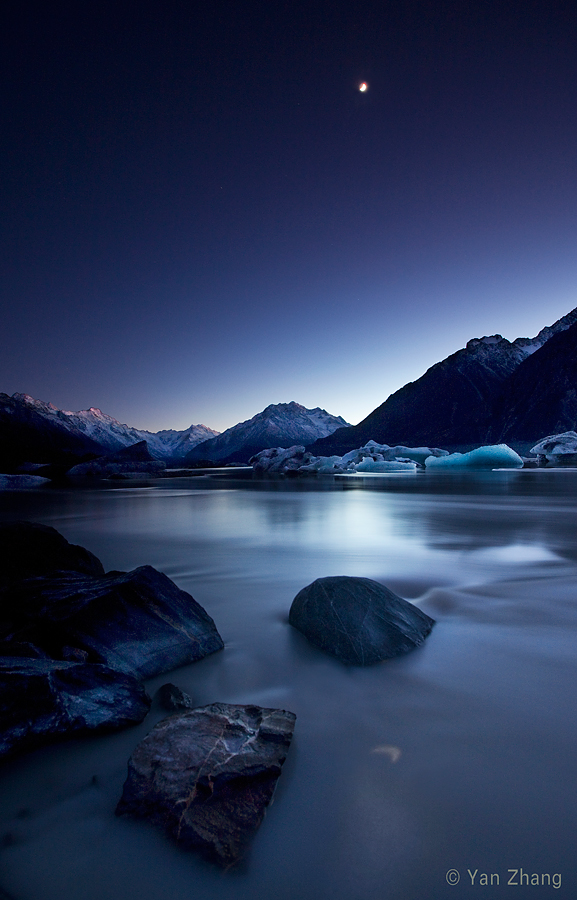
Photo by Yan Zhang. Click on the photo to enlarge.
Do you have any specific goals that you want to achieve in or with your photographs?
I said earlier that I started my digital landscape photography in 2007, and I sold my first landscape photo in the same year. Since then, each year I would sell some of my photographs through various art exhibitions in my area. In September 2010, I established my own photography website. Recently I sold several large prints. As an amateur photographer, I feel I am very lucky to be selling photos.
Having said that, I should stress that my photography goal is not just to make my works to be of some commercial value. More importantly, I wish my works to be recognised by the professional photography community. This was the main motivation that brought me to get involved in 1x.com photography website’s activities.
Photo by Yan Zhang. Click on the photo to enlarge.
This one is a selfish question, but I had to ask it :). In my photographic portfolio, landscapes section, did you see a photo that you particularly liked? And if you did, what did you like about it?
Yes. I like this shot:

because this image presents a nice mood with mist in the forest. The vertical trees in the mist create a good depth of field, which makes me try to explore this wilderness.
And finally, my traditional question. If you had only two advices to give to a beginning photographer, what would they be?
My two advices for beginning photographers who are dedicated to landscape photography would be:
(1) Originality – I believe that originality is the key to make photographs that differ yourself from other photographers;
(2) Persistence – to make outstanding photographs you have to be persistent, to stick to the idea you have in mind and then try every effort to fulfil this idea or adjust it in the field.
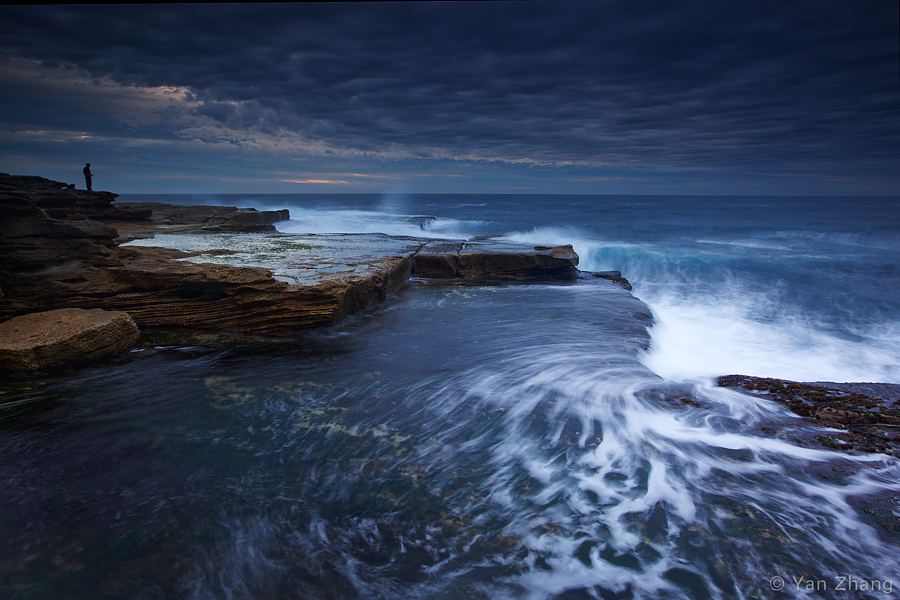
Photos by Yan Zhang. Click on the photo to enlarge.
Yan, thank you very much for this interview, and good luck in your future artistic endeavors!
You can see more of Yan’s beautiful photographs on his website:
Lately Ira and I adopted a new habit – we get up early in the morning and go out for a walk in the neighborhood before work. It is winter in Australia so we have late sunrises and early sunsets, therefore we often start our walk before the sunrise, and have the joy of witnessing it to the fullest.
From photographer’s point of view not just any sunrise, as well as sunset, is perfect for landscape photography. Of course it all depends – whether there are too many or too few clouds in the sky, if it was raining at night (if it was, there is a good chance of having crystal clear atmosphere with bright colors), if there is morning mist. It is also depends on your subject obviously, and on how you intend to photograph it – for example what quality of light do you need.
Anyway, I am talking about simple walk here, with no specific intentions. In this case good sunrise colors and interesting cloud formations can help a lot in creating interesting photographs.
Here, see for yourself:
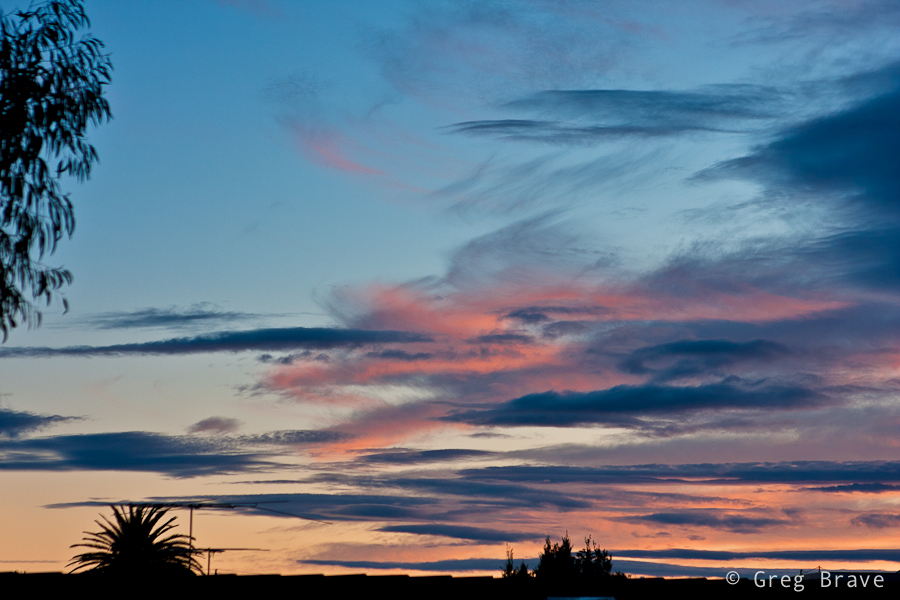
Click on the photo to enlarge.
I liked the sunrise-lit sky very much, and decided to make it the main subject of the photo above. I only had to find a decent framing for it.
I decided to call the photo below “Absense”… can you think why? If you have an idea please write it in the comments section below.
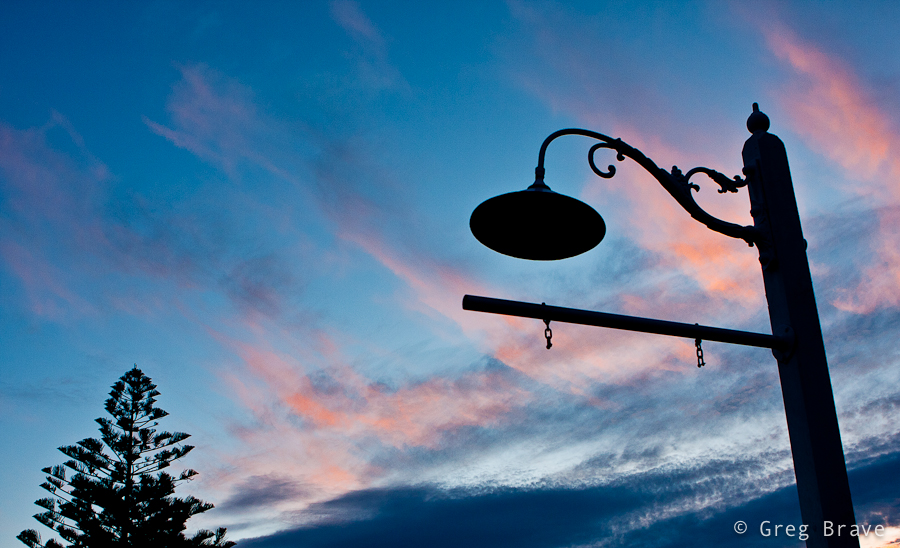
Click on the photo to enlarge.
Next photo shows a location that I’ve photographed many times, but under this light, I think it looks the best. I am bothered a little bit with the foreground, but I still like this photo very much. Many things come together here – as I already mentioned the light is beautiful, the depth is depicted nicely by the three planes – the foreground, the “middleground” with the white houses and the background plane is emphasized by the piece of land sticking out. The winding road takes the viewer’s eye smoothly through the planes, and the lonely car in the middle-left adds to the overall mood of the photograph.
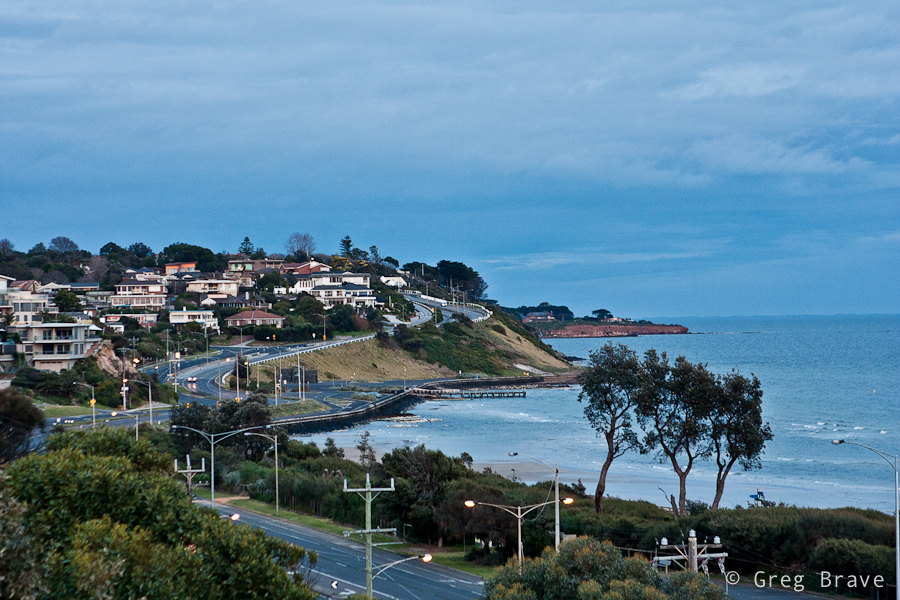
Click on the photo to enlarge.
I took the photo below because of two main reasons – one, to show the beautiful cloud shapes and sky colors colors, and two, to emphasize the pure graphic nature of the tree branches, which are very eloquent when depicted as silhouettes. I think that the plain poles in the middle add nice perceptual contrast to the intricate shapes of the trees.
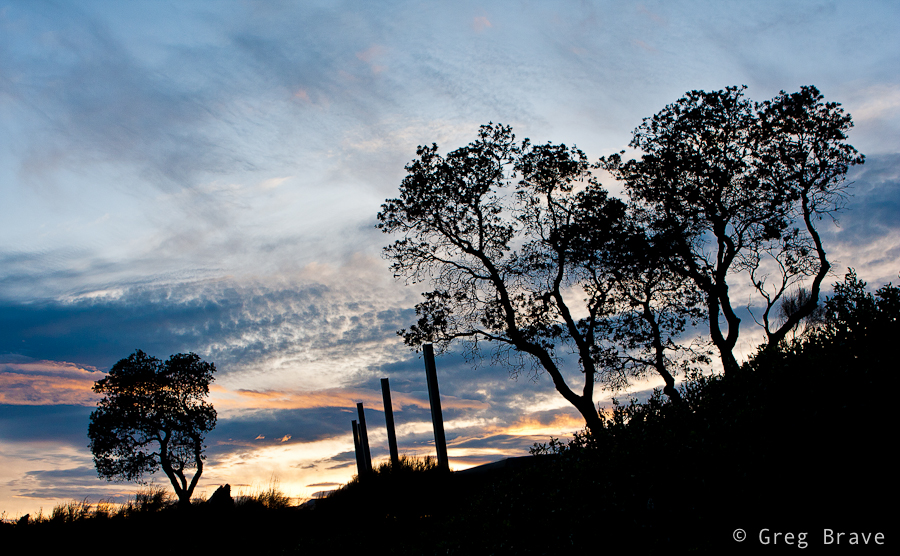
Click on the photo to enlarge.
Next photo is simply here for you to enjoy.
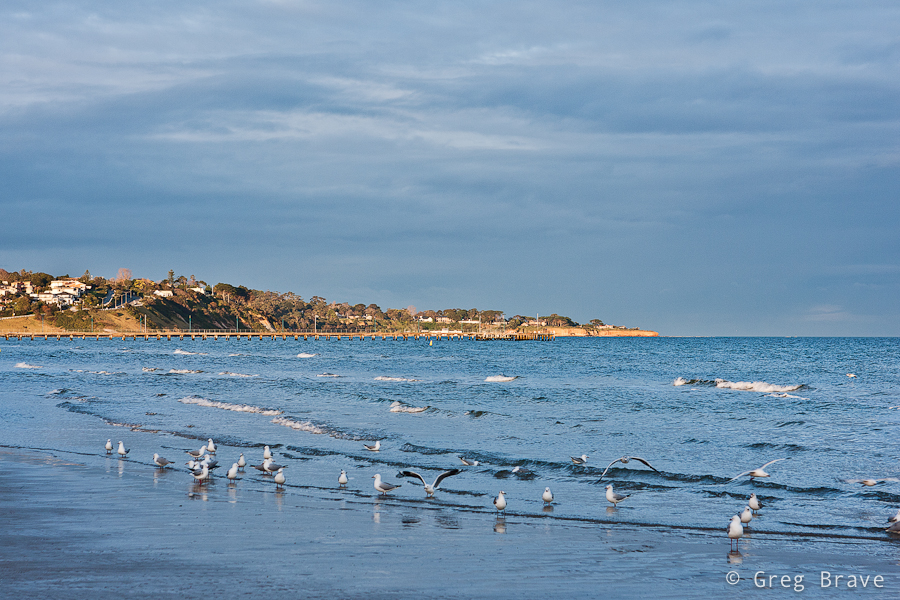
Click on the photo to enlarge.
I call the next photo “The victory of Light over Darkness”. Again the main interest in it is the sky, but without having interesting shapes of houses on the foreground I wouldn’t take it.
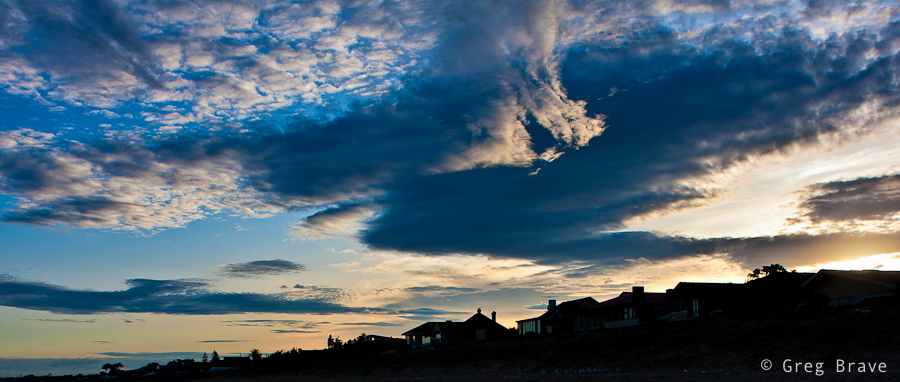
Click on the photo to enlarge.
Here’s couple more photos from the same walk taken after the sunrise, when the sky wasn’t so interesting anymore and I had to concentrate on other things 🙂
Click on the photo to enlarge.
Feel free to leave your thoughts, suggestions, and other comments in the section below.
I’m off to take some photos, be back soon!
Sassafras is a small village located in Dandenong Ranges. The area was named Sassafras Gully, after the trees which grew in the area. Sassafras is a tourist destination with some antique shops, boutiques, and nurseries.
While most of the tourists visit Sassafras on their way driving the Dandenong Tourist Road through to other destinations, Ira and I came here specifically. We wanted to visit the “Tea Leaves” store, which has over 300 teas and herbs. But then again, we are not tourists – we live within 40 minutes drive from here.
As you probably guessed I wouldn’t write this post if I didn’t have some photographs to share along with it. The tea store was really nice, but it was too small and crowded to photograph. After we finished our tea-shopping, we decided to explore the surroundings.
I always liked the Australian Magpies. I think that they are very interesting birds, and I also like their singing – Australian Magpies are considered to be among Australia’s most accomplished songbirds. There were plenty of these birds in Sassafras, so I could take a few photos, and here is one.
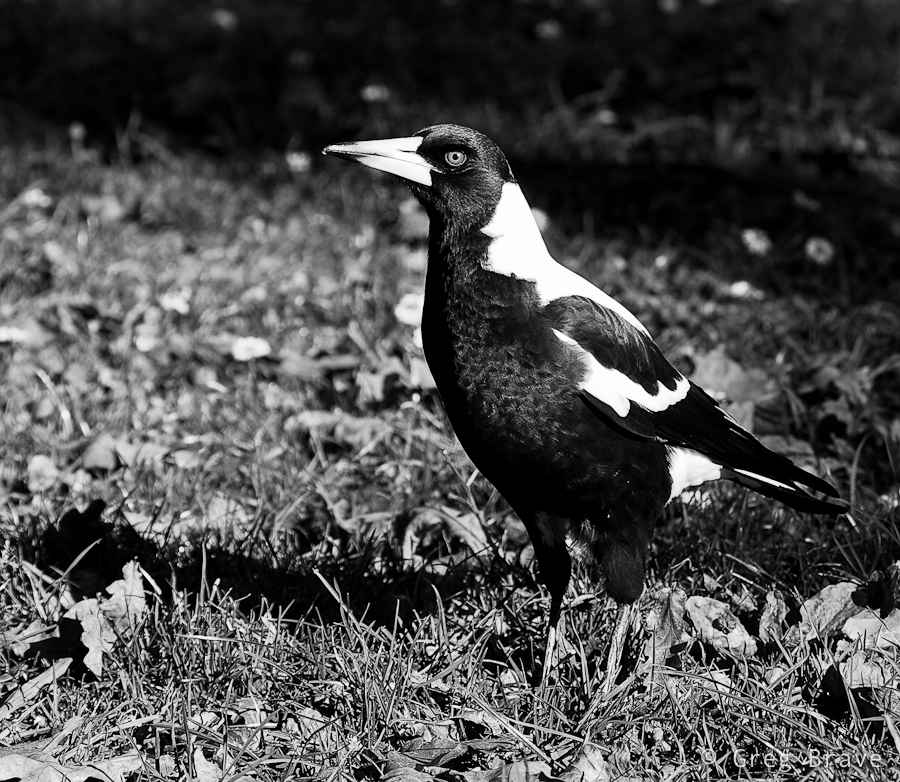
Click on the photo to enlarge.
Dandenong Ranges is a beautiful place, and Sassafras is surrounded with eucalyptus and fern-tree forests with kilometres of walking trails. Ira and I came across one of the trails and went into the woods. It was such a beautiful walk! I can still feel the cold fresh air filled with smells of nature…
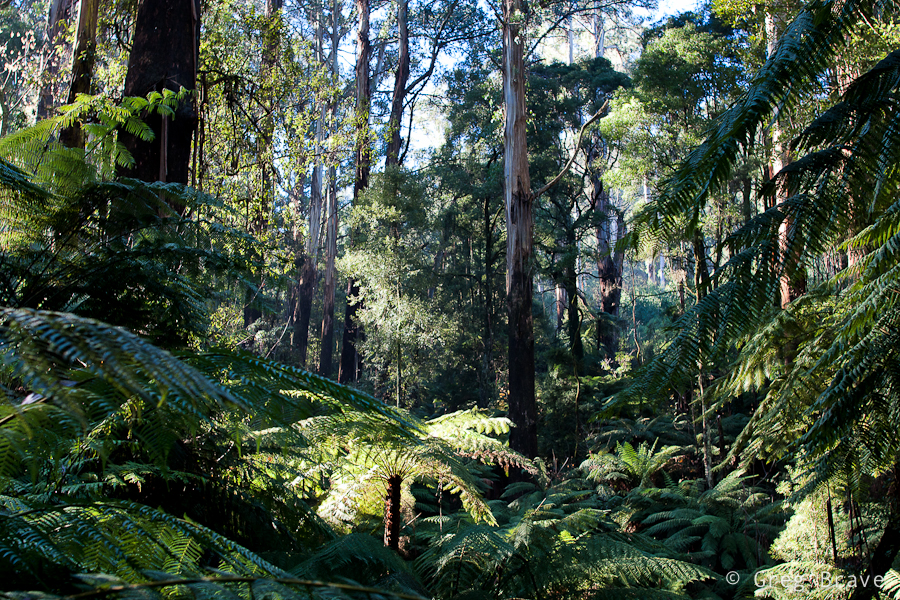
Click on the photo to enlarge.
The forest was magical. It was around three o’clock in the afternoon, and the sun was already setting (the sunset time is currently around five o’clock) so the light was beautiful. I was fascinated with the rays of light breaking through the foliage.
The biggest problem when photographing forests is to find distinction. What I mean is when you walk in the forest and you simply like what you see and take a picture, most of the chances that the resulting photo won’t be interesting. It will be very cluttered with leaves, tree trunks, and branches. One of the keys here is to find some kind of order in the forest and reflect it in your photograph.
The photo above is a bit too cluttered to my taste, but I still like it – I found an opening in the forest, saw this fern lit by the sun, and decided to make it a main point of interest in the photograph. Rays of light in the background add another dimension to the photo making it… airy?
Click on the photo to enlarge.
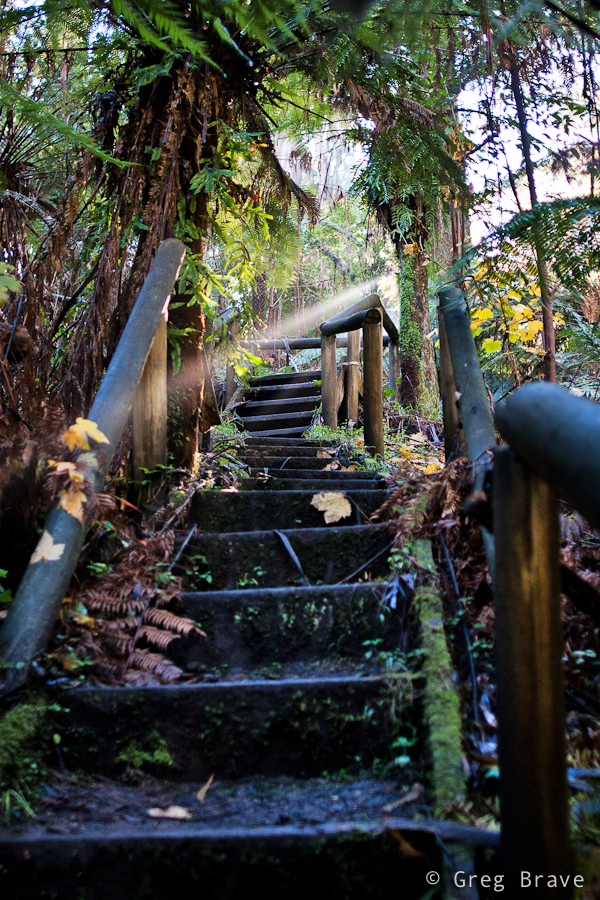
Walking down the trail we came across wooden stairs, and saw this “unreal” ray of light shining through. I just couldn’t pass the opportunity ☺. Though I am bothered a little by the wooden rail on the foreground right, overall I like this photo. The stairs lead the eye into the photo, and them being not straight enhances the feel of space, while ray of light helps creating magical forest atmosphere.
Click on the photo to enlarge.
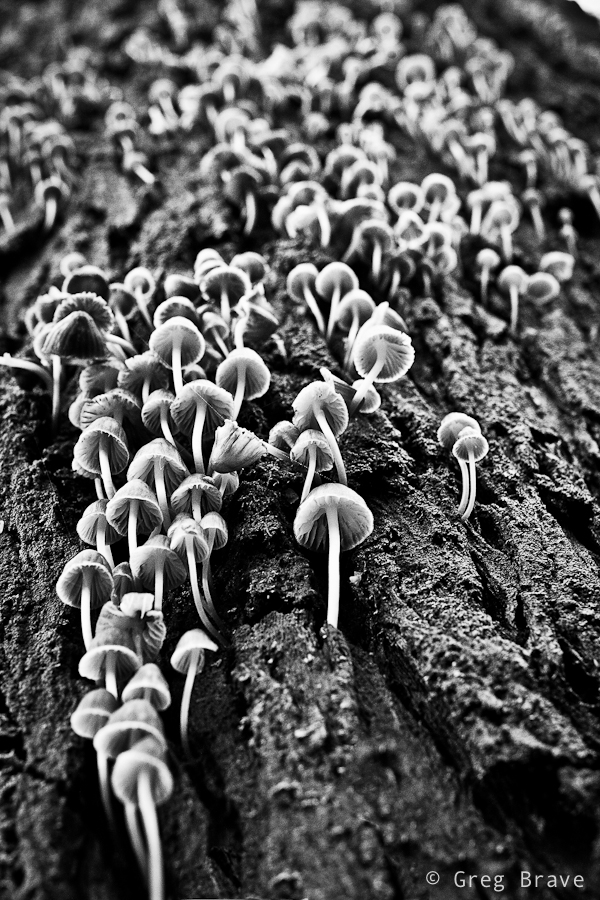
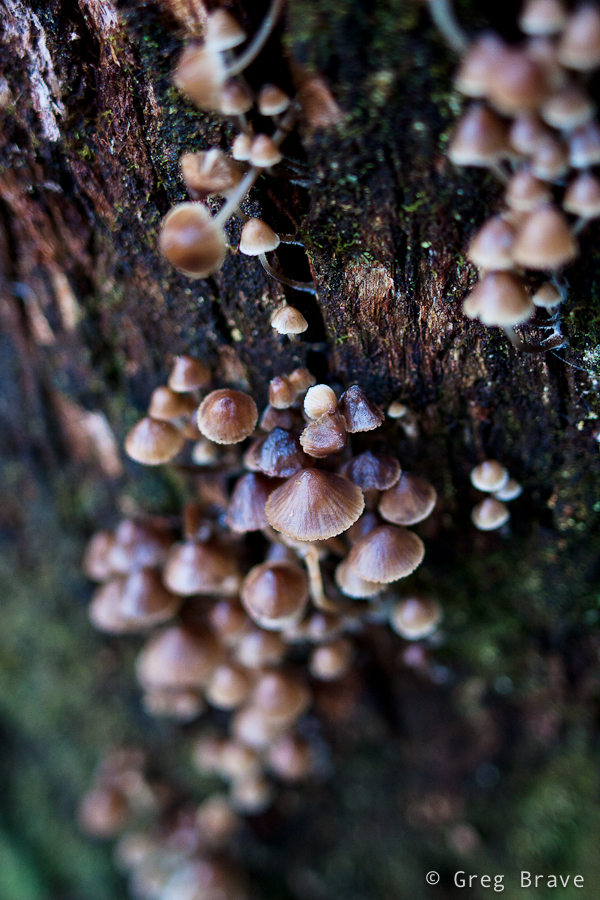
At one point I saw a huge eucalyptus and just stood there admiring this nature creation, then Ira said – “look! There are lots of tiny mushrooms growing from the trunk of this tree!” And only then I saw them. The tree trunk was so big, and the mushrooms were so tiny that I didn’t notice them even though there were so many. I really liked this “crowd” and spent a good 15 minutes trying to find an interesting angle.
Click on the photo to enlarge.
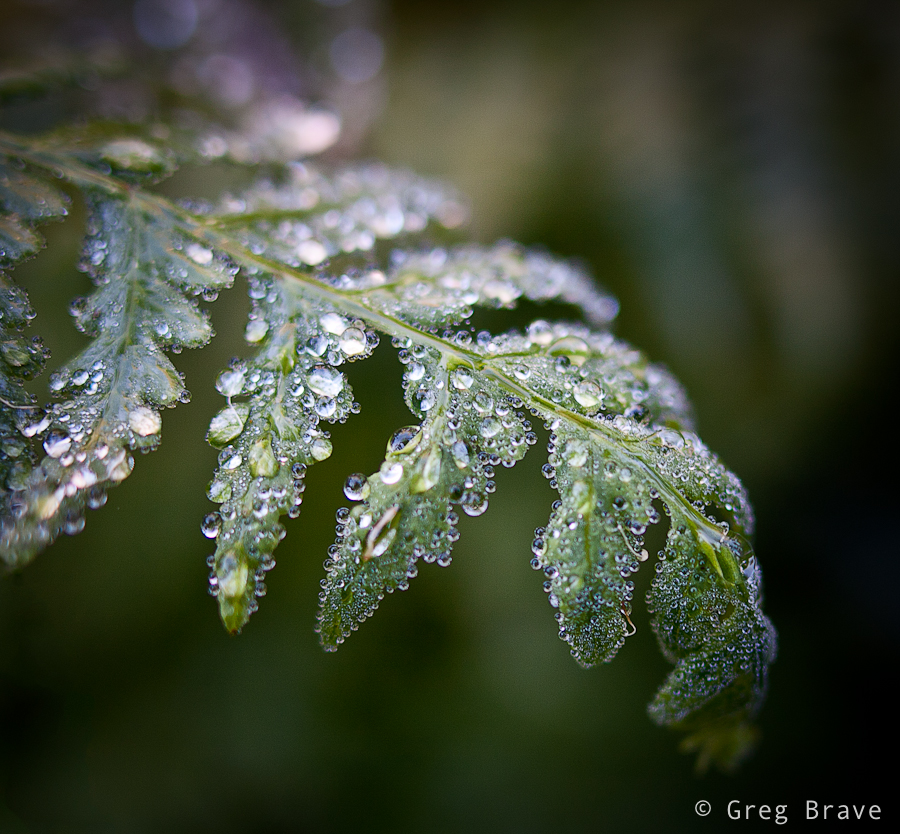
As in most of my walks in the nature, I couldn’t resist taking a few macro shots. I didn’t have a tripod with me (what a rookie mistake! ), so this photo might not be tack sharp, but it is sharp enough to show all the diversity of the water drops. I really like the tenderness and fragility in this photograph… one careless move and this beauty will disappear.
And finally I’d like to present my best photo from that walk in Dandenong Ranges.
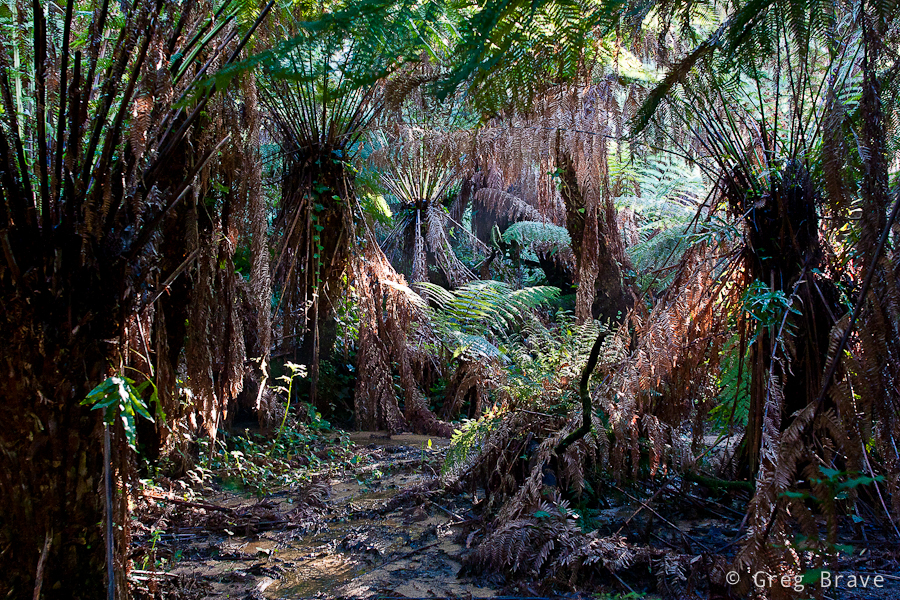
Click on the photo to enlarge.
I feel that in this photo I succeeded to create order from the forest’s chaos. I found a pattern made by the standing ferns, and a space in between, and the light was just right. I tend to think that in nature photography great photo is created when two factors come together – pure luck (the light, weather conditions) and the photographer’s vision. Sure, if there is no vision, there won’t be any great photos, but when you have the vision you still need the nature to play along with it.
I hope that you enjoyed this journey into the Dandenong ranges, a beautiful place in Australia, and I’ll see you next time right here, on my photo pathway.
As always your comments are most welcome!
While Spring rules in most parts of the world now, Australia is heading for winter. Driving through my neighborhood towards home from work I felt a kind of Autumn mood in the air. So when I came home I quickly grabbed my camera and went out for a walk. I wanted to capture this mood before it vanished.
This maple tree fascinated me. The autumn colors are revealed here in all their beauty. Warm light of the setting sun gets even warmer filtered through the orange-yellow leaves creating a very cosy atmosphere. The only thing I’m missing in this photo is a lonely person sitting on the stairs…
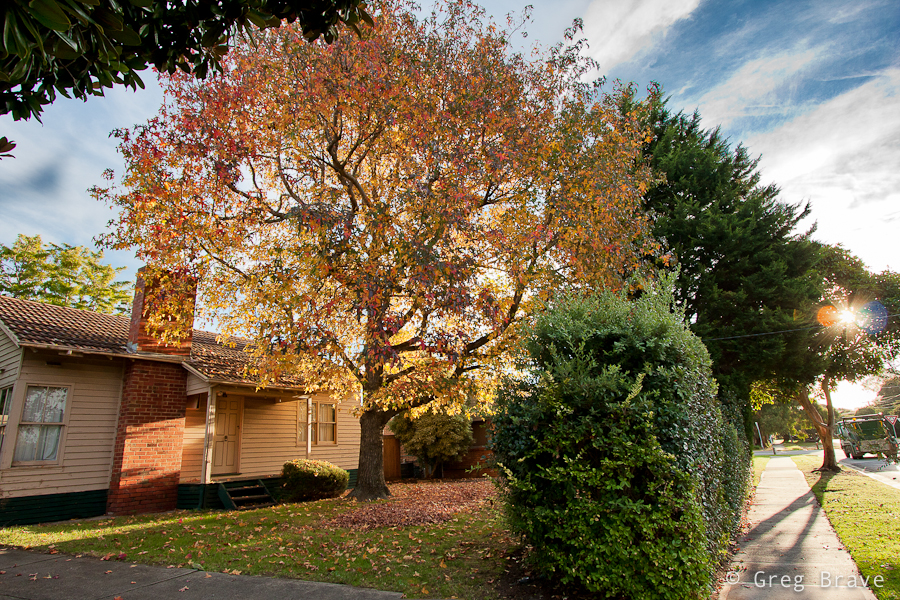
Click on the photo to enlarge.
In the next photo I focused my attention on the fallen Autumn leaves adding the fence on the left to emphasize the perspective and add a sense of movement to the photograph.
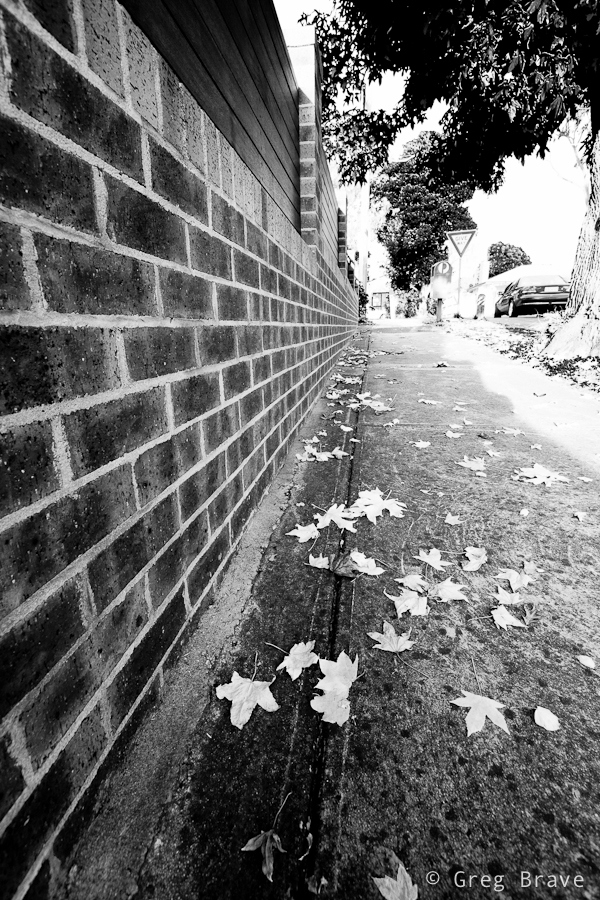
Click on the photo to enlarge.
At first I didn’t realize why I wanted to capture what you see in the next photo, but then I realized that it was the combination of cleanliness of forms, simplicity of the composition, and the background texture. Combined together these three factors formed a complete picture in my mind and I pressed the shutter-release button.
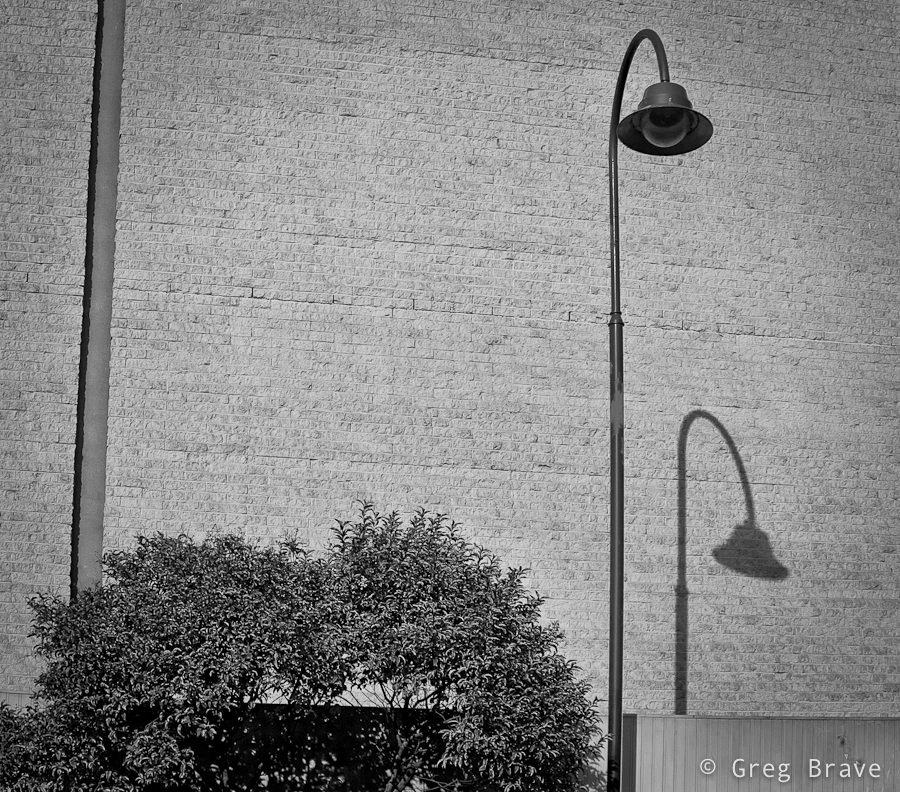
Click on the photo to enlarge.
Walking around I saw these bicycles and immediately the words such as “separation”, “loneliness”, “different” started popping into my mind. You know kids can be cruel sometimes, and in my mind this was a good visualization of this fact. Even thought there is not much of an Autumn mood in this picture, since I took it on the same walk I decided to present it here.
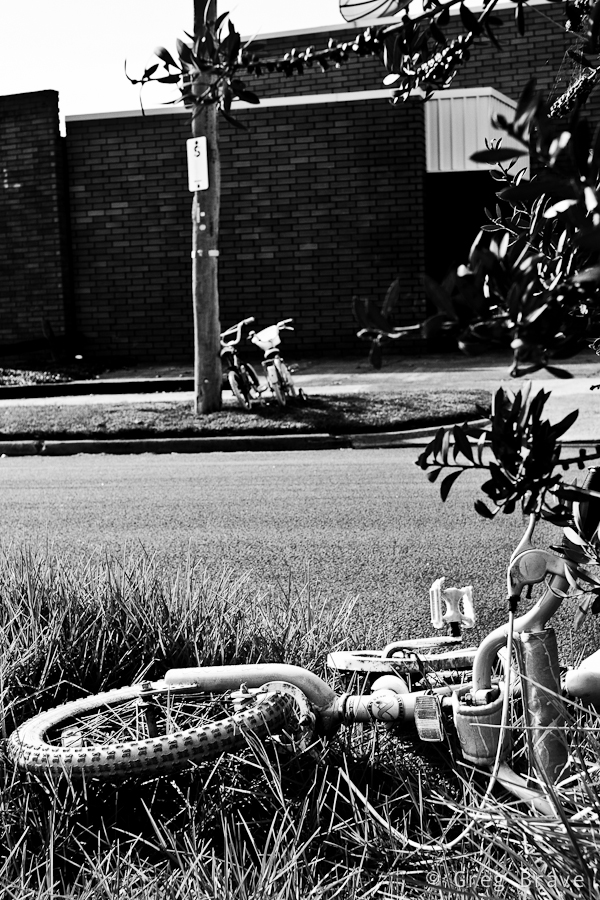
Click on the photo to enlarge.
And finally going back home, when Sun was getting close to the horizon, I took this photo. I can’t say much about it except the fact that I like it.
Click on the photo to enlarge.
Hope you enjoyed the photos. Feel free to comment on them in the comments section below, I’d be happy to know what you think!
Till the next time, take care!
Cheers,
Greg.
Alfred Nicholas Gardens are located in the Dandenong Ranges, Victoria. The place is pretty well known among Australian photographers for its scenic lake and beautiful trees. Most of the photos that you’ll find on the web usually made in late Autumn (which is April/May in Australia), when the trees turn yellow, red and orange. And it is indeed a really beautiful sight!
But I had the chance to visit the gardens in late Summer, when everything was still green, and I didn’t want to miss an opportunity to take a few photos, which I’d like to share.
There is a tiny waterfall flowing down into the lake, and even though when you look at the whole waterfall, it is not really photogenic, I found a fragment of it that I liked. I also wanted to create the “smooth water” effect. As you may know it is achieved by using long exposure. The loner the exposure, the smoother the water will be. But I had a problem – there was too much light, and I didn’t have any ND filters (Neutral Density) with me. My solution was to use a polarizing filter. In addition to “directing” the light, polarizing filter also reduces the amount of light by about 1.5 stop.
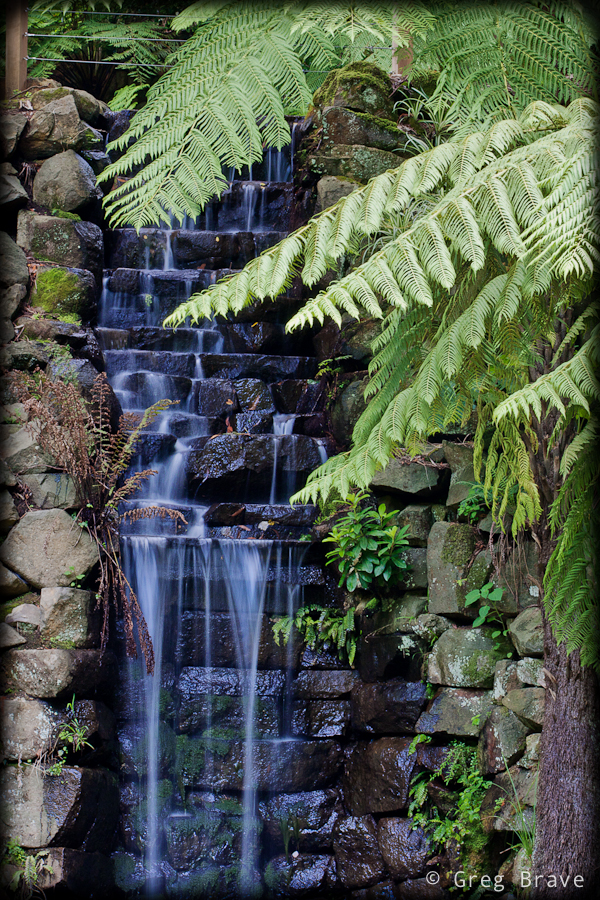
Click on the photo to enlarge.
The whole lake was covered with fallen leafs from the surrounding trees. Even though everything was still green, it was beautiful! I love the way the reflections can still be seen in the gaps between the leafs.
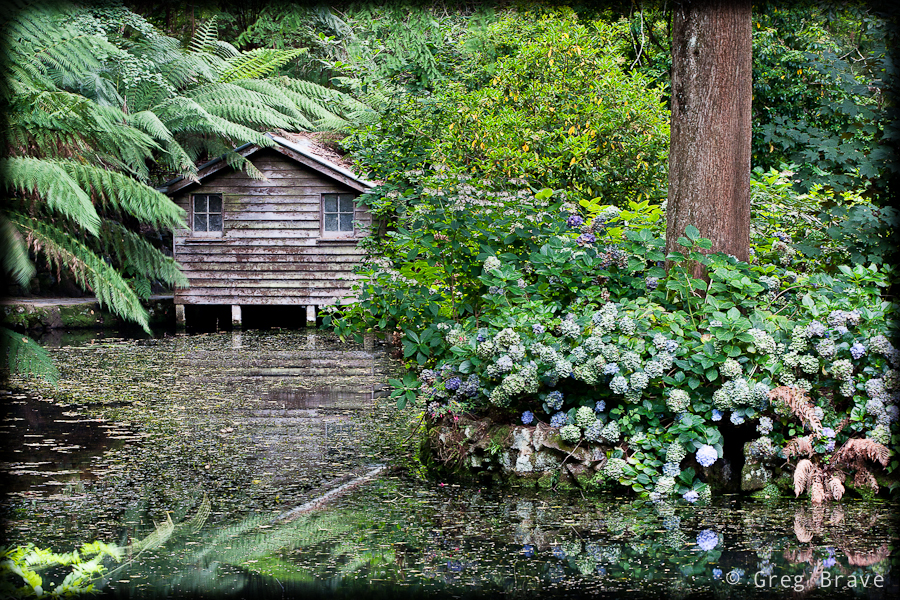
Click on the photo to enlarge.
Eventually I decided to concentrate on fragments, rather than the “global” scenery. These leafs are showing the closeness of the Autumn and I also liked their shapes. The lone red leaf at the back adds a point of focus to this somewhat chaotic composition.
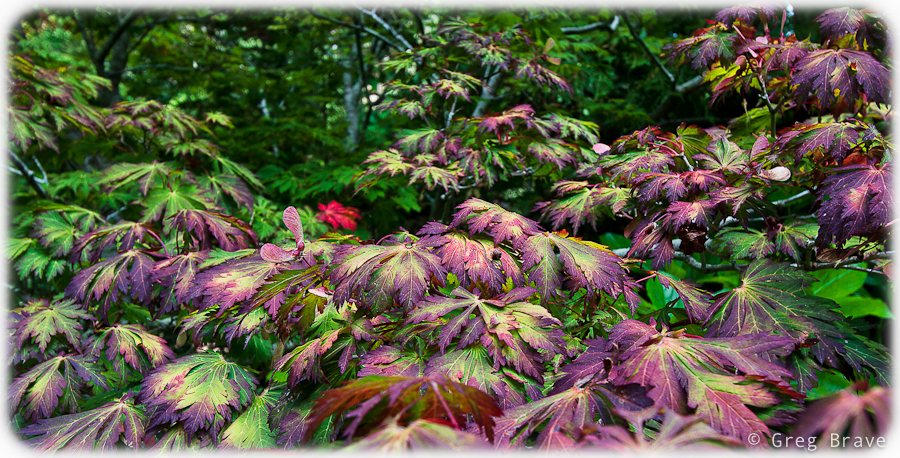
Click on the photo to enlarge.
At one point I decided to take a break and settled on this bench. When I got up I noticed how nice my hat looks lying on the bench close to these beautiful flowers. The only touch that I added to the photo was the yellow leaf on the hat. Looking at this photo I would like to change the leaf’s location a little… but what’s done is done 🙂
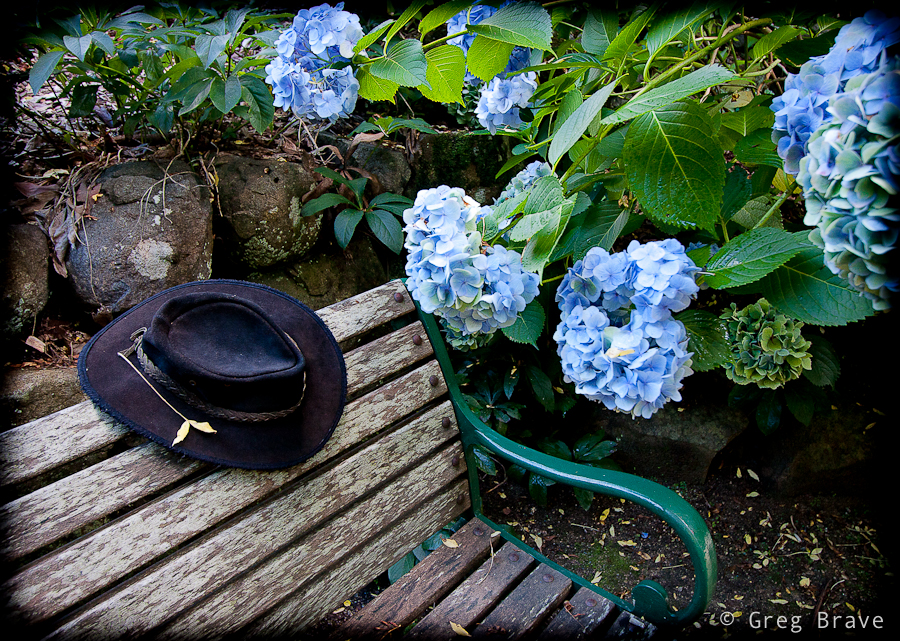
Click on the photo to enlarge.
I really enjoyed this place and I hope you enjoy my photos.
As always any comments are appreciated.
Cheers,
Greg.
Phillip Island is located approximately 140km south-southeast from Melbourne. From my home it is about two hours drive. It was named after the first governor of New South Wales, Arthur Phillip. Phillip Island is pretty small: it has 9 kilometers at its widest, and is 26 km long, but it has about 97 kilometers of coastline, which allows for many photographic opportunities.
Recently I took a three day trip to Phillip island. As always I had my camera with me, and I’d like to share my experience with you my dedicated readers! 🙂
One of the first places I visited were “the Nobbies”. This area has spectacular coastal views, which you can experience from the boardwalks and lookout points set amongst natural sea bird gardens.
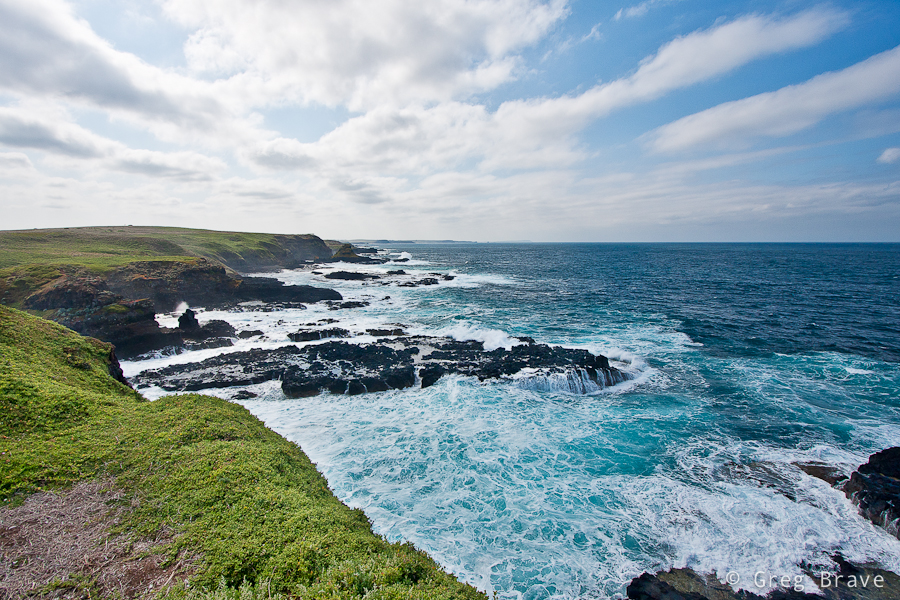
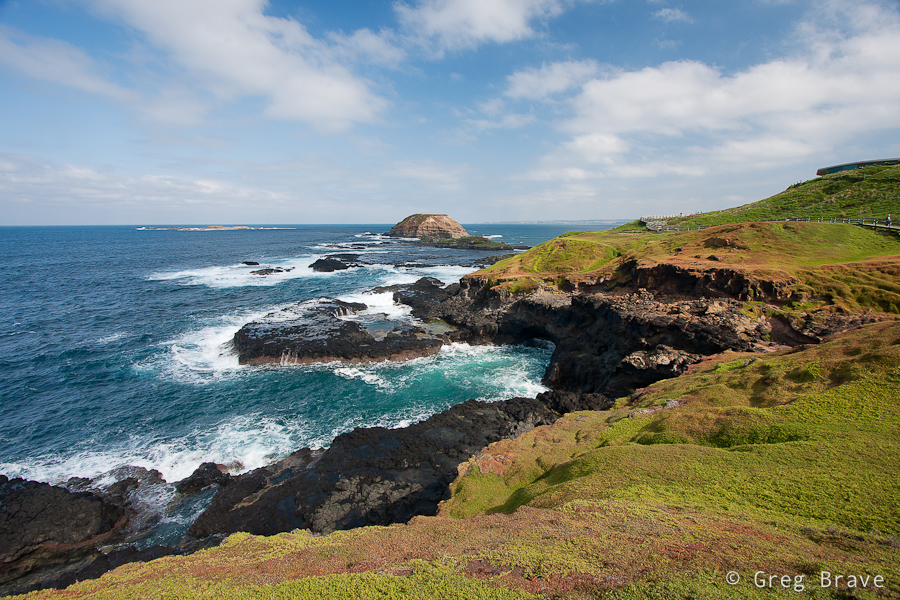
Click on the photo to enlarge.
The views were so magnificent that I couldn’t stop photographing. When I later saw my photos on the computer screen, the grass was so vividly green, as if I greatly increased the saturation. I even had to reduce saturation a little so the grass would look more natural! I really wanted to photograph this place on sunset, but the whole area closes before the sunset time due to wildlife activity in the twilight.
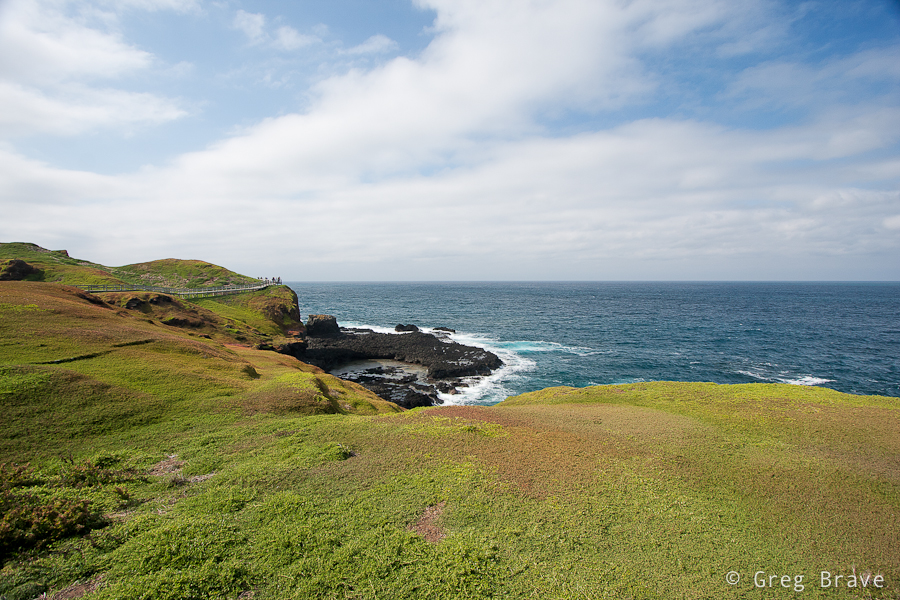
Click on the photo to enlarge.
My next stop was the Swan Lake, the only permanent freshwater lake on the island. I didn’t see too many birds out there, but there still were a few, and I liked the “layered” view, which you can see in the photo below.
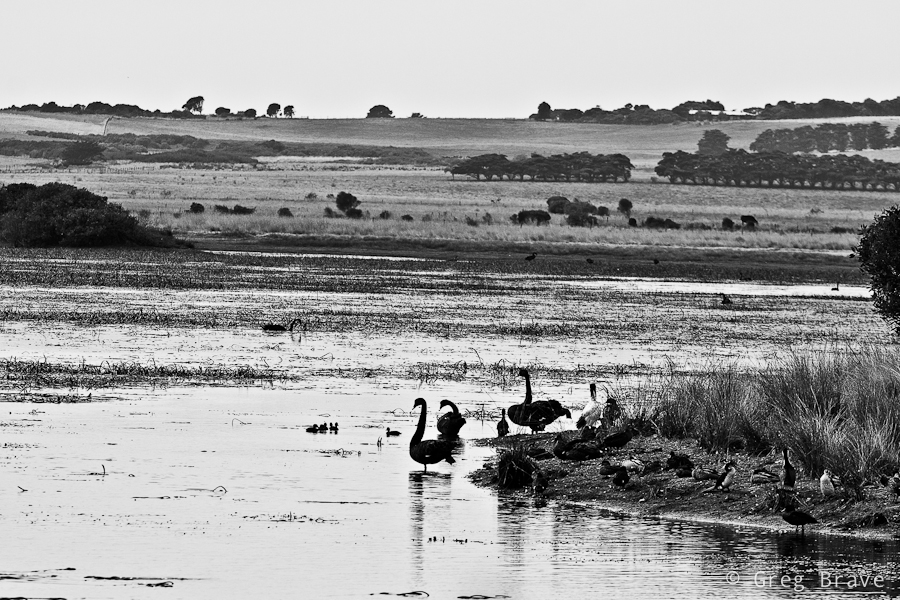
Click on the photo to enlarge.
There was a boardwalk leading around the lake with small hideouts along the route for watching birds without disturbing them. The shot below was made from one of the hideouts. I am not sure if swans sleep with their eyes open, or he noticed my presence despite the hideout.
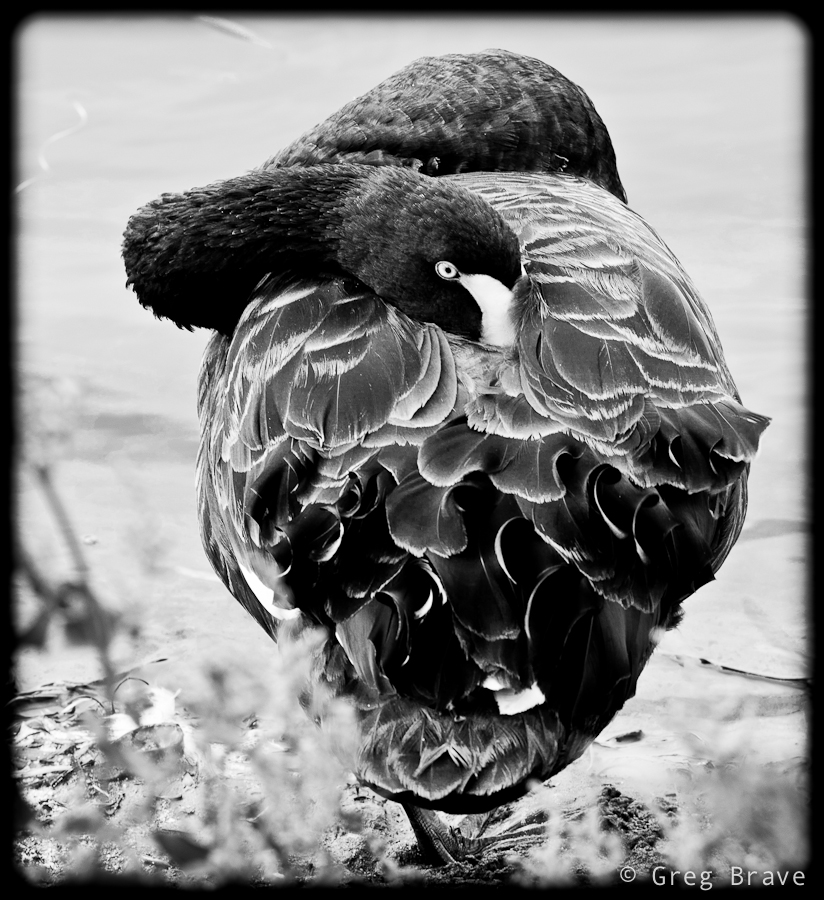
Click on the photo to enlarge.
On my second day on Phillip Island, on late afternoo, I found this beach. It is very close to the bridge that connects the Island with mainland. The photo below was made on this beach, and somehow it reminds me of ancient Greek amphitheaters. I also decided to come back to this beach on the next day’s sunrise…
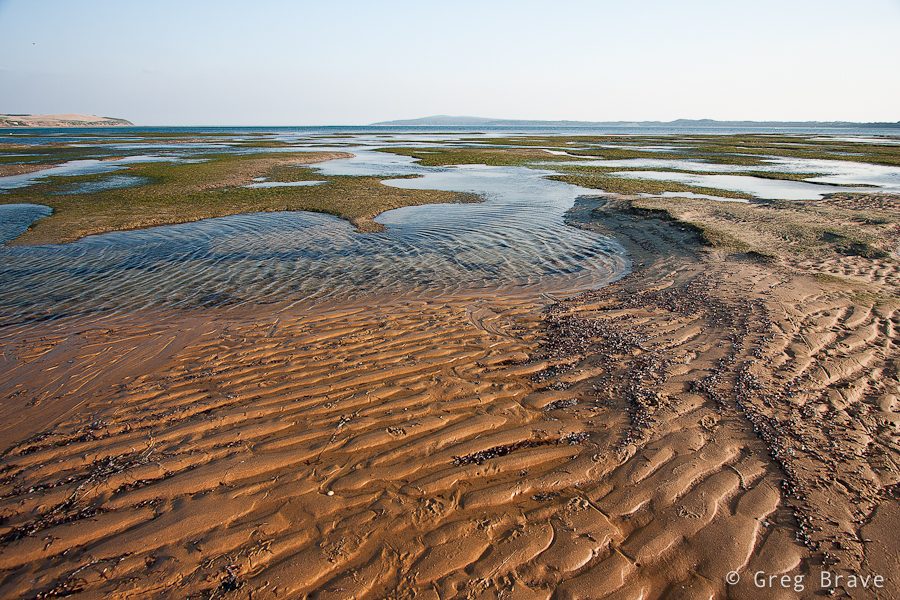
Click on the photo to enlarge.
and then I drove to another beach to photograph Sunset… why? you ask me. The answer is pretty simple – the sun was setting on the other side of the island! So the next photo was taken from Surf Beach, which is located on the way to Cape Woolamai.
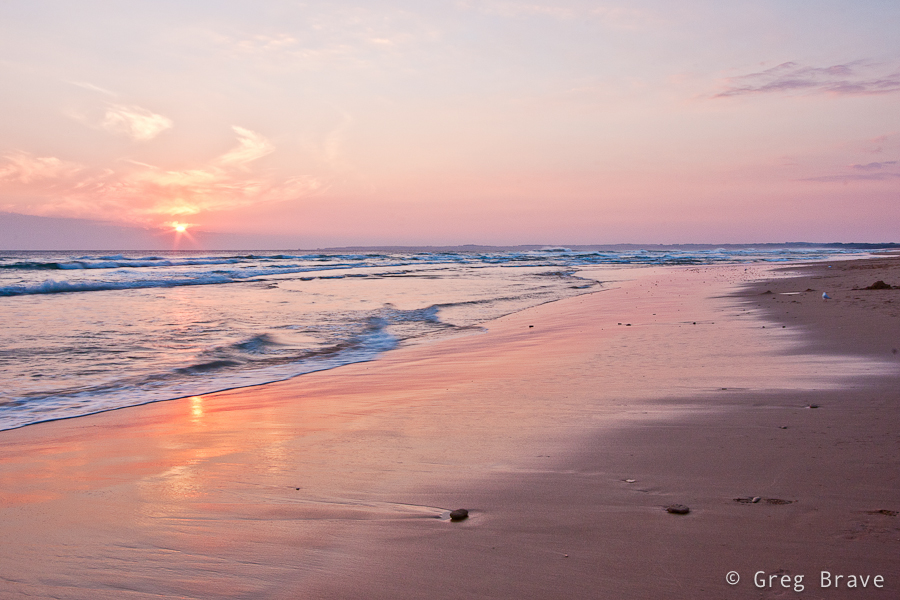
Click on the photo to enlarge.
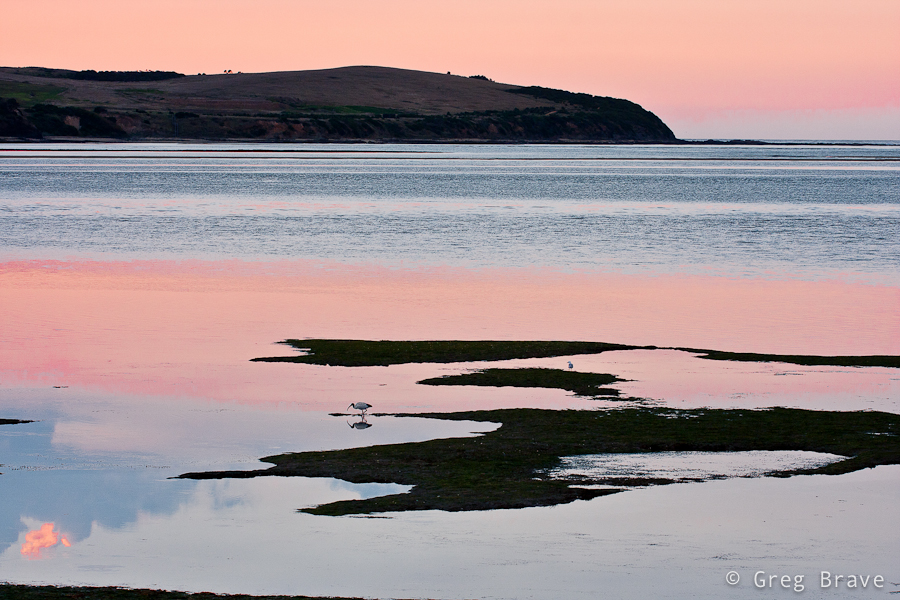
And we are back again, now at dawn to the same beach with the “amphitheater”. The land that you see in the distance is the mainland with small town of San Remo on it. Formed as a fishing village, San Remo’s economy nowadays mostly based around tourism.
Click on the photo to enlarge.
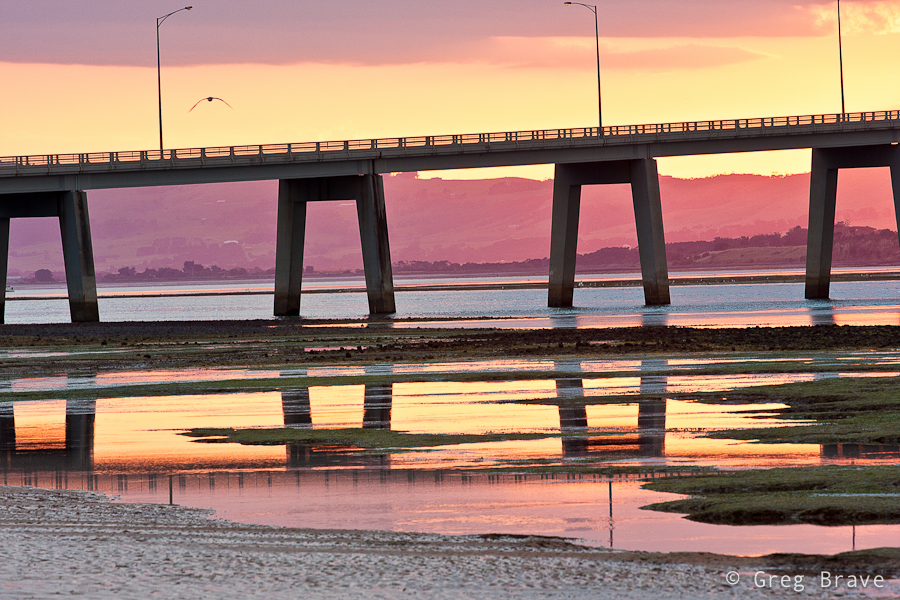
I think I already mentioned that Phillip Island is connected to the mainland by bridge. It is a 640 meter concrete bridge, which I found to be rather nice looking in sunrise colors.
Click on the photo to enlarge.
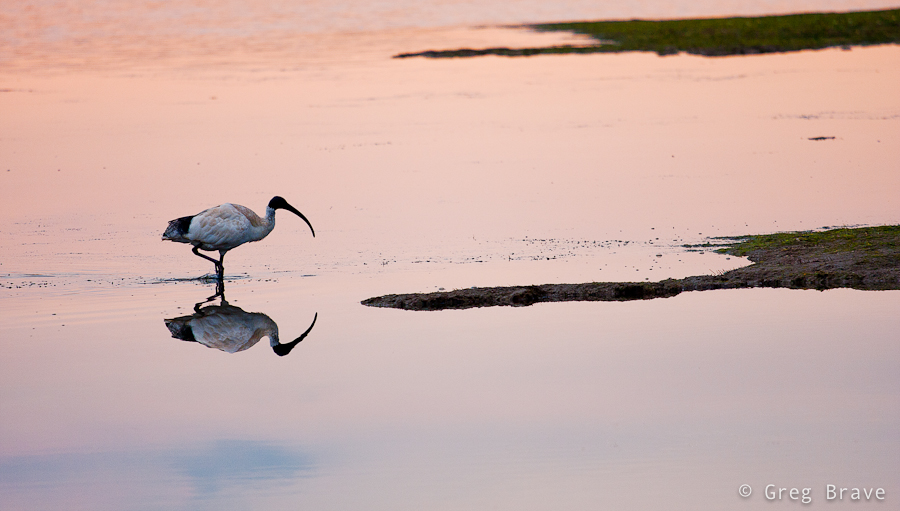
Unfortunately I have no idea what is the name of these birds but I find them very beautiful against the sunrise-pink colored water. For the shot below I used my Canon 70-200 f4 L lens and tripod.
Click on the photo to enlarge.
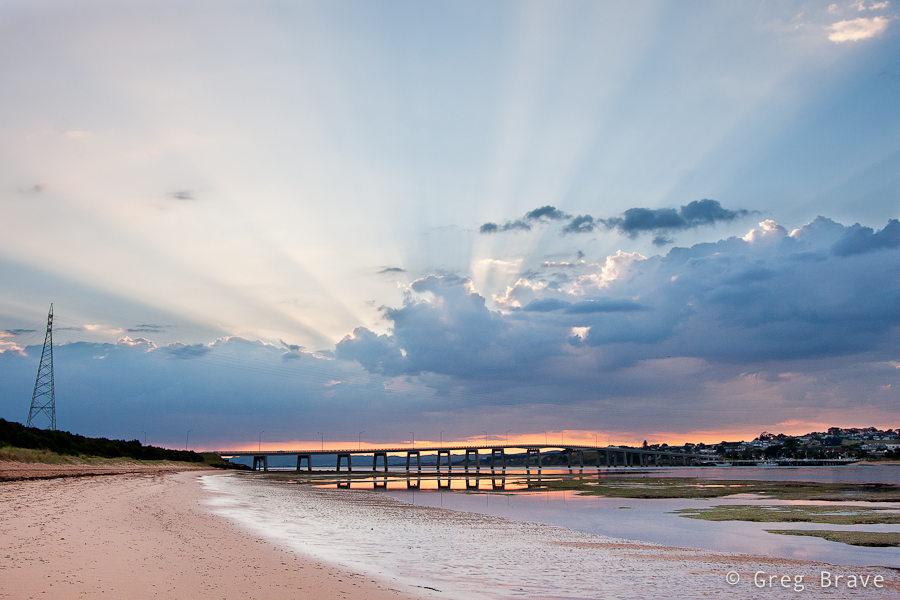
During the sunrise the clouds were moving pretty quickly so I was lucky enough to catch some pretty darn nice shots :), as you can see below
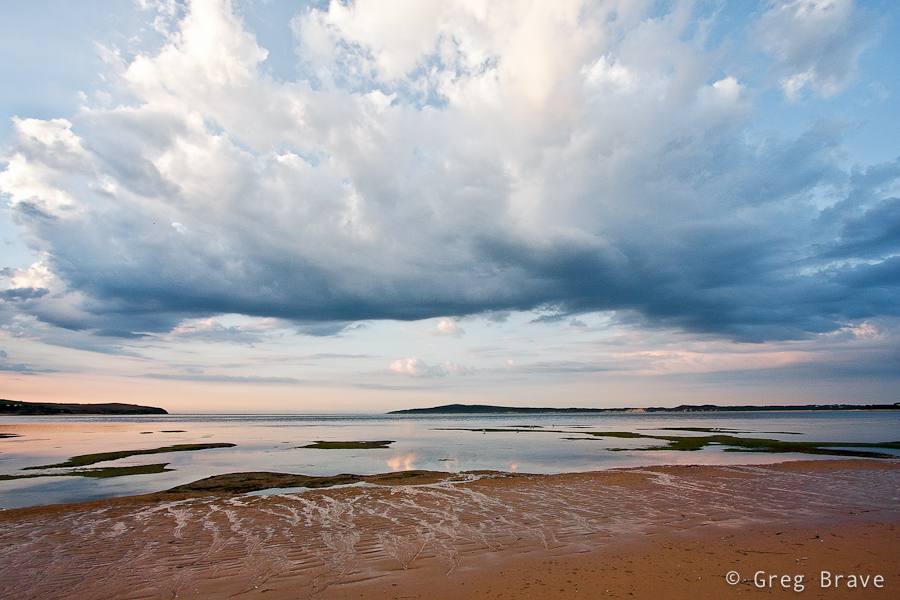
Click on the photo to enlarge.
And finally I went to San Remo’s jetty to watch pelican feeding. Unfortunately that day feeding didn’t occur but, I snapped the photo below. Look, they are twins!
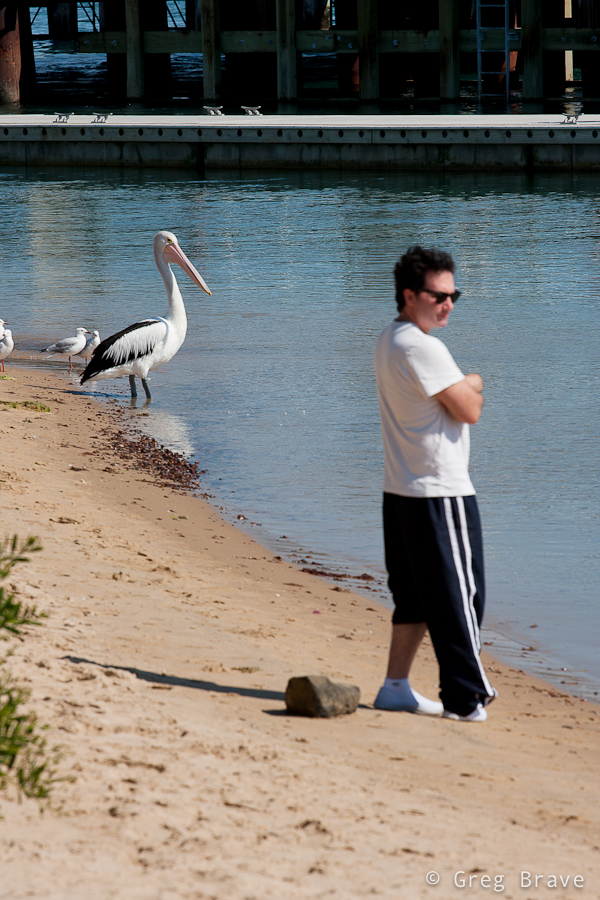
Click on the photo to enlarge.
That’s it for my photographic reportage from Phillip Island. I hope you liked my photographs, and
As always your thoughts and comments are welcome!
Till the next time, take care!
Cheers,
Greg.
Sometimes I see a photograph, and I wonder how it was done, what tricks or special equipment (if at all) did the photographer use to achieve the result? In most cases there is no way of asking him, and I have to guess and speculate on how it was done.
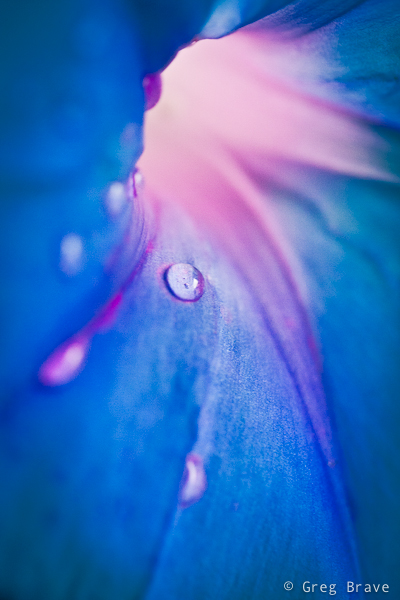
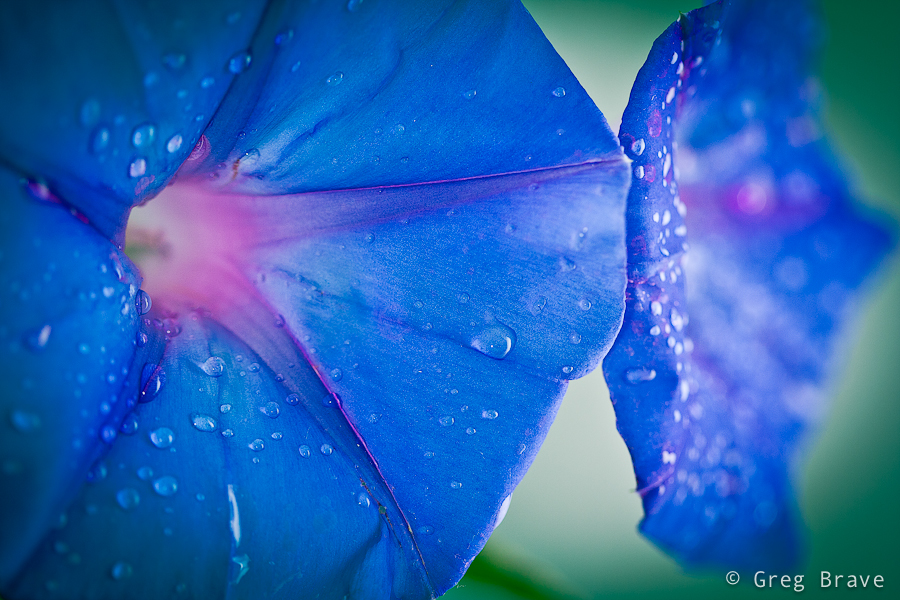
A few days ago I did a few flower macro shots, and posted one of them in a couple of forums. In the responses I’ve received I saw some questions as to how I did it, so I decided to write a post about it.
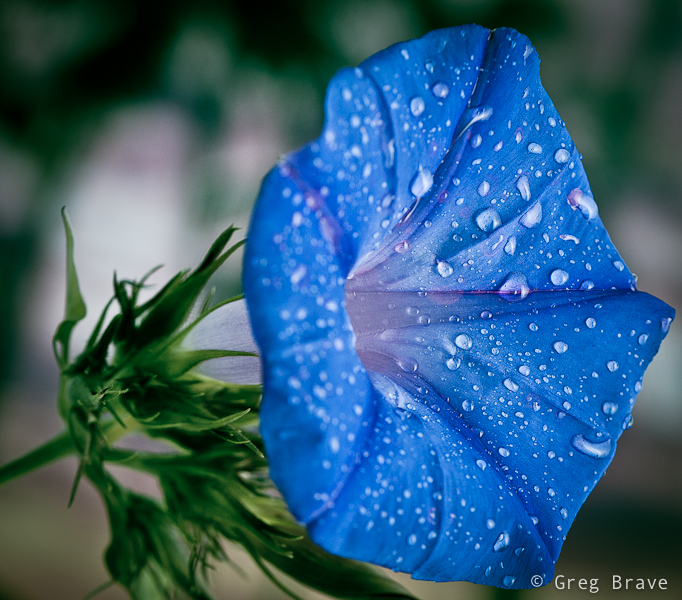
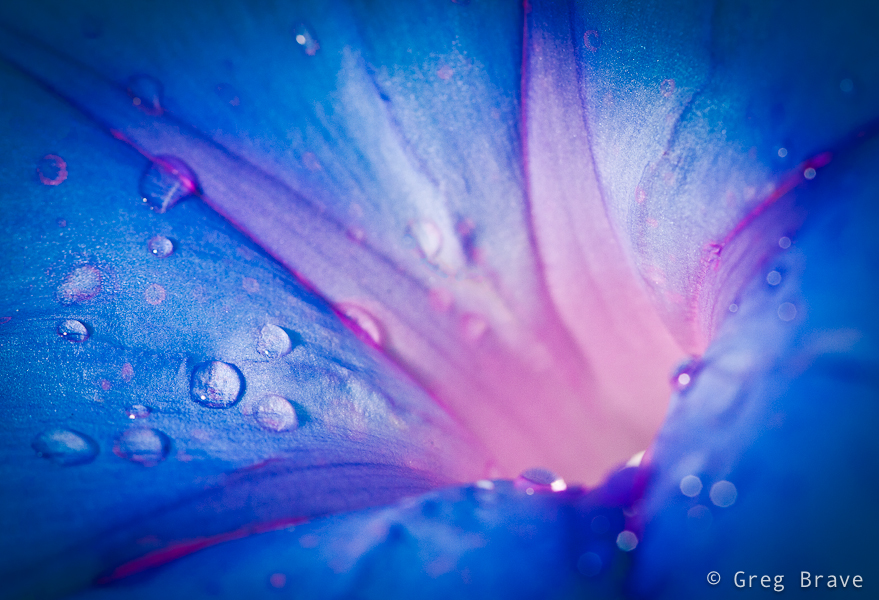
As you can see on the shot I sprayed the flower with water. Water drops are a very nice touch to many natural subjects, not only flowers. Sometimes photographers photograph the water drops on their subject in such a way that a reflection of something would be visible in the drops, and it makes for great images. In my case I wanted to achieve the exact opposite – I didn’t want any reflections in the water drops in order to focus the attention of the viewer on the flower, and to achieve that I photographed my flower in a white light tent.
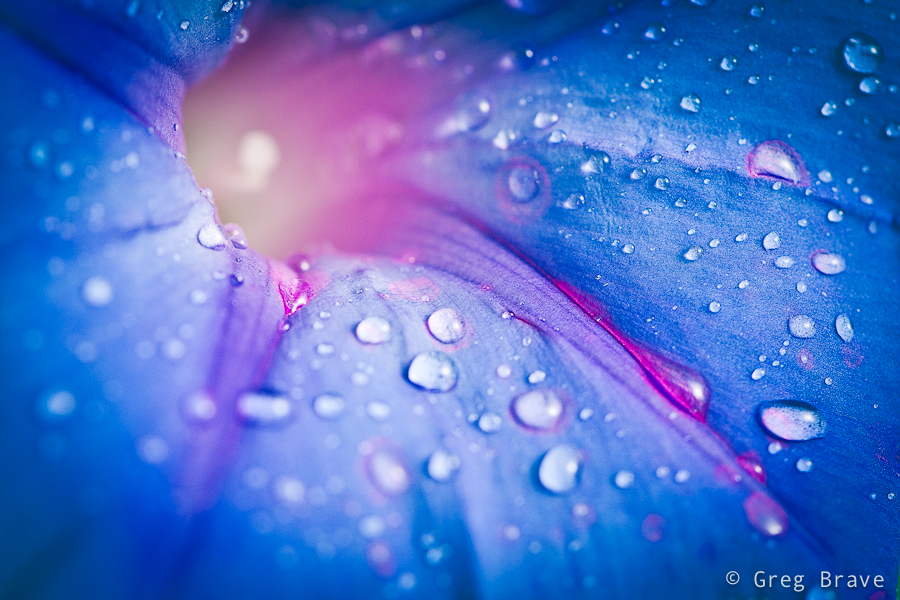
And finally, the background. In the shot above and in one of additional examples from that photo-shoot below you will see that my background wasn’t plain white. But what was it? It is easy – I used one of my calendars with colorful photos as the background. When shooting macro, DOF is so tiny that a photograph placed 30 cm behind the subject becomes totally indistinguishable collection of colorful splashes, which makes for a nice background.
Below you can see a few more examples from that shoot
 >
>
I hope you learned something from my experience.
As always, feel free to share your thoughts and suggestions in the comments section.
Cheers,
Greg.
P.S. For those of you who wonder, the flower’s name is Morning Glory
Wilson Prom is a peninsula, which is the southernmost point of the Australian mainland. Its coastline is about 130km in length and it is framed by granite headlands, mountains, forests and fern gullies.
During my visit there it was very windy. Winds reached speeds of 65 km/h, which made it pretty difficult to photograph the place, but the ever-changing clouds created a very moody atmosphere.
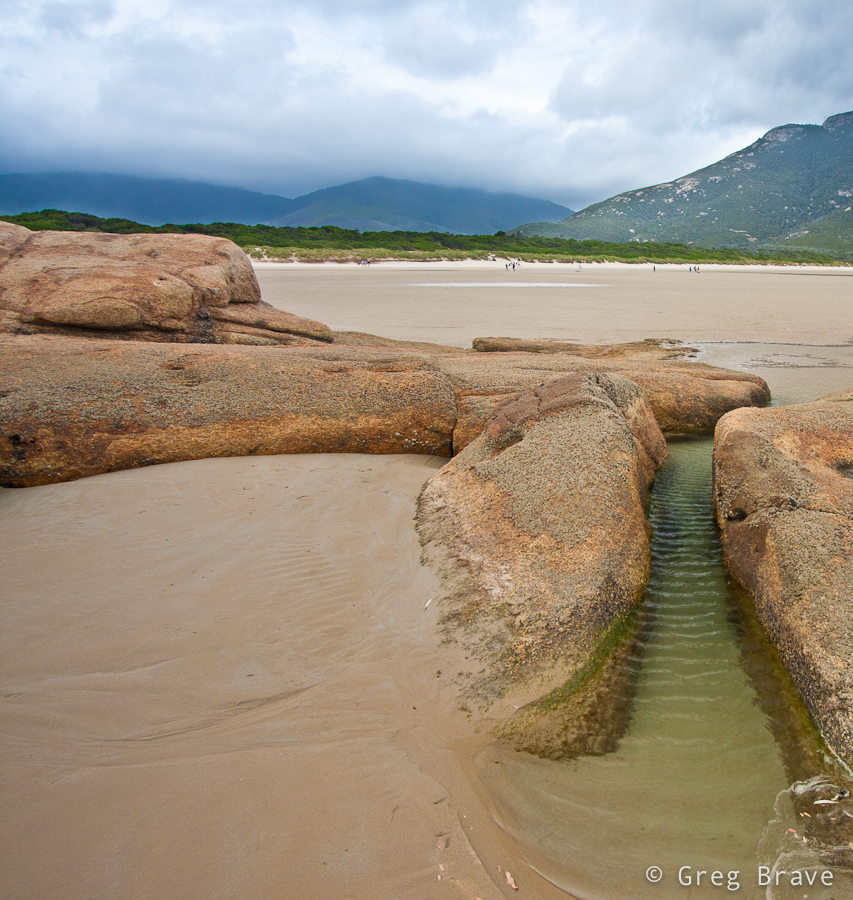
This photo was taken on the beach. I liked this small water canal and the ripples on it. If you look closely the rock on the left resembles head of a dolphin. Actually I didn’t notice that until my father saw this photo and pointed it out.
Click on the photo to enlarge.
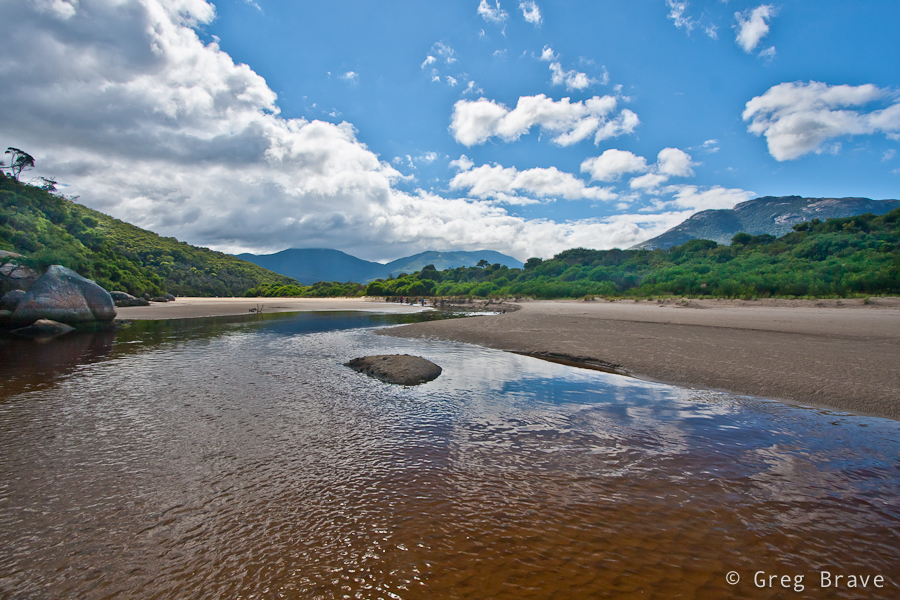
The river in the next photos named Tidal River. It is the main river in Wilson Promontory. It runs into Norman Bay and swells with the tide (hence the name). The river has a very interesting color, a purple-yellow. This is due to the large amount of tea trees in the area, which stain the water with tannin giving it a tea-like appearance.
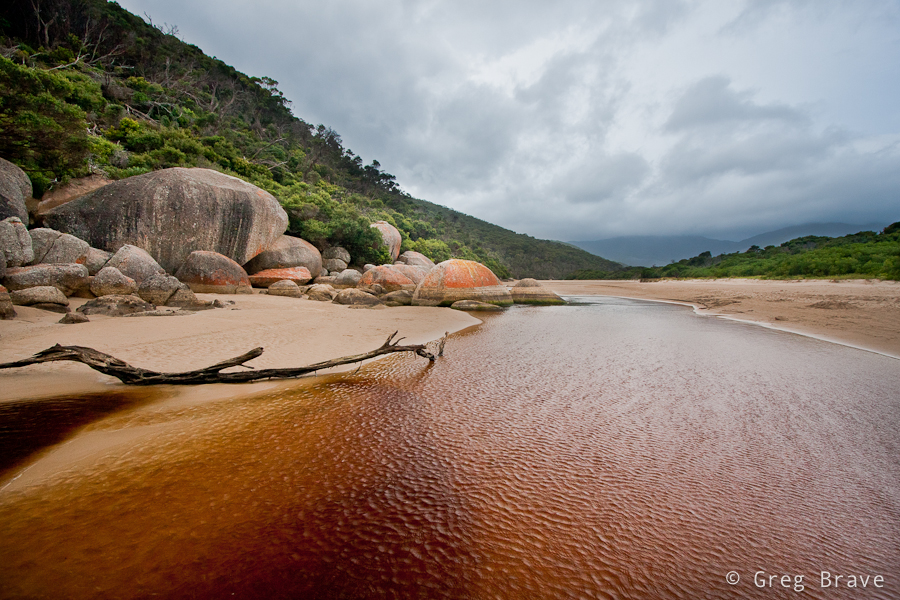
Click on the photo to enlarge.
Here I wanted to emphasize the texture of the boulders, and I also wanted a minimalist look. Lack of color achieved it in my opinion.
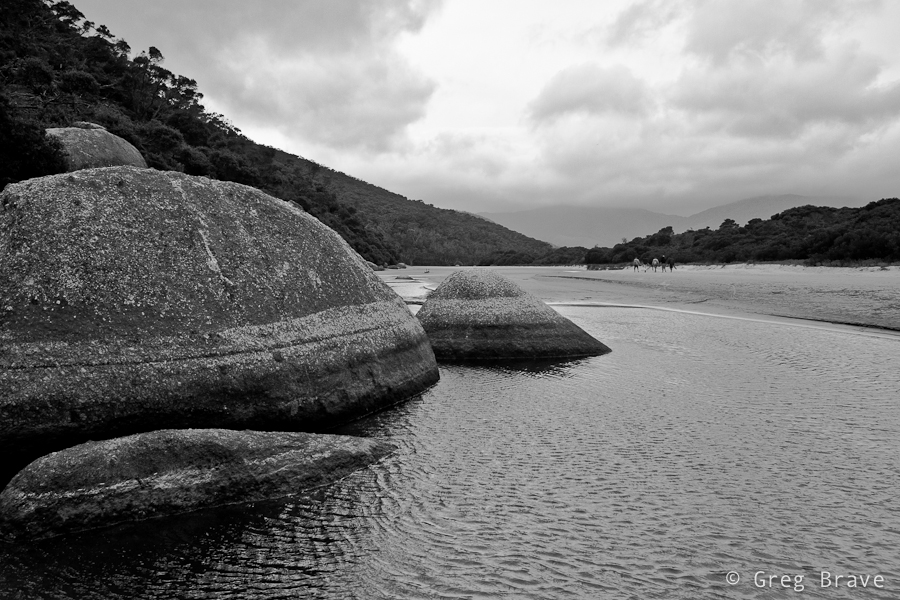
Click on the photo to enlarge.
This is the famous whale rock. As you can see it resembles whale’s head.
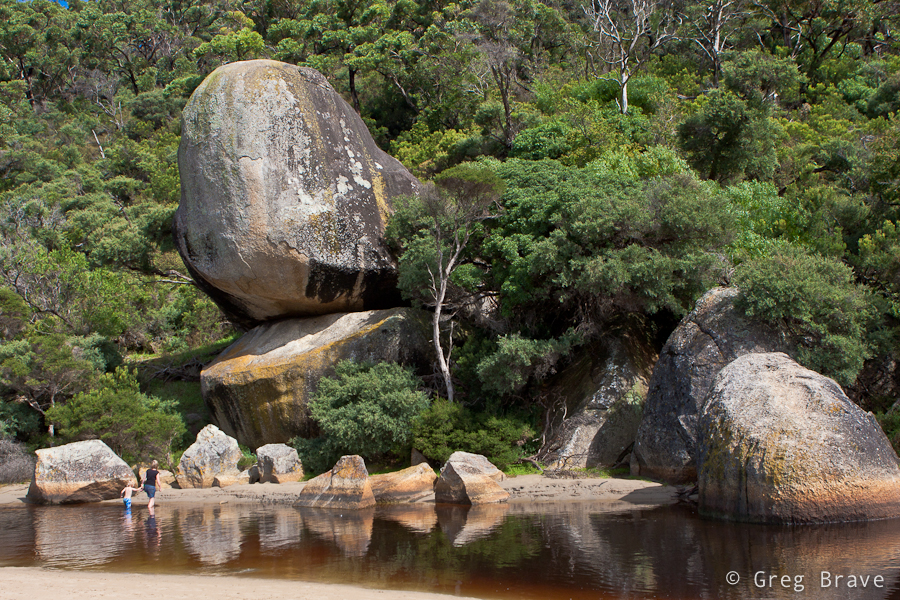
Click on the photo to enlarge.
In about 100 meters from here forward Tidal River meets the ocean. The next photo and the rest of them was made on my second day at Wilson Prom. The winds weakened, and the weather improved a little. As a result you can see people swimming in the river.
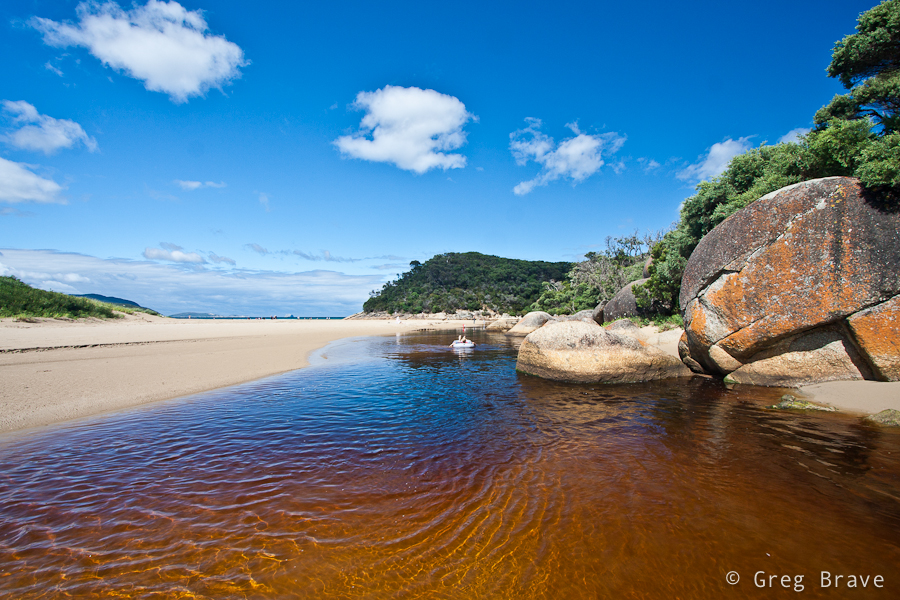
Click on the photo to enlarge.
The photo below was pretty heavy processed. I shot it into into the sun, which made the lower part very under exposed, and I had to increase fill light to a horrible 87 percent in Lightroom! I must really start thinking of purchasing ND Grads… Nevertheless I really like the composition and feel of this photograph.
Click on the photo to enlarge.
I always loved to photograph the ocean. As you can see Tidal River gives its color to the ocean making it look very unusual but also very beautiful to me. Clouds add the final touch, and below you can see the result.
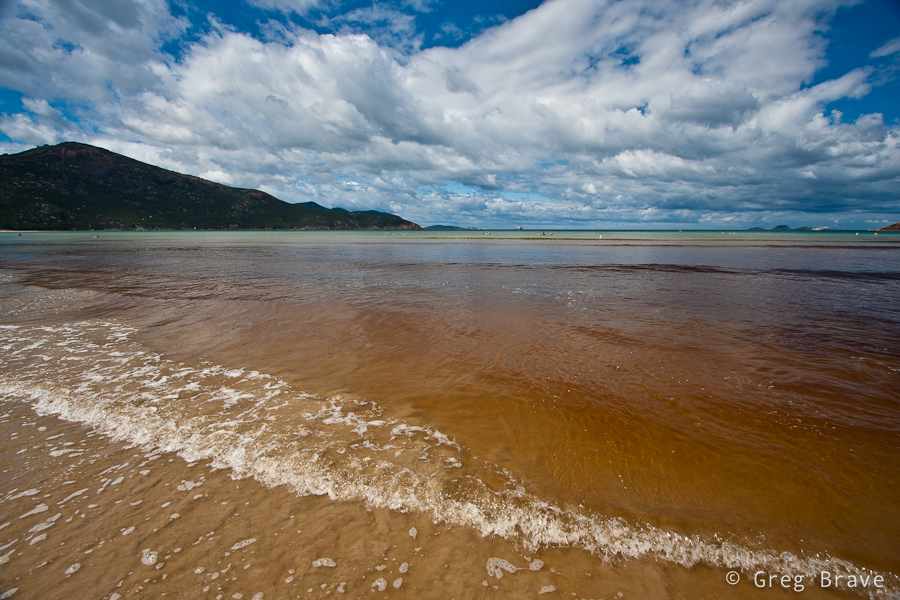
Click on the photo to enlarge.
I’m convinced that photographers don’t give seagulls enough attention, and I’ve decided to fix that. In coastal Australia seagulls are everywhere, and they are not afraid of humans. On the contrary – they are always near, waiting for food. I found a nice location at one of the picnic areas, and took many shots of seagulls with the help of my 3 year old nephew who was throwing them food 🙂
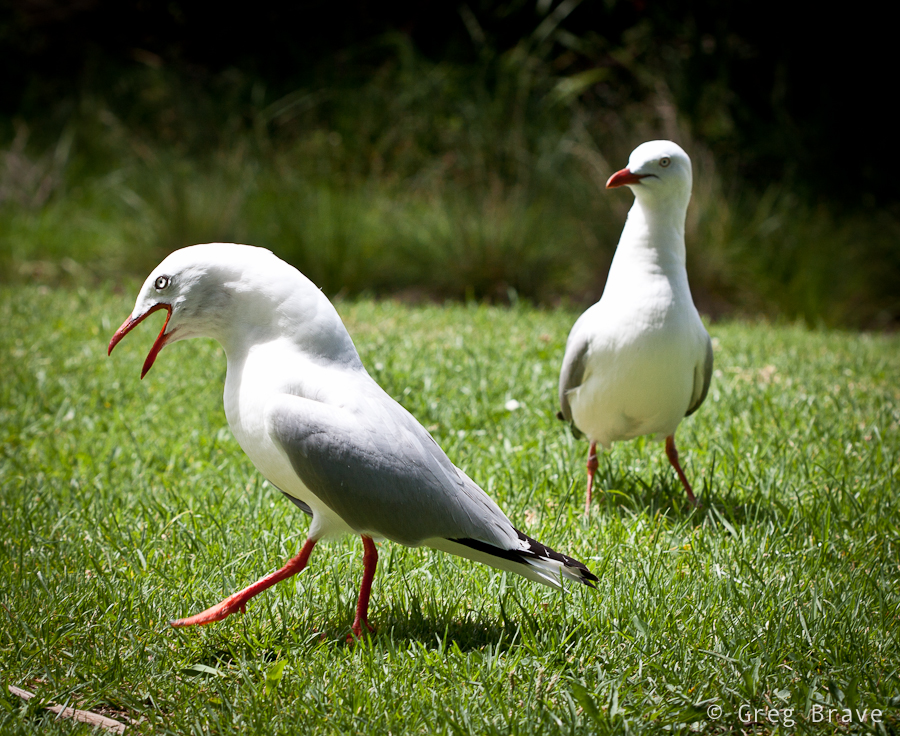
Click on the photo to enlarge.
And last but not least two photos from the Squeaky Beach. The photo on the right is called “The Elephant Legs”. These rocks looked magnificent, and I want you, the viewers, to concentrate on their shapes and textures, hence the b&w.
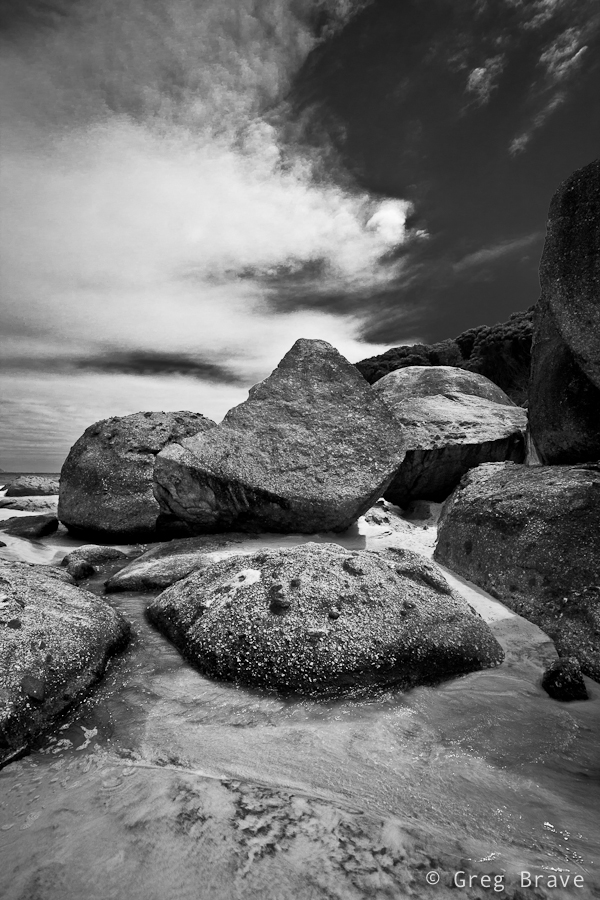
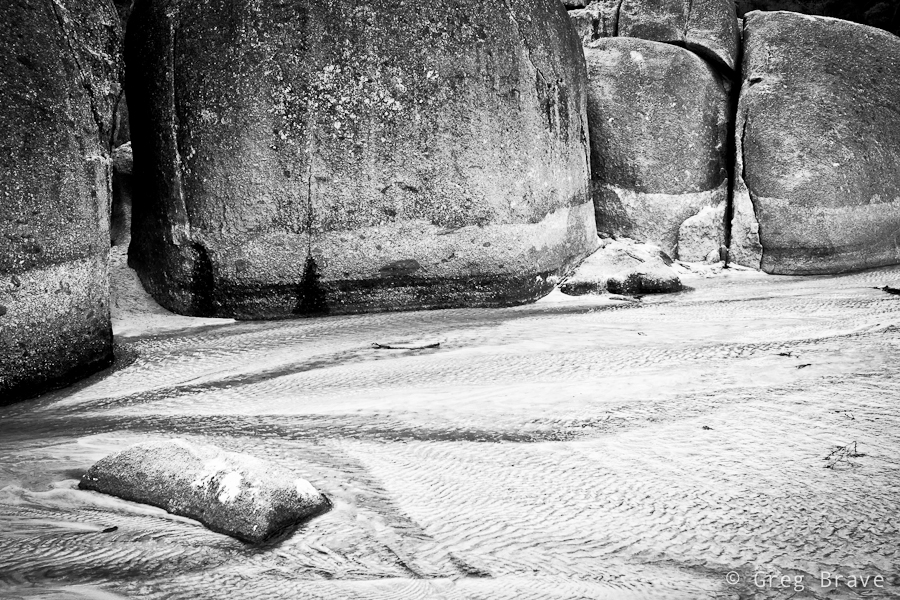
Click on the photo to enlarge.
I used tripod for most of the photos you saw here. Just to give you an idea – I shot about 570 images in total, from them I deleted 520, and the photos you saw here were the chosen ten. If you liked these photos, you can see eight more on my Facebook page: www.facebook.com/photopathway
As always any comments are appreciated!
Till the next time, take care
Greg.
Those of you who frequently visit my blog probably know that I like shooting sunsets, so now I want to share some of my recent shots.
This one has strange colors, but I like it anyway. I was shooting sunset from the pier and suddenly in the far distance I saw this ship. I quickly changed to my telephoto lens, and made a few clicks. But something was missing… the photo was empty. Then a bird appeared in my viewfinder, and I got this shot.
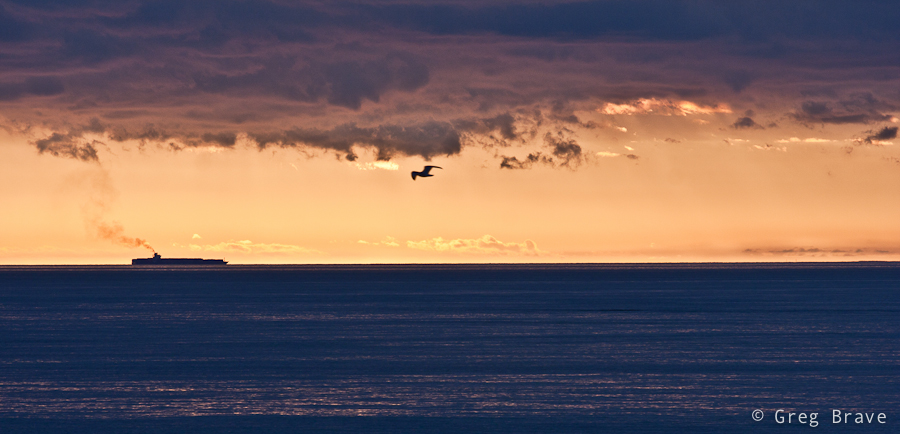
Click on the photo to enlarge.
Here is one pretty simple photo. I like its simplicity, and I also like colors and reflections in this photo.
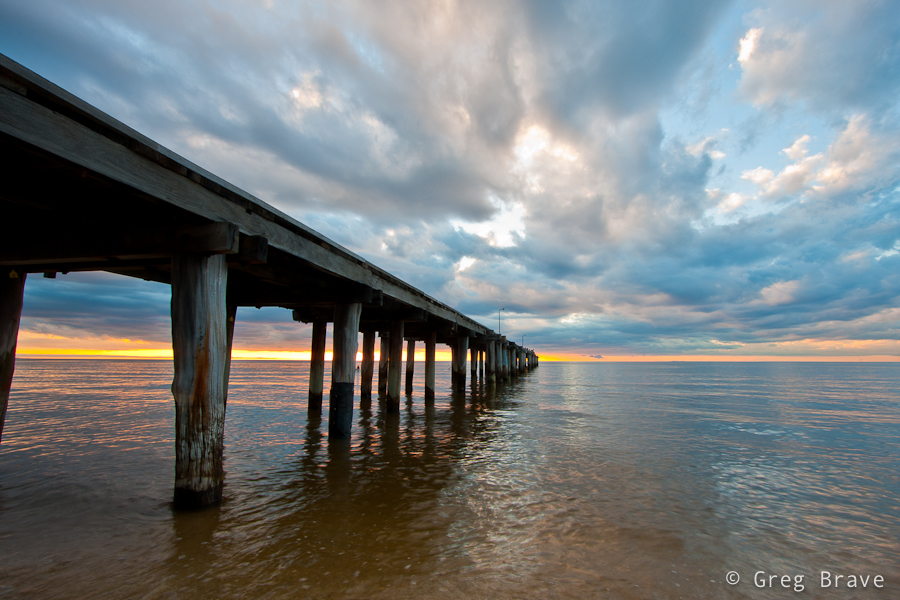
Click on the photo to enlarge.
I wish the girl on the boat would come closer, but this is the best I could do under the circumstances 🙂
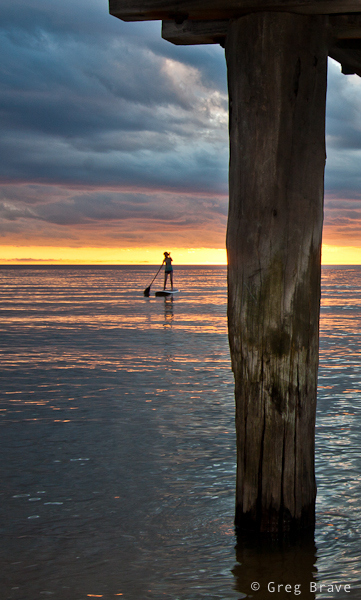
Click on the photo to enlarge.
This shot was also taken with my telephoto lens because I wanted to isolate a small part of the shoreline.
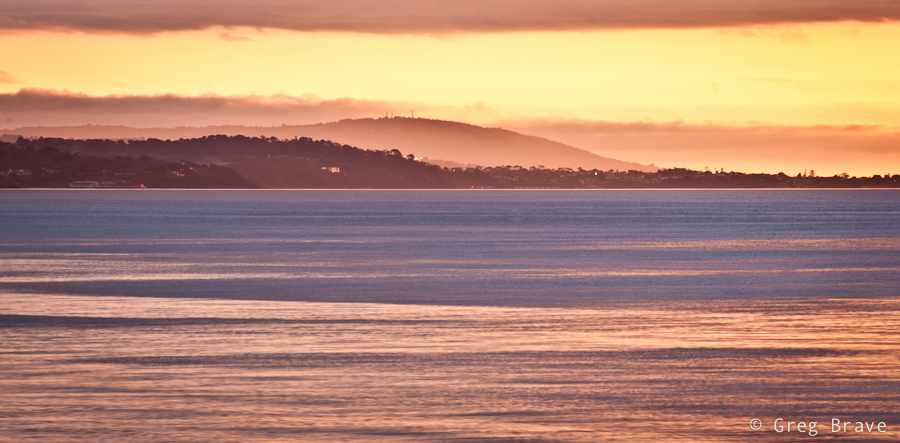
Click on the photo to enlarge.
I call the photo below “classic sea sunset photograph” – setting sun, orange water, two silhouettes…
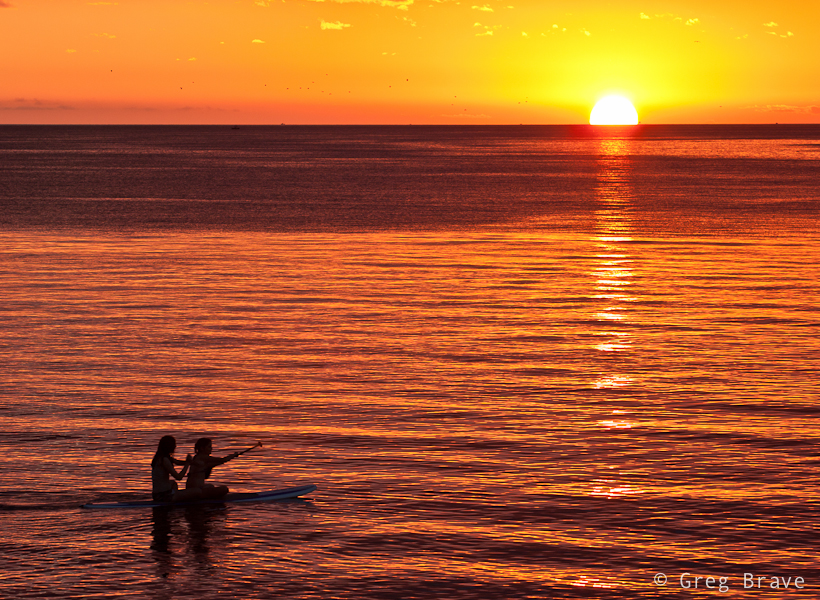
Click on the photo to enlarge.
This collection wouldn’t be complete without a little humor. I was shooting standing under the pier (you can see photo from that location in this post), when two boys came and sat on it. I quickly turned and had time to take only one photograph. After a few moments one of the boys ran away, and it wasn’t that interesting anymore.

Click on the photo to enlarge.
I hope you liked the photos. Feel free to comment on them!
Till the next time, take care!
Greg.
You might think I’m going a little bit crazy here, but hey, don’t make any rushed judgments!
Yes, flash won’t help you to light the landscape but it can help you make your sunset photos a little bit different. Usually when you see sunset photos, the foreground elements of composition are silhouettes due to the high contrast between the backlight from the setting sun and the darkness of the foreground. Sometimes these silhouettes of objects or people look good in the photo, but sometimes adding a little foreground light can improve the final image.
In the following example you can see pretty much the same composition taken with (on the right) and without (on the left) the flash.

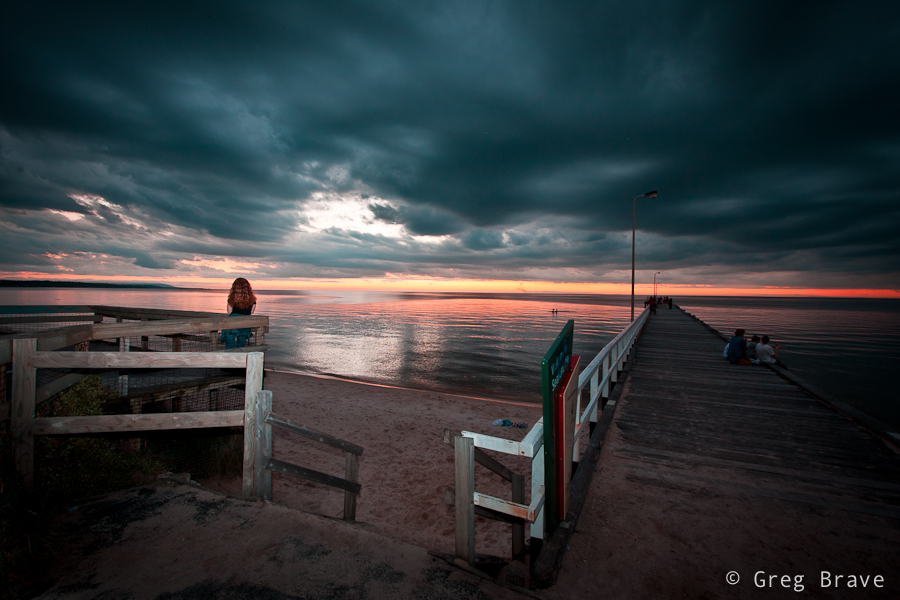
Click on the photo to enlarge.
While the silhouette in the left photo looks nice, using a little bit of light to show the cool red hair of the standing person adds a nice touch to the photograph. It also reveals a bit more detail in the foreground, though I’m not sure if it is a good thing in this case.
In the photo below I also used flash to light the foreground, and show the beautiful color and texture of the wood. Without flash this photo would have been too dark and much less interesting. Another way of achieving this result would be shooting several frames with different exposures and later combining them into an HDR image, but it would take much more time and possibly look less realistic.
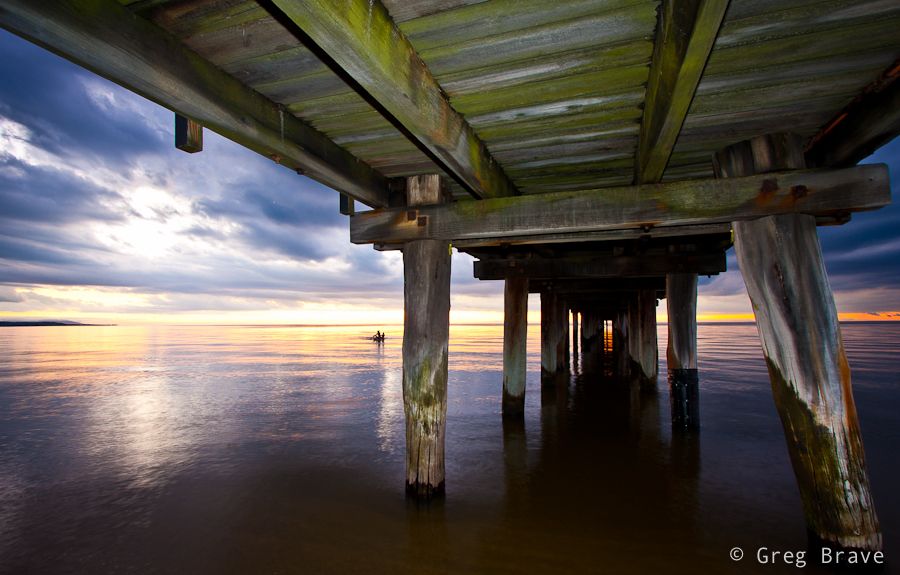
Click on the photo to enlarge.
These are only a few examples of endless possibilities which open up when you start using flash in many situations where it is not normally used, not only during sunset. For example you can use flash when shooting in harsh daylight in order to soften the hard shadows that daylight produces.
Hopefully this post inspired you and gave you a starting point for your own creative ideas when and where to use that flash that has been lying in your photo bag for too long 🙂
If you have any original ideas or examples of unusual use of flash, please share them in the comments.
Cheers,
Greg.
If you think about it, in many landscape photographs there are these often small compositional elements that create the overall mood of the photograph. The whole photograph can show a magnificent landscape, but still what makes all the mood (or sometimes adds the final but vital touch) are these elements. And once you thought about this, you can try and consciously add them to your photographs. Just like I did.
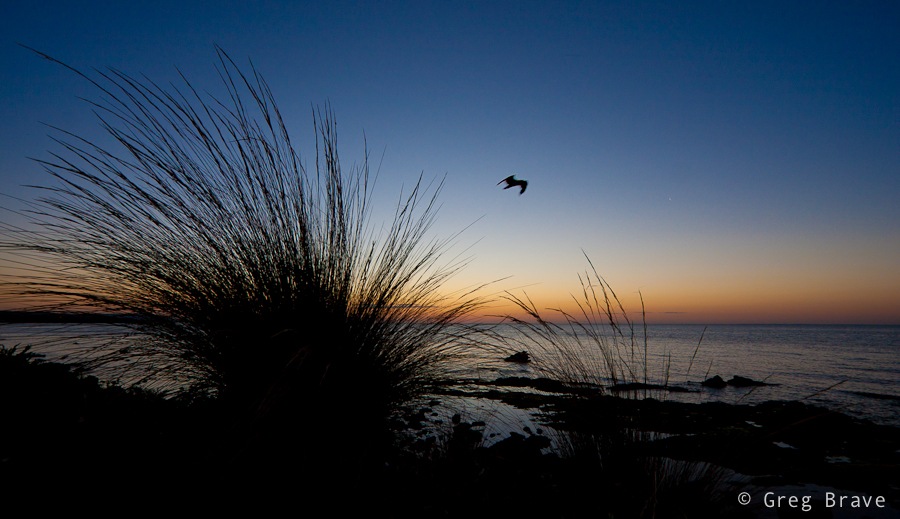
This photo would be nice even without the bird, but it would be empty and lifeless. Having the bird in the photograph adds life, motion, and mood to it. Yes, the bird is not sharp ( due to the rather long exposure), and there are not many details of the bird visible, but it is not important. The most important thing is that it is there.
Click on the photo to enlarge.
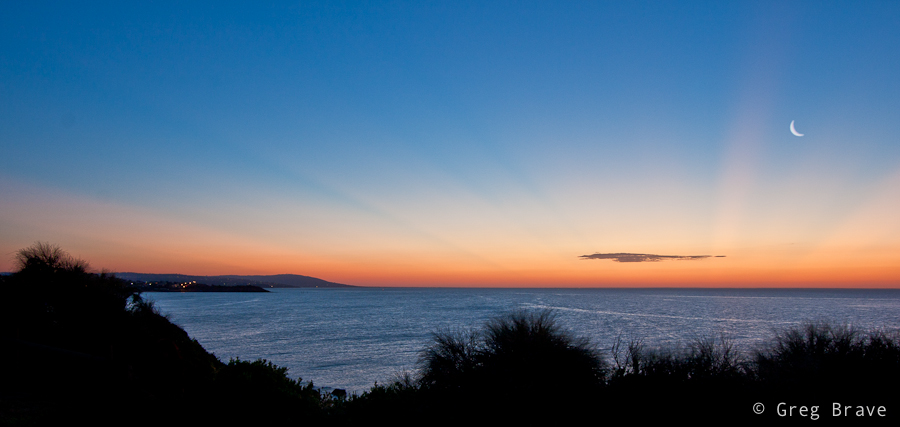
Can you guess what is the “mood” element in the photo below? It is the moon. Without it the photo would still be nice, with the beautiful rays of sun reaching the sky from below the horizon, but moon adds a final touch to the composition. In my opinion photo wouldn’t be complete without it. And also, I think it is important that it is a young moon and not a full moon. It has to do with our stigmas and perceptions – full moon associates with dark night, bright moon light, and in my opinion would be inappropriate in this image, while the young moon associates with evening or morning sky and fairy-tales.
Click on the photo to enlarge.
As you can see in my two examples important mood elements are small in dimensions, compared to other parts of the image, but are very important and vital when composing the shot.
I hope that having this in mind will help you create more striking and meaningful images.
Here’s to your next photo! Go out there, and don’t forget to have fun!
Greg.
In this post I’d like to talk about photographer’s artistic interpretation of the observed scene.
When I decide to take a photograph of a location, it is usually because I feel some sort of impulse. This impulse comes as a result of the surroundings communicating a certain mood, or association to me. You can say that I am photographing more of a mental image of the scene that I have in my mind at that moment than the actual scene. And consequentially, later when I see the photograph on my computer, it is quite different from my mind’s picture.
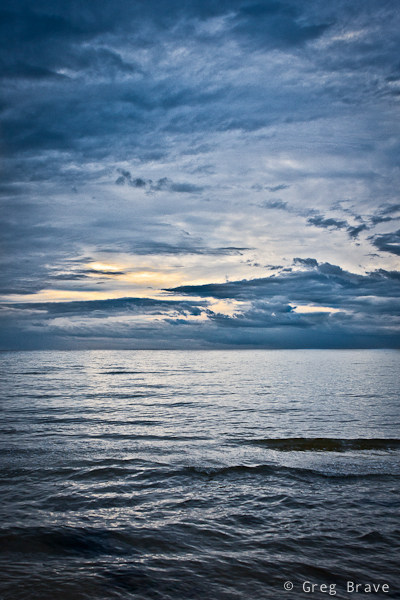
I call bringing the two images together “Artistic Interpretation”, and use post processing to achieve that. I constantly feel the need to improve my post processing skills to be able better present my photographic intentions.
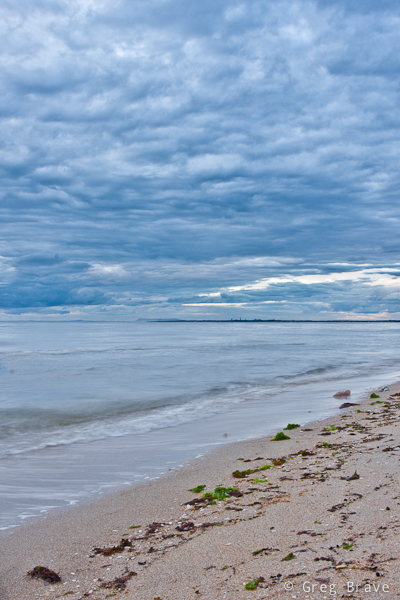
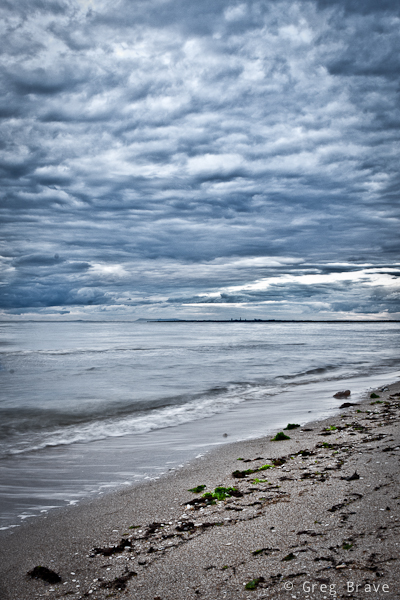
In the following two examples, you can see the photographs before and after my artistic interpretation (left photo is before and right photo is after).
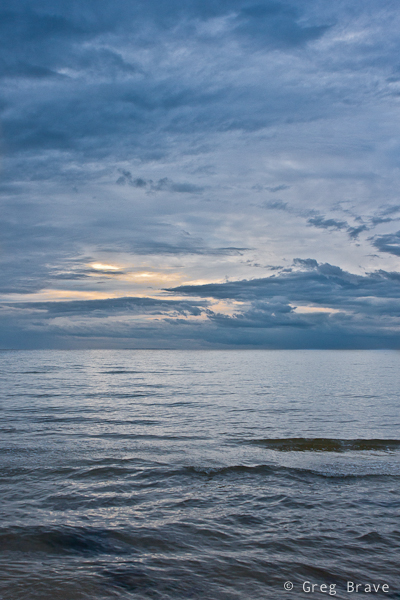
It was evening time, about 40 minutes after the sunset. The darkness came quickly and the sky was cloudy, it was going to rain any minute. I felt the “pressure” of the coming rain in the air taking this photograph. When I saw the resulting photograph, I felt that this feeling of a close rain and late evening was gone and I had to bring it back. I increased contrast and reduced saturation. I feel that I succeeded in bringing that mood back, but I’ll leave it for you to decide.
Click on the photo to enlarge.
On another occasion I was again walking along the beach. It was a shortly after the sunset, and because it was cloudy, I could barely see the faint remnants of sunlight. The clouds were really beautiful and I couldn’t resist taking a photo. In post processing I increased contrast and added a bit of saturation to the yellow. I also added slight vignetting to concentrate the viewer’s attention on the horizon.
Click on the photo to enlarge.
What do you feel looking at these images? Can you bring your own examples of your artistic interpretation?
As always any comments, suggestions, ideas and anything else you’d like to say are welcome.
Till the next time, take care!
Greg.
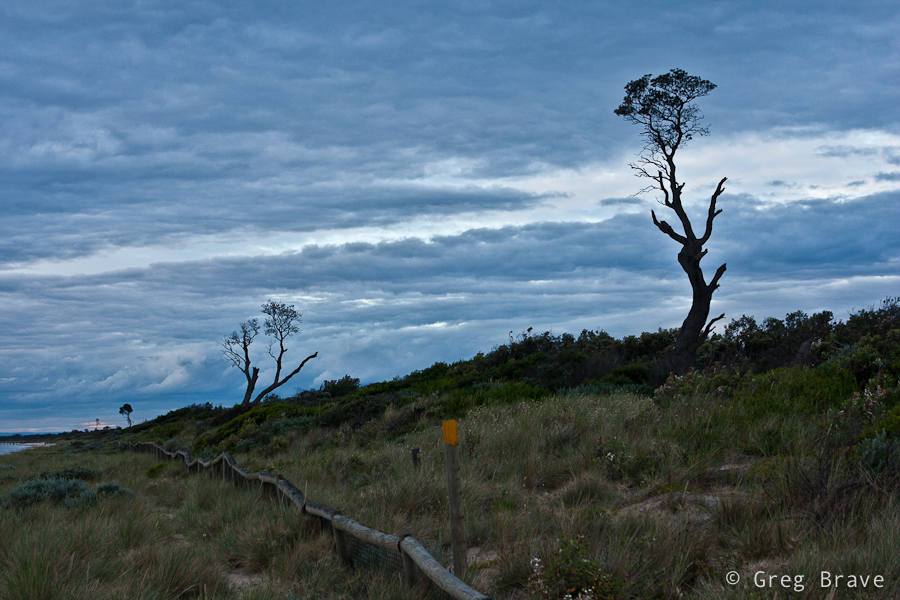
One of the compositional tools that photographers use to draw the eye of the viewer into the photograph is lines, which lead the viewer through the photograph. And by lines I don’t mean pencil drawn lines or anything like that. These “lines” can be represented by various contours of elements in the image.
Here is an example of leading lines in the image:
Click on the photo to enlarge.
As you can see there are several such lines in this photo. One of them is the line of the wooden fence. The “line” can be broken and not straight, as is the case here, but nevertheless it still does the job. Another line is formed by tops of the bush, and finally the third imaginary line appears when your eye connects between the three tree tops.
All three lines converge at the lower left part of the photograph leading the eye from right to left. However there is one more line, which “breaks” this pattern. It is the stripe of bright sky protruding through the clouds. While other lines are relatively easy to control because they are stationary , this line could be caught only during a short period.
Lines can be a very strong compositional element when used wisely and in place, for example you can use such lines leading the viewer’s eye to the main subject of your photograph.
What are your examples of leading lines? You can share your photos in the comment section to this post.
Till the next time, take care!
Cheers,
Greg.
Sometimes photo doesn’t need a frame, it is complete as it is. But then there are photographs that just don’t feel right until you frame them. Frame often adds sense of completeness to the photograph. Photographers often look for compositional elements to naturally frame their subject within the photograph.
It is also important to choose appropriate frame for each particular photo, otherwise it might distract the viewer, or even worse – ruin the whole impression from the photograph.
In our digital age it has become common practice to add frame directly to the photo during the post processing. This way of adding a frame has one significant advantage – flexibility. There are many different
applications that have collections of various frames, which you can add to your photos, or if you are familiar with programs like Photoshop you can draw your own frame around the photograph.
Since most of the photos that we come across are seen on display (either from our digital cameras or the Internet) adding frame directly to the digital photo adds to the viewing experience, and later photo can be printed and hung on the wall without the additional expense on the “real” frame (actually this point can be argued by many who prefer real frames).
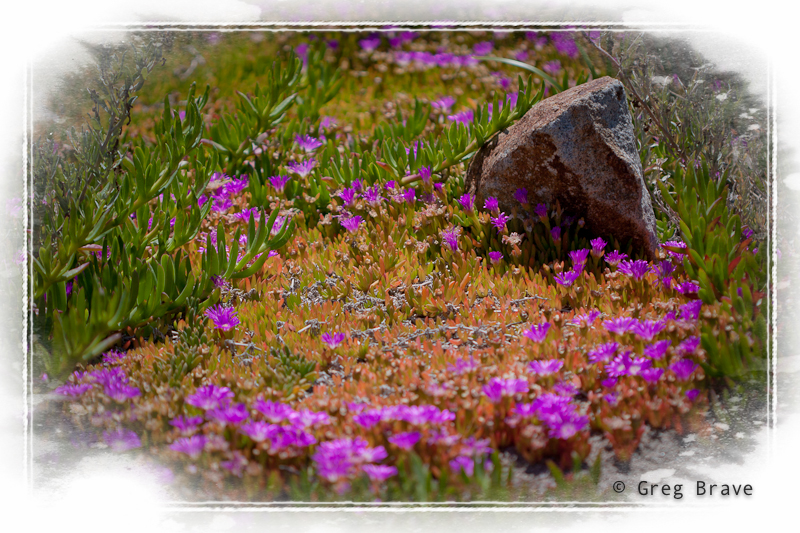
I’d like to present here two examples of photos with digitally added frames.
Click on the photo to enlarge.
In this photo I added white frame, which in my opinion turns it to a nice postcard, smoothly fading edges of the image and creating dreamy look.
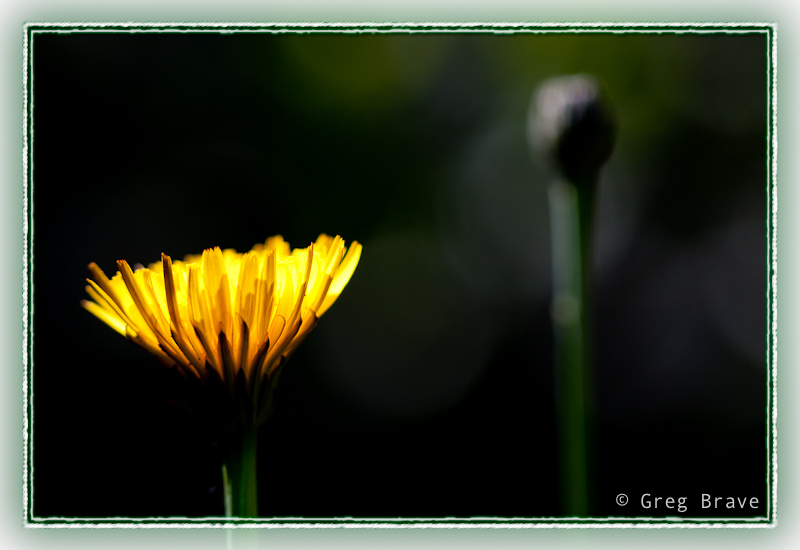
The photo below would be incomplete without a frame, it’s black edges would leave a sense of incompleteness. So I decided to add a frame. The frame’s color is intentionally greenish to match the tone of the photograph.
Click on the photo to enlarge.
What do you think about framing your photographs?
Remember, you only have to enter your name to leave a comment.
Cheers,
Greg.
Lately I was thinking about minimalism in photography. For me it is conveying a message (mood, idea, emotion, etc.) to the viewer through minimum of visual details or subjects. When you see a successful example of minimalistic photography, it seems that it is very easy to accomplish, because there are not many details in the composition that you have to think about.
But that is not true. While trying to create photographs with minimum details, I found it to be pretty difficult to come up with a good one. It is due to scarcity of detail that each detail has to be absolutely necessary and located in the right place.
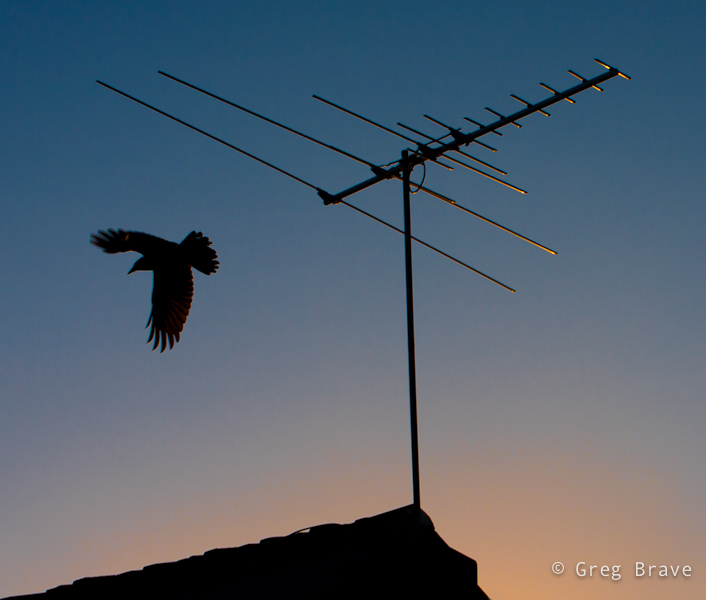
After numerous unsuccessful attempts I came up with this photo, which I like because it creates a certain mood.
Click on the photo to enlarge.
Initially I wanted to make this photo with the bird sitting on the antenna, so I was waiting with the camera aimed at the scene for the bird to sit in “photogenic” pose (which would be such that its whole silhouette would be visible), but instead the bird flew away, and then I caught it changing my composition intentions on the fly. I was lucky to catch the bird with open wings as I made only one shot.
Now when I look at this photo, I think that I could have waited more for this or another bird to appear and sit on the roof, and it would make another interesting composition. Then I’d compare the photos to decide which I like best. But these are merely afterthoughts, and this image is the only one I have.
I would be happy to hear your opinions on this photo – what would you change in it and why? And any other thoughts that you’d like to share on the subject of minimalism in photography.
Remember, you only have to enter your name to leave a comment!
Till the next time,
Greg
As I promised, here are some more photos from where I live now, which is Australia if you haven’t followed me until now.
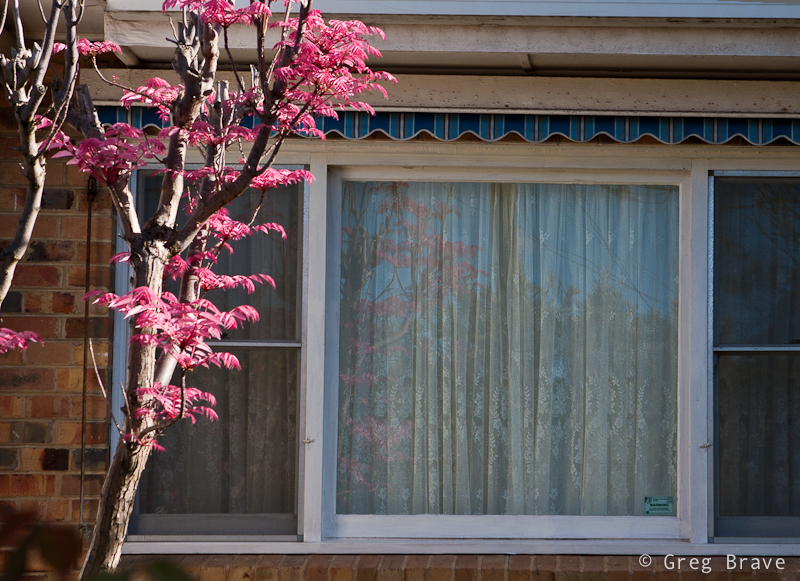
There are so many beautiful flowers and trees here, that I can’t resist photographing them and in the last month I gathered quite a collection of flowers and trees photos. Everything blooming now, it is Spring here. Take this tree for example. Imagine how it would be to look out of your living room window and see this beautiful tree!
Click on the photo to enlarge.
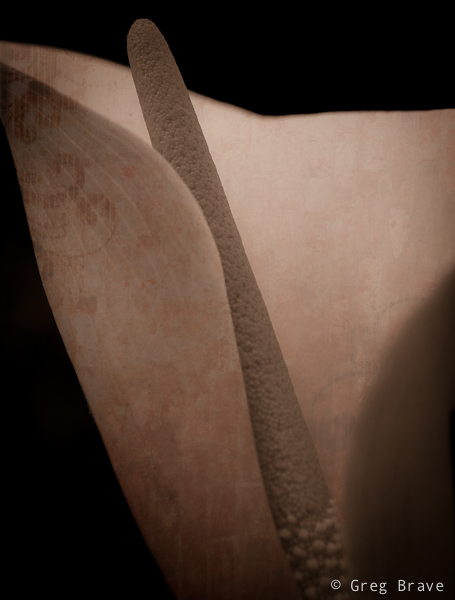
In the next photo I couldn’t resist doing some Photoshop editing, and added a texture to the flower in addition to converting it to black and white (with dual toning). If you’d like to know how I did the conversion, you can read my post “Creative Conversion to B&W in Lightroom”. Thinking of it, I probably will also write a post about how to add textures to your photos.
Click on the photo to enlarge.
The photo below was taken at Frankston’s Sculpture Park. This sculpture of a lady standing there created a mystic mood, and I tried to capture it. Whether I succeeded or not is for you to decide.
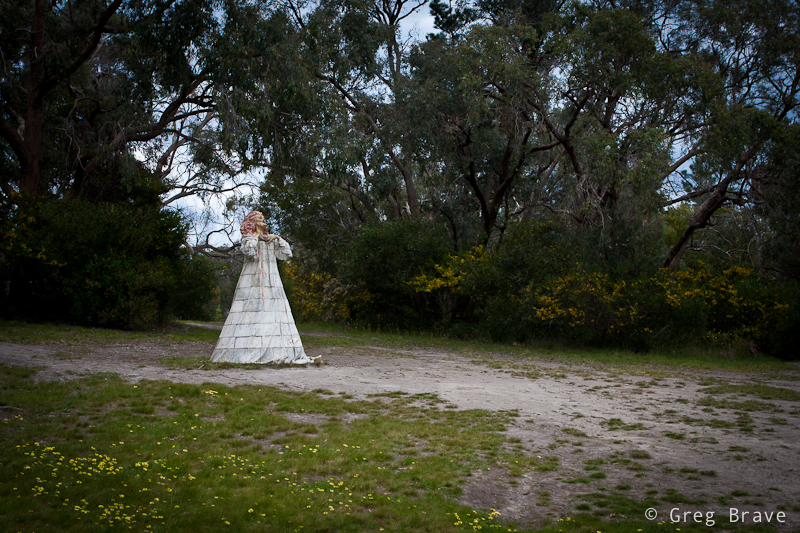
Click on the photo to enlarge.
These are Pelicans that live on the small beach in Hastings (small town). They are waiting for the lady from fish shop, which is located nearby, to come out and give them some fish leftovers.
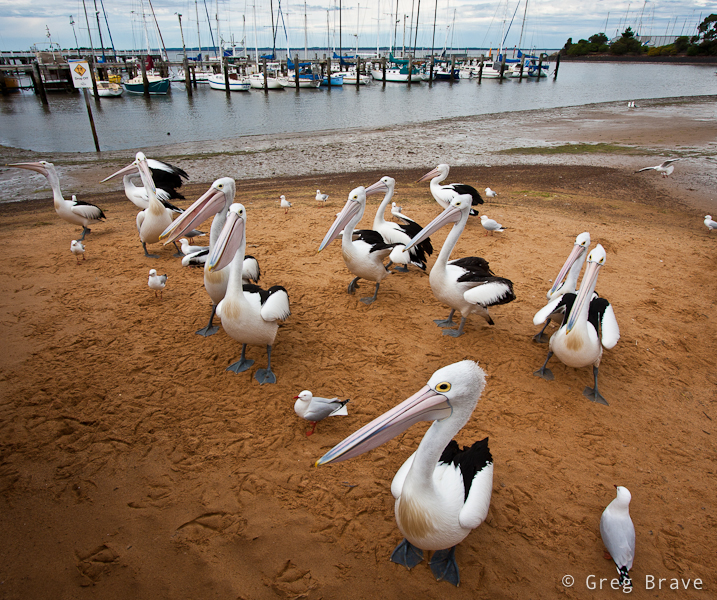
Click on the photo to enlarge.
This photo is from the same location.
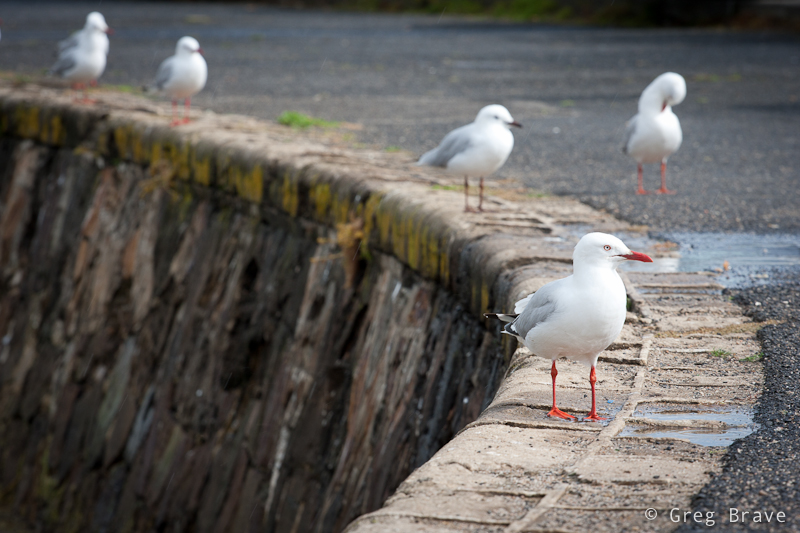
Click on the photo to enlarge.
I am fascinated by the shapes of the gum trees that are so common in Australia. Here is one example, but there are so many different and magnificent tree shapes that I might just create a collection of them.
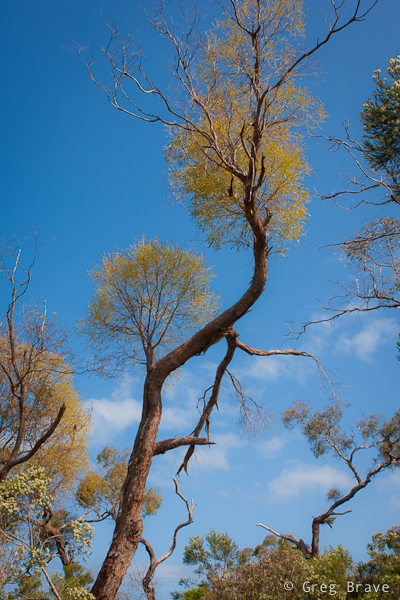
Click on the photo to enlarge.
This photo was taken in Sydney in the outdoor art exhibition “Art and About”. I liked how these two guys were looking at the huge photo.
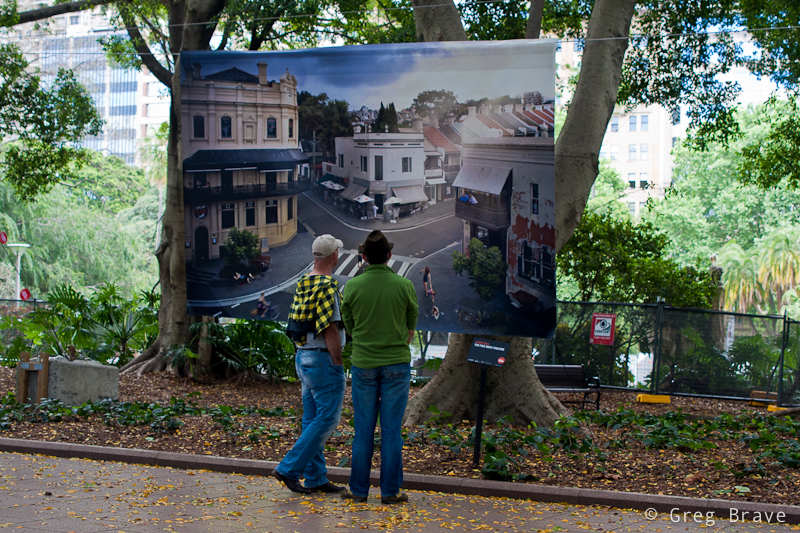
Click on the photo to enlarge.
It was a pretty short post, but I hope you liked the photos.
Any comments are always welcome and,
Remember, you only have to enter your name to leave a comment!
Greg.
Scott Hotaling loves nature and outdoor activities and photography was a natural extension of his passions. Scott’s love and appreciation for nature can be clearly seen in his beautiful photographs. I was lucky to get an interview with him, and without further adieu please welcome Scott Hotaling!
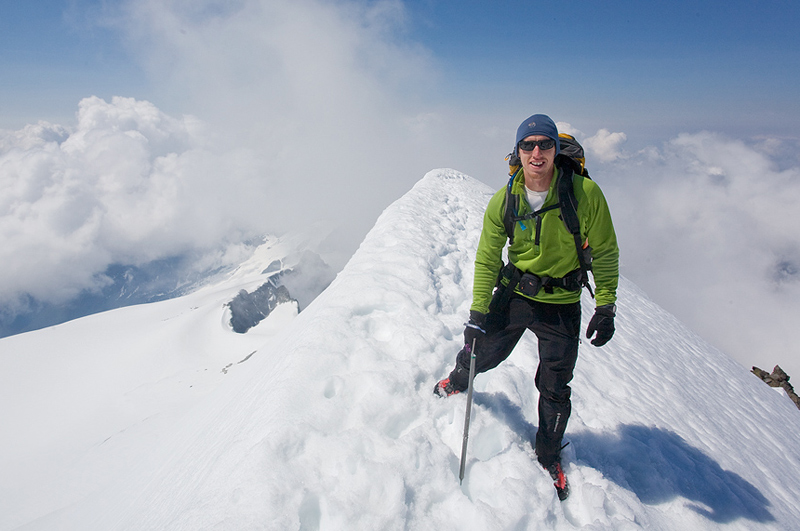
Click on the photo to enlarge.
Tell a little about yourself. What do you do for a living? How did you get involved with photography?
I’m a North Carolina native and I’ve spent a majority of my life exploring the southern Appalachian mountains. Despite a good bit of travel across North America and stints living elsewhere I still consider western North Carolina my home. Currently, I’m spending several months focusing solely on my landscape photography work but in January, I’ll be starting a doctoral graduate program in Lexington, Kentucky. So, for the time being, I’m working solely as a photographer for the first time in my career. As for getting started, it was simple cause-and-effect for me. I loved exploring new places but never managed to shoot photographs that translated the beauty I found to those around me. Most of the time I’m still trying to figure it out but every once in a while I luck into something good.

Photo by Scott Hotaling. Click on the photo to enlarge.
How do you pick your spots for taking pictures?
For me to do my best work I have to be physically drawn to a place. It’s not uncommon for me to visit a location ten or more times under a variety of seasons/conditions before I get the photo I’m after. The process can take years but it’s one I respect and enjoy. But despite frustrations and bumps along the way, at the core of it all, is a deep appreciation for a specific place and the desire to showcase it under optimal conditions. I carefully construct what the perfect conditions would be for a location in my head then do my best to capture them. In most cases, the right conditions include a certain season, landscape condition (fall color, fresh snow, etc.), time of day, cloud cover, and more.

Photo by Scott Hotaling. Click on the photo to enlarge.
What inspires you to take photos?
The natural world and the infinite combinations of light, dark, rock, plant, water, etc. that make every photograph different from the next. From a microscopic to global scale we live in an incredible place and I want to see as much of it as humanly possible, my camera simply comes along for the ride.
But, specifically, I’m particularly drawn to places with dramatic views – mountain summits, ridges, cliffs, etc. And, particularly those that aren’t easily accessed or less widely known. For example, a winter sunrise from a remote mountain summit is the best case photographic scenario I can envision.
Do you hike and photograph alone, with someone, or in a company?
Usually alone. More by necessity than choice, my schedule and plans dictate my hiking company more than my personal preference. But, I’ve been lucky to have a wide variety of wonderful people join me for adventures and that’s always much more fun.
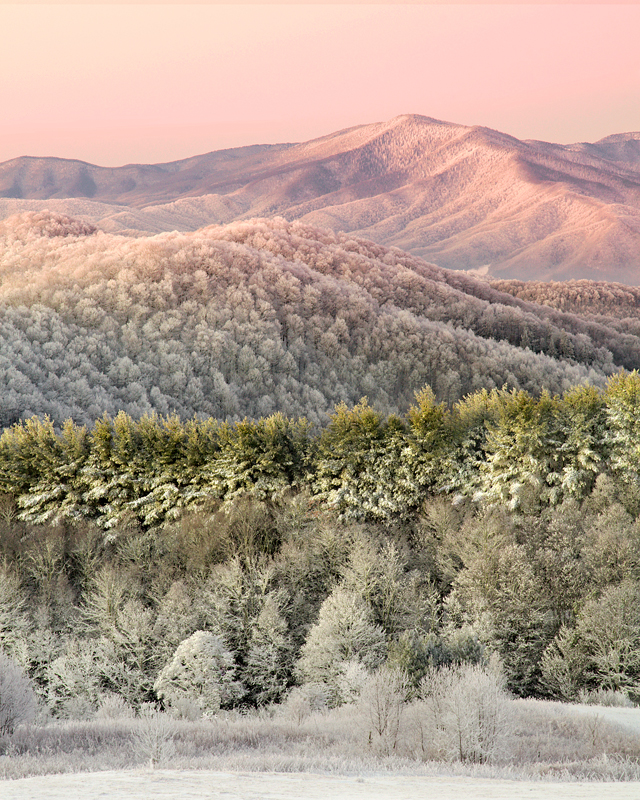
Photo by Scott Hotaling. Click on the photo to enlarge.
What photographic equipment do you use and for which tasks?
I like my kit to be simple. I don’t need nor want a bunch of stuff to lug around. My workhorse camera is the Canon 5D. I don’t subscribe to manufacturer debates over which system is better – it’s all the same to me. My 5D has gained my respect over the years because I can’t seem to break it. It falls on icy glaciers, gets soaked in the rain, sees temperatures below 0° F regularly in the winter and despite plenty of other daily torment, it never misses a beat. When it does finally die, that’ll be fine, I’ll just get another one.
From a lens perspective, people are often surprised to find out that I only have two – a Canon 17-40 f/4 L and 70-200 f/4 L. Much like my camera bodies, my lenses take a good deal of abuse and don’t seem to mind.
The often unheralded piece of gear in my bag that truly does the dirty work are my HiTech neutral density filters. I carry five, four graduated and one non-graduated, and use them nearly every time I’m out. My sunrise and sunset photos would be impossible to capture in one exposure (I don’t use any HDR or similar techniques) if it weren’t for those filters. I highly recommend any beginning landscape photographer look into purchasing a set.
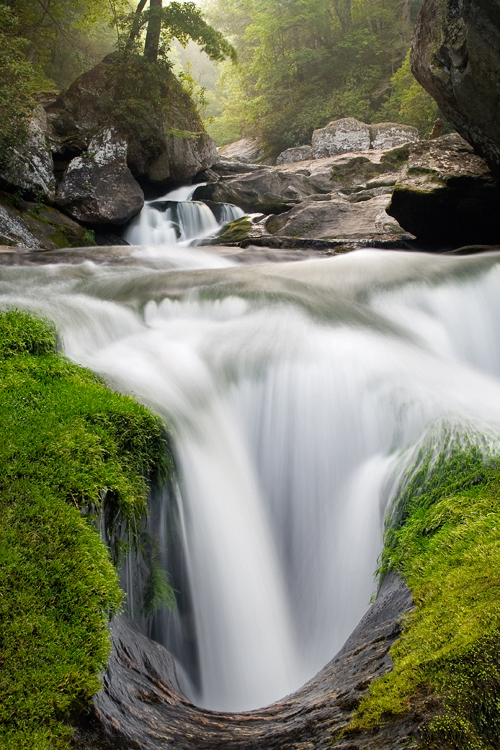
Photo by Scott Hotaling. Click on the photo to enlarge.
What is the average weight of your hiking backpack?
Average weight is a tricky subject. If I’m backpacking, my pack is probably in the 20-35 pound range depending on season and trip length. I try to stay as light as possible, despite carrying a tripod. If I’m only day hiking, I would venture a guess of 5-15 pounds.
I have this issue with tripods – I can’t find the perfect tripod for me. Which tripods do you use and why?
I’ve been using the same tripod for years. Many photographers would consider it too small, or too heavy, or too cheap but it works great for me. Both head and legs are made by Manfrotto – the head is a 466RC2 and the legs are model 3001BPRO.
Photo by Scott Hotaling. Click on the photo to enlarge.
Recently I wrote an article about using UV filters to protect lenses. What is your opinion on that issue? Do you use UV filters?
I don’t use UV filters at any time. The only use I see for one is protecting a lens when photographing in a place that has unavoidable, major hazards to the lens glass present. From a purely photographic standpoint, it doesn’t serve any purpose in my opinion.
Photo by Scott Hotaling. Click on the photo to enlarge.
Do you post process your photos? What software do you use, and what are the main adjustments that you perform?
I post-process all of my photos using Adobe Bridge for RAW conversions and Adobe Photoshop CS3 (or maybe 4?) for the rest. I avoid major processing work as much as possible – the tools I stick to are, in no particular order, spot removal, levels, contrast, color balance adjustments, and localized color tweaking. Dodging and burning is a major part of my processing as well and adds depth to the finished image.
Photo by Scott Hotaling. Click on the photo to enlarge.
If you had only two advices to give to a beginning landscape photographer, what would they be?
Get off the beaten path and shoot what you love.
Thank you Scott for this great interview. I hope to see more photos from you in the future.
If you liked Scott’s photographs, you can visit his website at
I didn’t write here for over a month now and I have good reason for that. Me and my life partner Ira moved from Israel to Australia, and now we are living in Melbourne. It is a big change for us, and this month we were all busy with the move, and only recently had some time to explore our new surroundings.
Here are some of my first impressions of Australia (actually it is not my first time in Australia, but last time was three years ago).
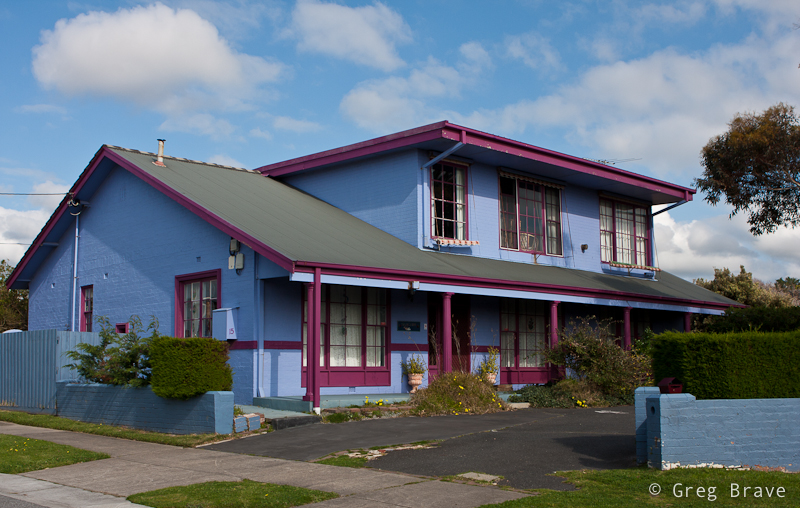
I liked this house because of its unusual colours… it looked to me as if it was taken from some fairytale, especially under this beautiful blue sky with white clouds.
Click on the photo to enlarge.
I saw many pictures of piers from all over the world, and here is my contribution to the world’s collection. I am sure that it is not the last one from me. I will also go back to this pier to photograph it under different lighting and weather conditions.
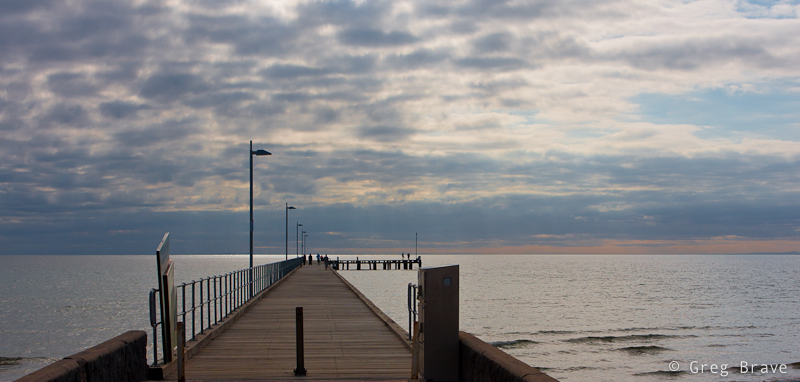
Click on the photo to enlarge.
Here is a very common sight in Australia – gum trees and parrots. I especially liked this photo because of the curved tree on the foreground and the fact that parrot’s posture slightly resembles that tree.
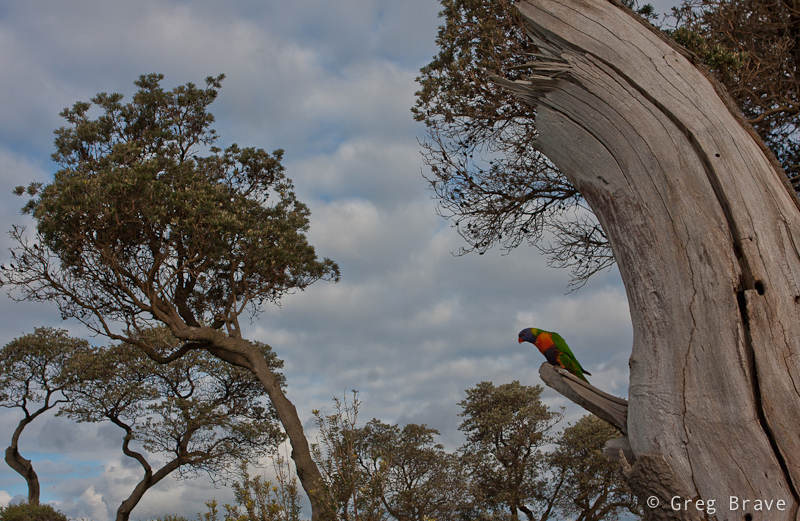
Click on the photo to enlarge.
The following photo is a view from the boardwalk on the Mornington Peninsula. The water colours are beautiful…
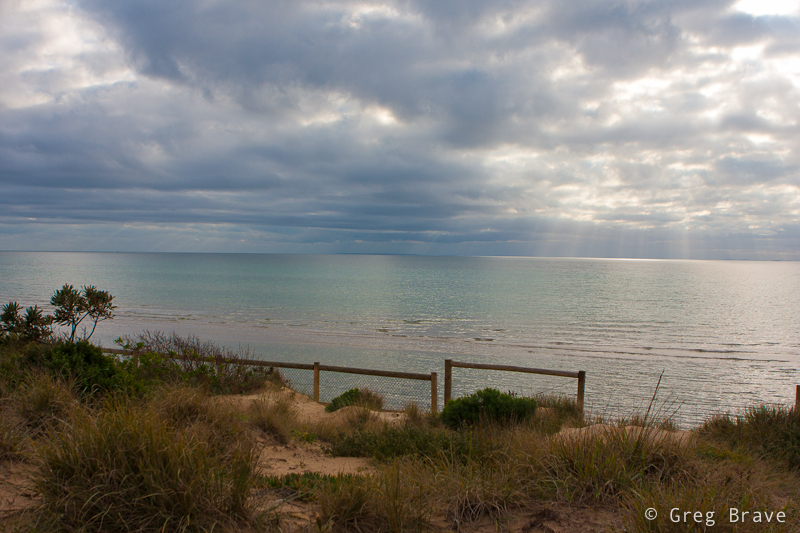
Click on the photo to enlarge.
A few days ago we went to the tulips festival and I couldn’t resist shooting some flower photographs, here are the ones that I liked the most.
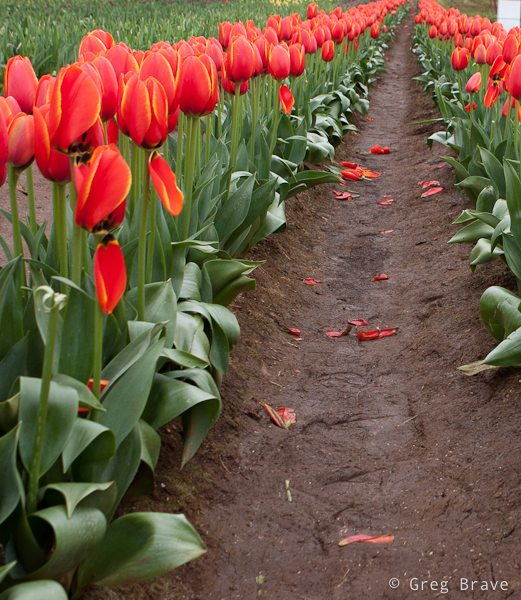
Click on the photo to enlarge.
The following two are obviously post processed. The reason for post processing was that I wanted the viewer to concentrate on the form of the flowers in the left photo and not being distracted by their bright and vivid colours, and in the right photo I wanted to create a mood “appropriate” for the broken flower.
By the way, I did not break that flower! It was already like that when I saw it.
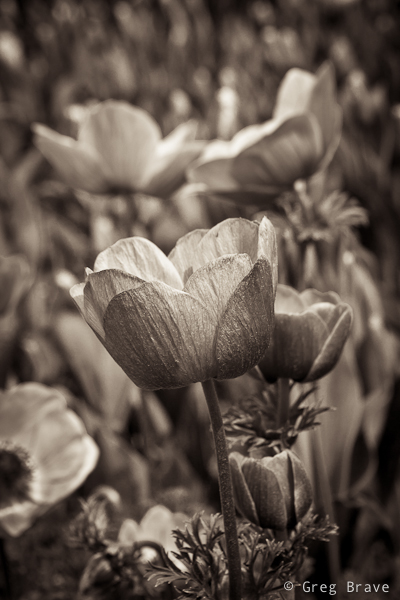
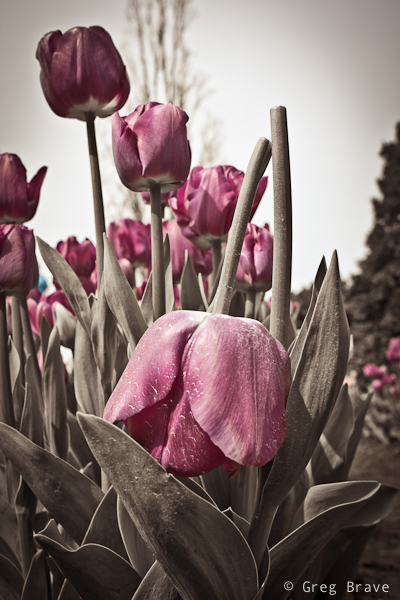
Click on the photo to enlarge.
The sunsets here in Australia are magnificent, especially if they come at the time when sky clears a bit after rain. Here is a sunset that I photographed from my back yard.
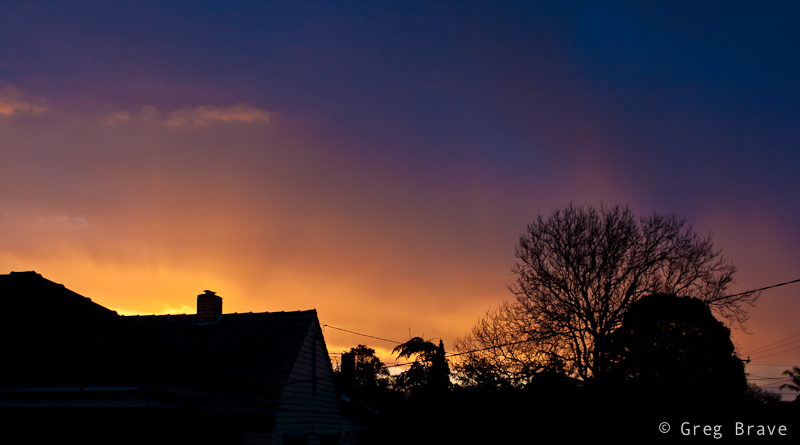
Click on the photo to enlarge.
And last but not least a series of three photographs I took at sunset from that same pier that you saw before. In two of the photos you can see Ira posing for me.
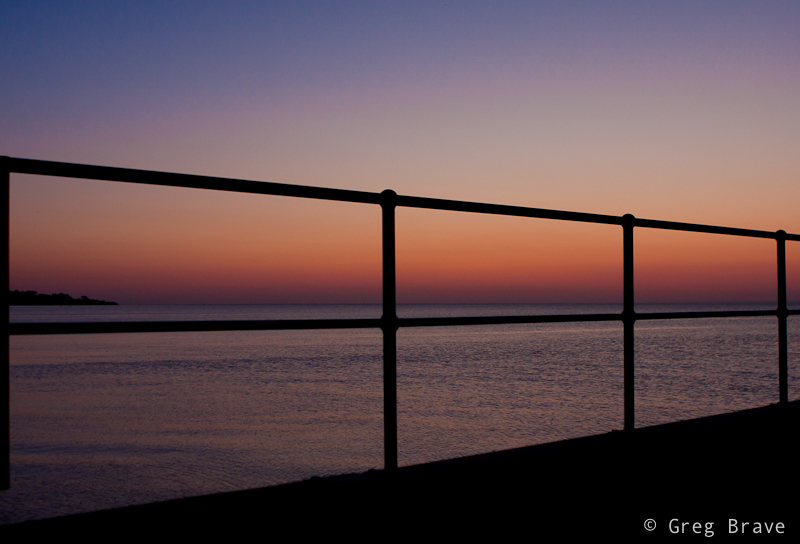
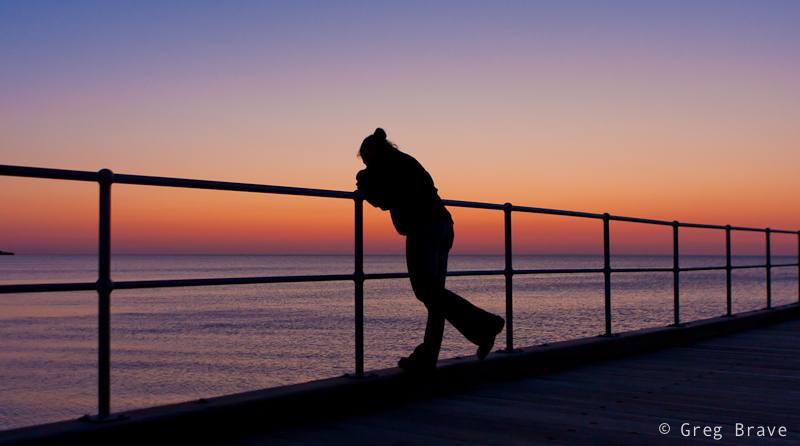
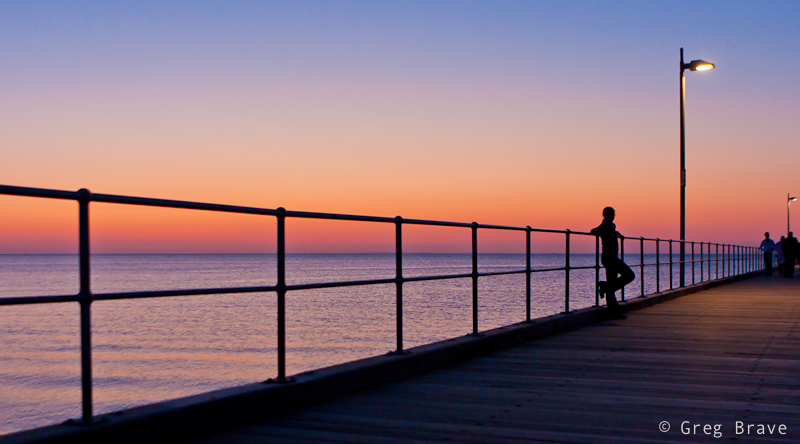
Click on the photo to enlarge.
That’s it for my first impressions of Melbourne. I hope I will be able to write and photograph more from now on and also I hope that you liked my photos.
Your comments are always highly appreciated, and
Remember, you only have to enter your name to write a comment!
Till the next time,
Take care!
Greg.
Before reading this interview I suggest reading my Introduction to Interviews with Photographers.
Ilia was born in Uzbekistan. When he was thirteen he moved to Israel with his parents. Ilia’s affair with Mother Nature started when he was a young boy and continues to this day. The breakthrough in his photography happened in the year of 2000 when he bought his first digital camera, and since then you can find Ilia’s photographs in many books and leading magazines such as National Geographic, Practical Photography, The Guardian, Daily Mail, Telegraph and many more.
Ilia also specializes in bird photography and has a large collection of magnificent birds photographs.
Ilia kindly agreed to this interview and made time in his busy schedule to answer my questions.
Please welcome Nature, Bird, and Wildlife photographer Ilia Shalamaev!
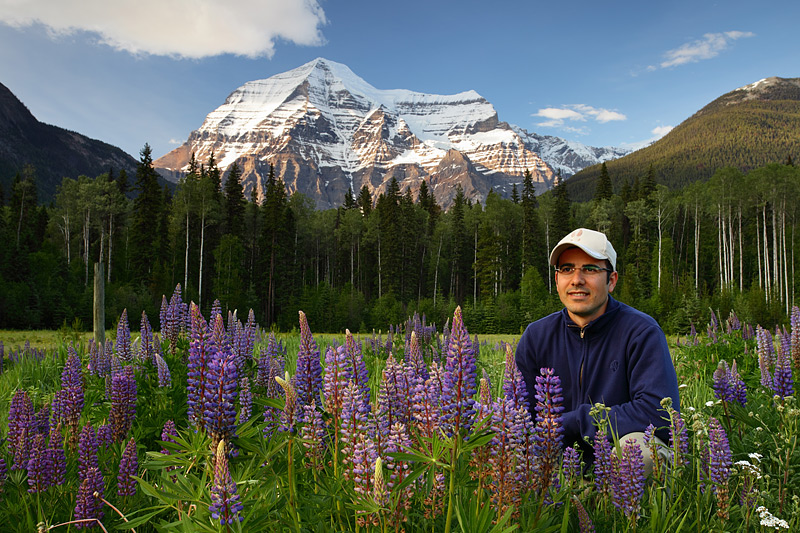
Click on the photo to enlarge.
How do you choose the locations to shoot your beautiful landscape images? I mean how do you know that from a certain location you’ll get a great image?
Choosing the right location is the most difficult part of the job. I try to look for right places before I actually bring the gear to the field. Second thing is to decide in what season and hour of the day the subject will look in its best. What left is to wait for the right moment to give it a shot.
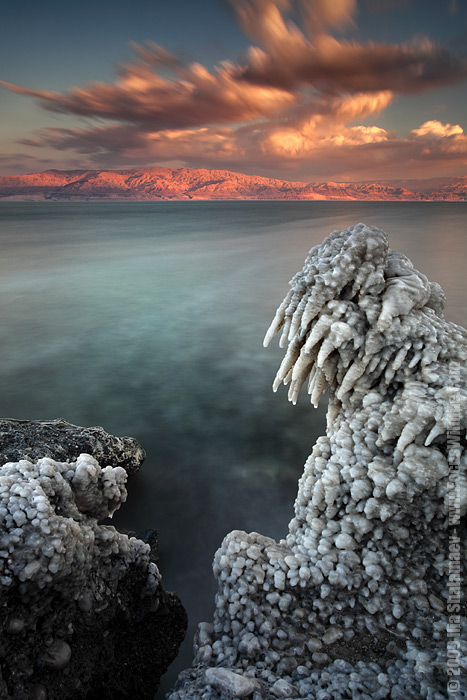
Photo by Ilia Shalamaev. Click on the photo to enlarge.
The colors in your landscapes are absolutely magnificent. Is this due to post processing enhancements, good lenses, or just perfectly chosen weather conditions and time of the day?
Most of my landscapes I take in the magic light of sunrises or sunsets, the harsh light of midday, especially in our region leaves no chance for a decent image. In addition, the right use of polarizer and set of ND Grads (Neutral Density Graduated filters) really enhances the color saturation and dynamic range of the images I take.
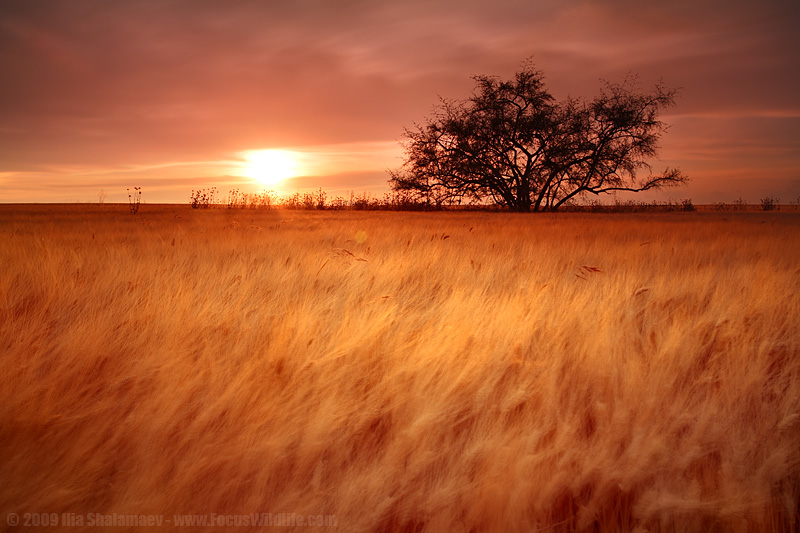
Photo by Ilia Shalamaev. Click on the photo to enlarge.
I understand that in order to get some of your beautiful images you had to hike quite a distance outdoors. Could you share some of your tips regarding hiking with photographic equipment in the nature?
There are some must things for traveling in the wilderness: Good hiking boots, pro backpack for the gear, light tripod, a lot of water and a light thermal jacket with you. The backpack should be very comfortable and protected from rain. As to photo gear, try to take with you the minimum you need. Usually on a hike I don’t take more than two lenses with me .
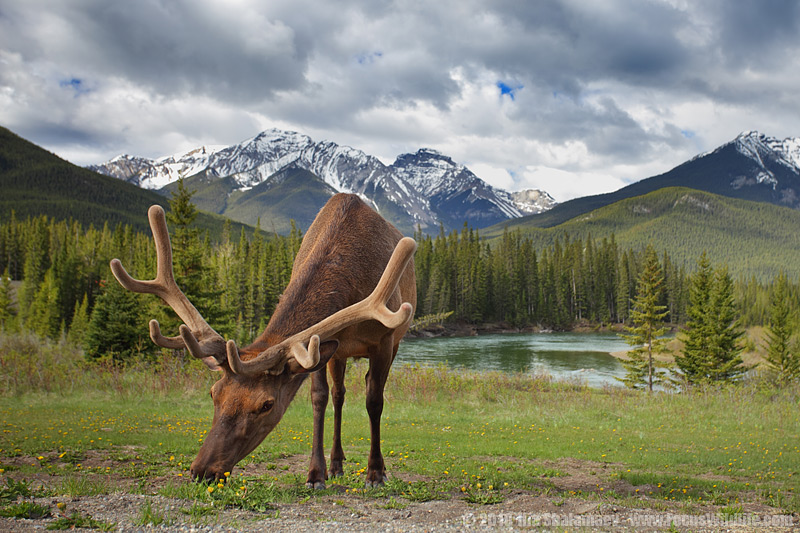
Photo by Ilia Shalamaev. Click on the photo to enlarge.
In your image “The Charm of Light” you managed to beautifully capture sun rays spilling over the waterfall. How did you do it ?
In that case most of the credit should go to Mother Nature. Rays of sunshine on that warm morning melted the last remaining snow and filled the air with mist that joined millions tiny droplets of water, created by the 60 meters high waterfall. All these combined created this celebration of nature.
The gear I used for this shot is canon 5D, canon 17-40mm f/4 lens, 2 stops soft ND-Grad, tripod.
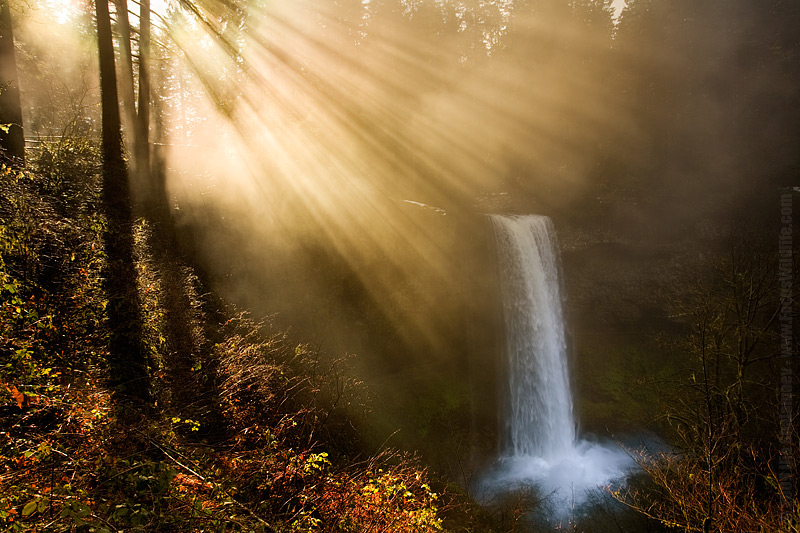
“The Charm of Light”. Photo by Ilia Shalamaev. Click on the photo to enlarge.
You are also a professional bird photographer, having a wonderful collection of high quality images.
What are the most important aspects of bird photography?
It is a bit difficult for me to pick just one so I will mention two of them:
a. Patience – you will need a lot of it, in order to success in this field of photography. Sitting for hours in a tiny hideout with 45 degrees Celsius inside, without moving or making a noise, is just one example of bird photographer’s reality.
b. Knowing your subject. Bird photographer should understand his subject and in many cases predict its behavior, in order to get intimate images of it.
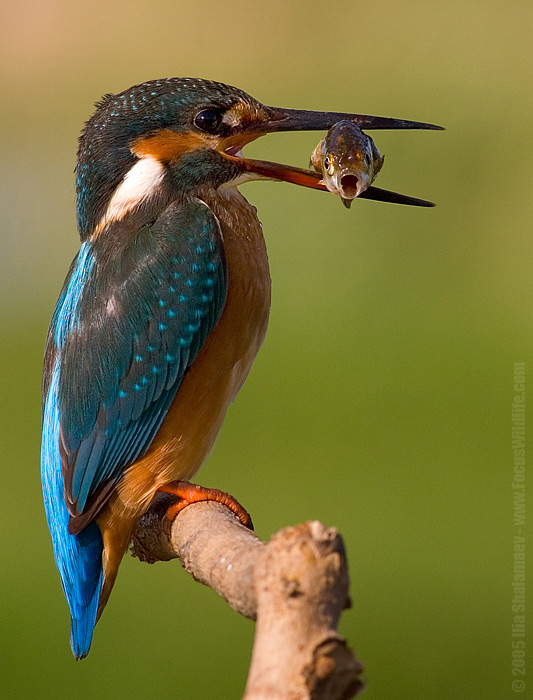
Photo by Ilia Shalamaev. Click on the photo to enlarge.
I assume that technically to be able to create such shots you have to use some professional equipment. What equipment do you use specifically for your bird photography?
I use Canon gear. Canon 5dMKII body and canon 500mm f/4 IS L lens, Gitzo basalt fiber tripod. Occasionally canon EX 580 flash.
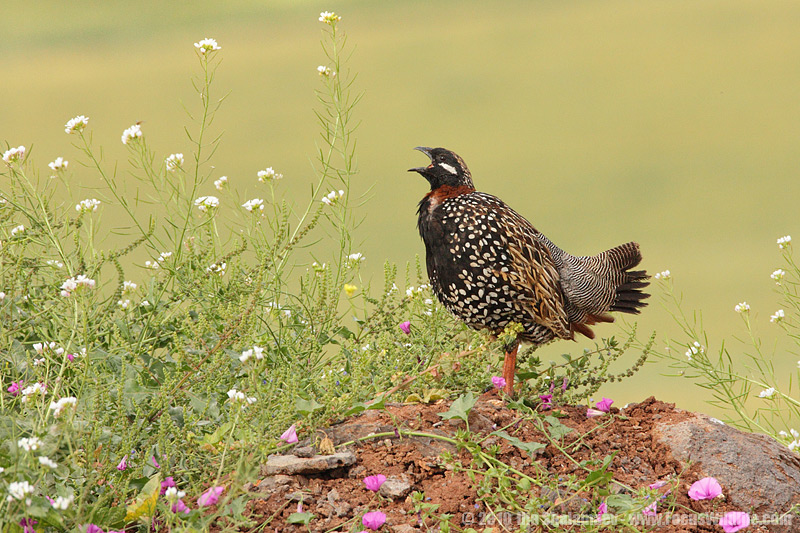
Photo by Ilia Shalamaev. Click on the photo to enlarge.
What photographic equipment do you use for everything else?
For my landscape photography I use the same
There is no other camera body on the market that can compete with output quality of the 5D MKII in even close to its price range, due to 5D’s full frame, high resolution sensor and its reasonable price. So it’s obvious that this body is an ultimate tool for landscape photographer. Many will say that its focus system is not match for Nikon D700 FF camera and will be perfectly right, but I don’t even use automatic focus when shooting landscapes, so it’s not an issue for me.
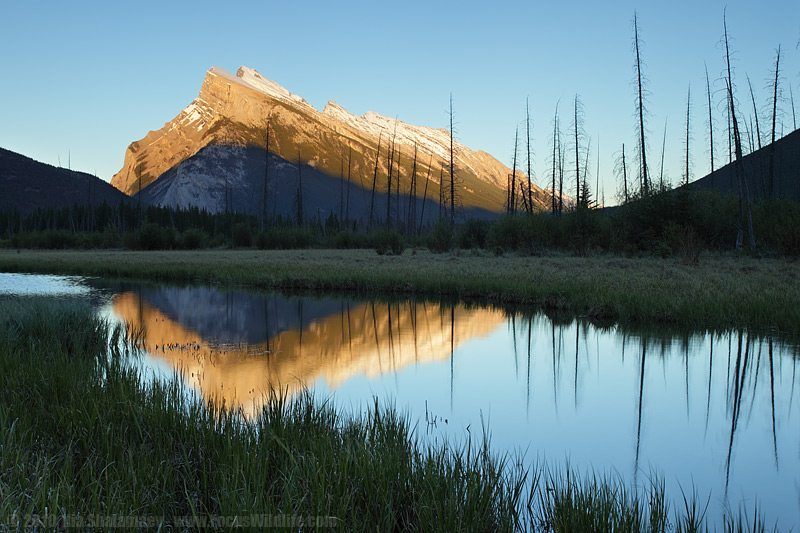
Photo by Ilia Shalamaev. Click on the photo to enlarge.
You also conduct nature photography workshops in Israel. Tell us about your workshops. How can people sign up for your workshops?
I give master classes of landscapes and birds photography, mostly in association with “Galitz” school of photography. Next start date, for 5 meetings Landscapes photography workshop, is in 26 of September 2010.
It has become my tradition to ask this question – if you had only two advices to give to a beginning photographer, what would they be?
1. Watch and understand your subjects before thinking about taking pictures.
2. Do not choose the easiest target – find one that not many have photographed. Better choose subject that you have repeated access to, and concentrate on it. Eventually you will obtain the pictures you first imagined.
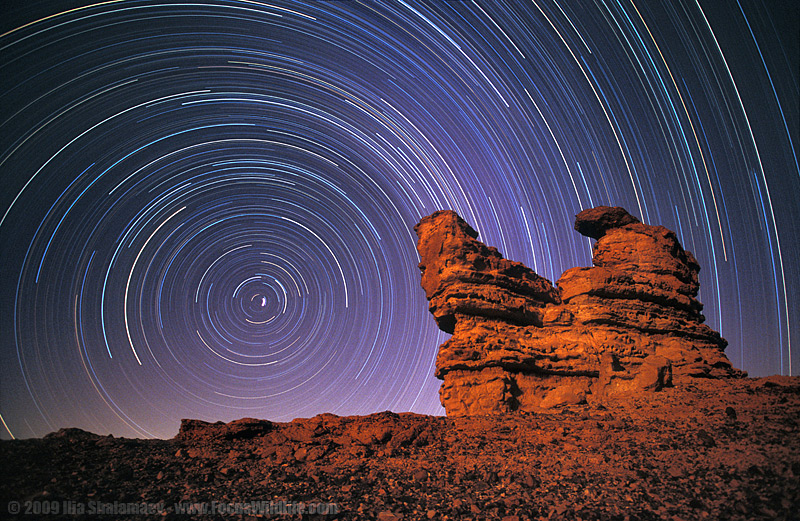
Photo by Ilia Shalamaev. Click on the photo to enlarge.
Ilia, thank you very much for your time, effort and knowledge, and keep up the great job that you are doing!
You can see more of Ilia’s work on his
Hello everybody!
Today I’d like to talk about photographing sunflowers in the outdoors. I mean not one or two sunflowers at home but photographing them in the open field.
It all began when my friend asked me to make a picture for her. She wanted a very specific photograph of a large field of sunflowers, that would be completely yellow because in her imagination all the sunflowers would look up at the sky. This idea came to her while she was driving along a sunflower field, but she didn’t really pay attention to them.
I was glad to have an assignment like this because I just love any opportunity to be creative, and also if she would later hang my photo on her wall, it would be very flattering. So we decided on a day and drove to that sunflower field. I chose second half of the day towards sunset, but early enough to have time to scout the area and choose location.
When we arrived at the sunflower field I was surprised to see that all the sunflowers were NOT holding their heads up, as you can see in the photograph below. I am sure that there is a scientific explanation to this (maybe they were ripe and heavy for example), but in my mind I have always imagined sunflowers to hold their head up high. As a result it was impossible to make a photograph that my friend wanted. In the photo below you can see that there is too much green in between the yellow.

Photograph by Greg Brave. Click on the photo to enlarge.
But since we have already came I decided not to leave empty-handed and began to think of various creative ideas to shoot the sunflowers in their current state. Let me remind you that it was around sunset time and the sun was getting lower and lower. The shot that you see below was made almost against the sun. The sun was almost facing directly inside the lens and then I lowered it a little. So the flare can be seen, and in my opinion it contributes greatly to this photograph by creating a certain end-of-the-day mood. I also like how it lights the white “hair” on the stalk emphasizing its shape.

Photograph by Greg Brave. Click on the photo to enlarge.
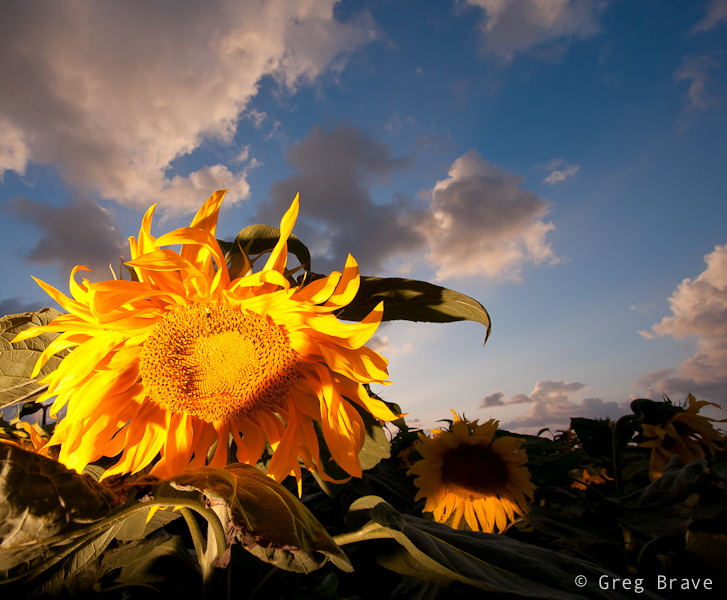
When the sun descended more, the contrast between the sky and the sunflower field grew and it was impossible to capture both the blue sky and the yellow sunflower heads without flash. Either the sky was burned out and the sunflowers were correctly exposed, or the sky was correctly exposed and the sunflowers became very dark. So I took my Canon 430EXII flash out and started using it together with my Yongnuo remote trigger. I was shooting on manual, setting the exposure to correctly expose the sky and setting the flash power so that sunflower would also be correctly exposed. I asked my friend to hold the flash in a way that the sunflower would be lit from the side creating nice shadows.
But, of course, nothing comes out right from the first try, and I want to show that here. As you can see from the photograph below the lighting on the sunflower looks too bright and too artificial, and the shadows are too harsh. In addition there is a big shadowed area of the sunflower as a result of incorrect flash position. And even though the sky is correctly exposed it is not enough to make a good picture.
Photograph by Greg Brave. Click on the photo to enlarge.
But I didn’t give up, and after numerous attempts and adjustments I found the right combinations and my photographs started to improve. I was thinking less and less about technical side of the photographing process and concentrated more on the creative side. In the photo below you can see more natural lighting and balanced composition.
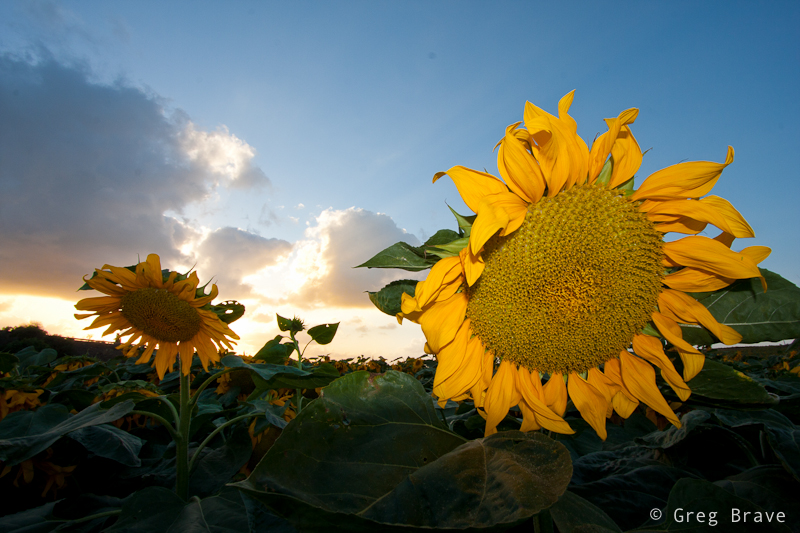
Photograph by Greg Brave. Click on the photo to enlarge.
I thought that the sunflower above came out too yellow so I decided to add a 1/4 CTO gel to the flash and see what happens. And I liked the result of that, which you can see in the photographs below. I liked the warmth of the light, which matched good (in my opinion) with the warm colors of the sunset.
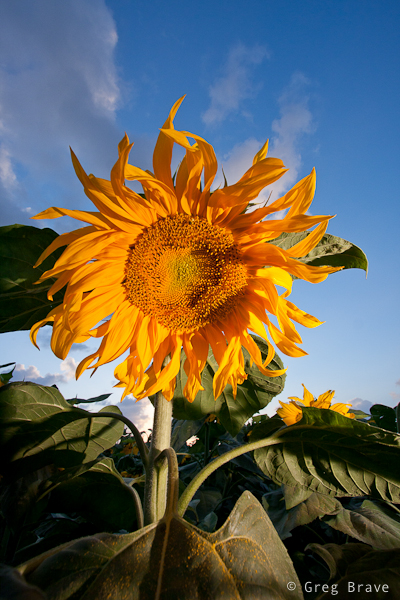
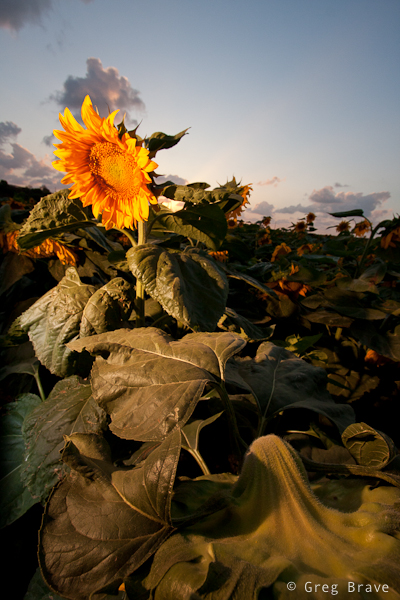
Photographs by Greg Brave. Click on the photo to enlarge.
As the sun was getting almost down to the horizon I got this interesting idea to shoot the sunflower with the setting sun in an interesting juxtaposition (never believed I would use this word 🙂 ), and because the sunflower heads weren’t looking up I could do that! I came low under the sunflower and positioned it to be in front of the sun, asking my friend to point the flash from my right at the sunflower. I needed the flash to point a little up so that the light wouldn’t spill on the green leaves.
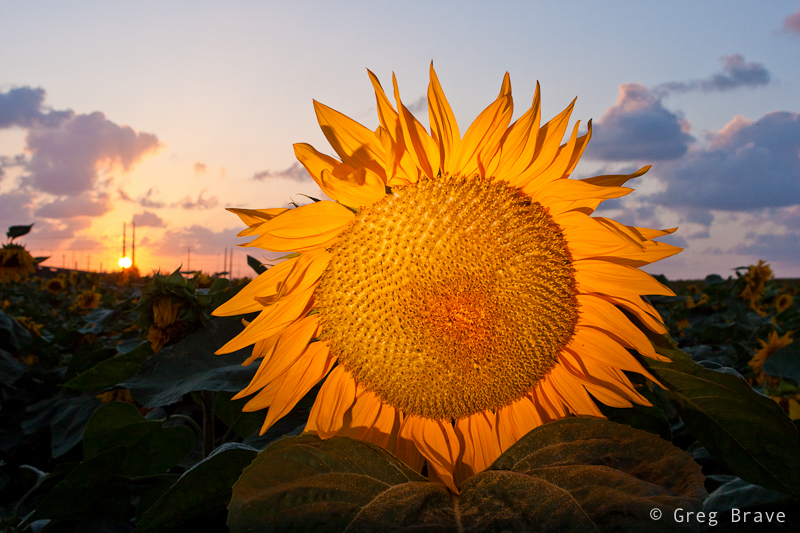
Photograph by Greg Brave. Click on the photo to enlarge.
After getting the shot above I was pretty much satisfied but decided to try more compositions and lighting directions just to see what comes out. And it turned out to be the right decision, because in my opinion then I made my best photo of that evening.
I call it “Don’t want to look at the sunset”
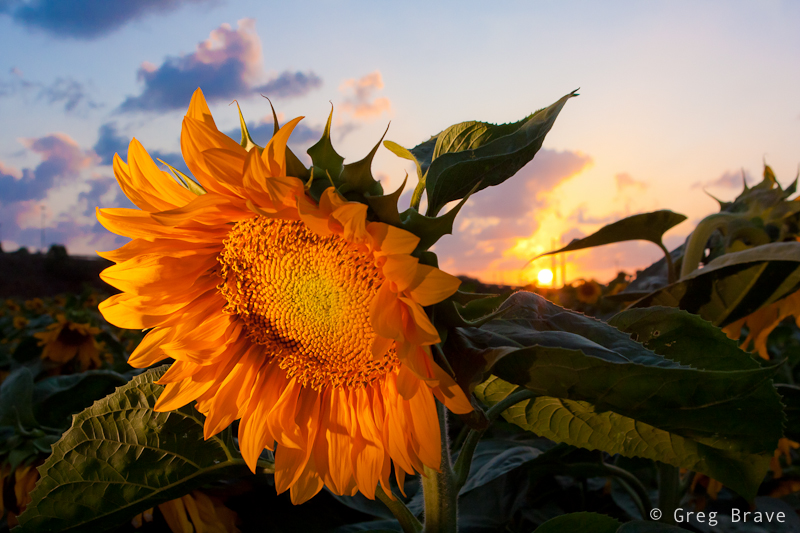
Photograph by Greg Brave. Click on the photo to enlarge.
One more thing – you could say that I didn’t have to use flash but to take several exposures and combine them together in HDR. Yes, I could but in order to do that I had to use tripod and also if it was windy (even a little), it would be difficult to create a good HDR photograph. Taking into account that I had limited time as the sun was setting pretty fast, if I was using tripod I wouldn’t have time and flexibility to try as much different compositions as I did just hand-holding my camera.
I hope you liked viewing these photographs, and learned something new in the process.
I want to read your comments and your suggestions are always appreciated. If you have pictures of sunflowers that you’d like me to review, you can send them to greg at photopathway dot com and I’d be glad to do that here on my blog.
Remember you only have to enter your name to leave a comment!
Good day everybody! It has been a while since my last post. I had some pretty cardinal changes in my personal life, and was so caught up that couldn’t free my mind to write anything. But I continued to take photos and have some new stuff to share.
In addition to the changes, during this time me and Ira also went on an 8 day trip mainly to Switzerland but with short, 2 day stop in Prague. Actually one out of these two days we weren’t in Prague but in a small village named Černošice. It is located about 20 minutes by train from Prague, and it is so beautiful!
Černošice lies on the Berounka river, so we stepped off the train and went to the river right away. There is a nice walking trail along the river, and in the photos below you can see some of the views that we saw while walking there.
I saw these naked trees on the shore and their beautiful reflections in the water. I wanted to photograph them but thought that only the trees with their reflections were not enough to make interesting photograph, so I was looking for an additional element for my photograph. These red tulips were it.
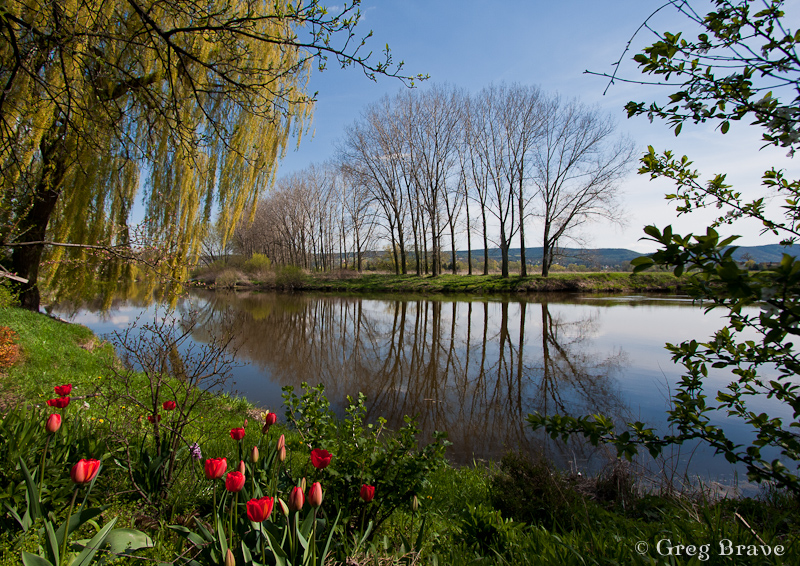
Photograph by Greg Brave. Click on the photo to enlarge.
The photograph above was not enough for me and I was looking for additional ways to photograph these trees and their reflections and as a result I got the photo below. The additional element was the tree branch from the left. As you can assume I have much more photos of these trees in my collection, but I chose these two to show here because I think they are most successful composition-wise.
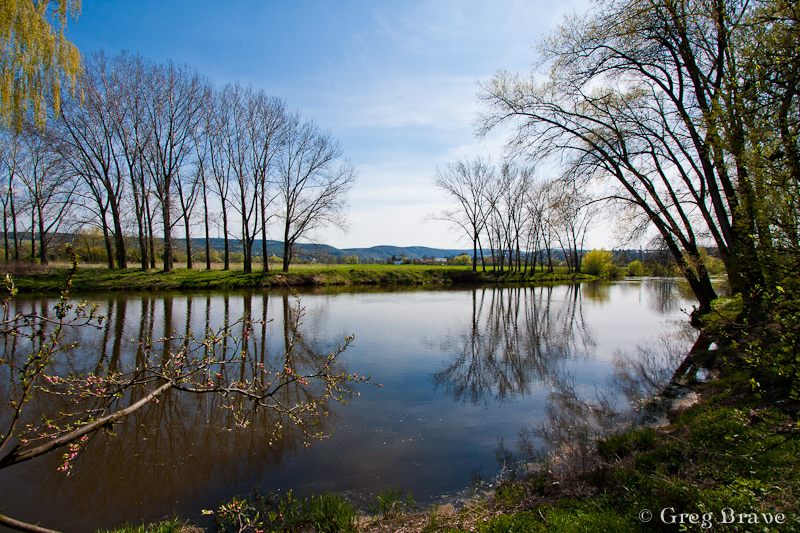
Photograph by Greg Brave. Click on the photo to enlarge.
While walking, I saw this horse’s hoof fungus. Well, it is not an unusual sight, at least not in Europe, but I just got this idea to photograph it, but as always I looked for somewhat different way of doing it. I decided to use a wide angle lens to emphasize its form and at the same time to hint about where it grows.
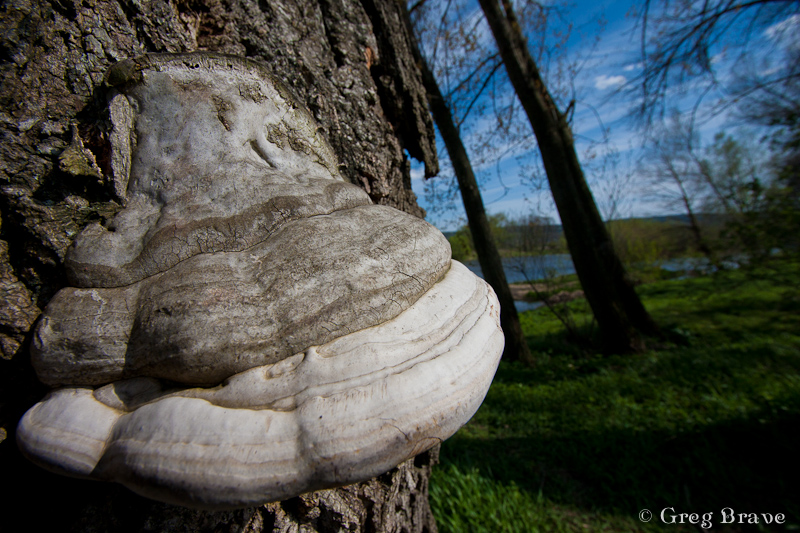
Photograph by Greg Brave. Click on the photo to enlarge.
When I took the photo below I was almost certain that it won’t be something I’d share. The sun was harsh creating a very high contrast between the sky and the earth, but the clouds looked so interesting that I couldn’t resist giving it a try. And I am glad I did! I like this photo because it is pretty simple, but at the same time it conveys movement and a feel of space.
Actually this photo didn’t look exactly like this when I opened it in Lightroom. The lower half of it was almost completely dark. But here comes the magic of shooting raw – using the “fill light” slider I was able to recover many details. In general, I use the “fill light” adjustment slider when I am forced to shoot in harsh afternoon light, and there are some strong shadows. The fill light adjustment helps make these shadows much less disturbing.

Photograph by Greg Brave. Click on the photo to enlarge.
Next photo is pretty ordinary, I mean there are many photos like it out there, but I still liked it for being so bright, happy, and colorful, and couldn’t resist sharing it.
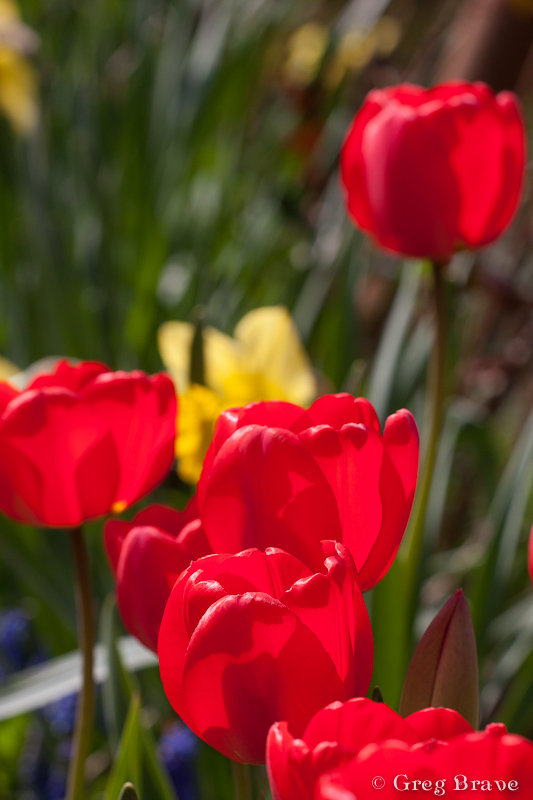
Photograph by Greg Brave. Click on the photo to enlarge.
I am not presenting here photos I made in Prague, since not long ago I had a more substantial trip to Prague and already posted photos from it. You can find my articles about Prague here and here.
After short stop in Prague we continued to our main destination – Switzerland. I always wanted to see whether this country is as beautiful as photographs show. Believe me – it is!
Our first destination was small town named Grindelwald. It is located in a very beautiful and mountainous area, which was exactly what we wanted. We camped in Grindelwald and went for a long hikes up the mountains from there. Since late April is still pretty cold, there weren’t much tourists (the ski season was over, and the summer hiking season didn’t begin yet), and we mostly hiked alone.
In the photographs below I will show some of the stunning views we saw on our hikes.

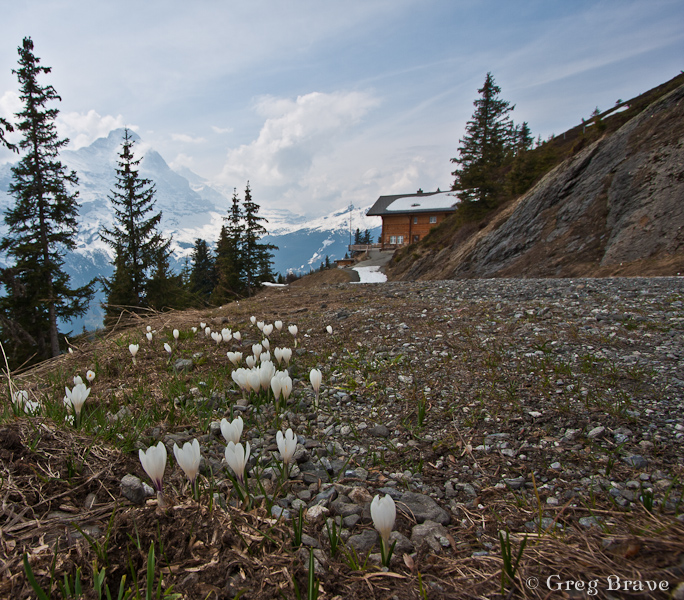
Photographs by Greg Brave. Click on the photo to enlarge.
I was looking for interesting shapes, patterns and angles to create interesting photographs, that would stand out. Whether I succeeded or not is for you to decide.
On one of our hikes we went so high up the mountains that we reached areas where snow didn’t melt yet and the wooden houses, which are restaurants and resorts in the summer, were completely covered with snow! There is one catch in photographing snow under bright sunlight (just in case that you are not familiar with it) – because the snow is so white it reflects the light very good, and the light meter in the camera perceives the scene to be very bright thus underexposing the photograph. So you have to set your exposure compensation to about +1 stop. It is not an exact science so just try and see for yourself.
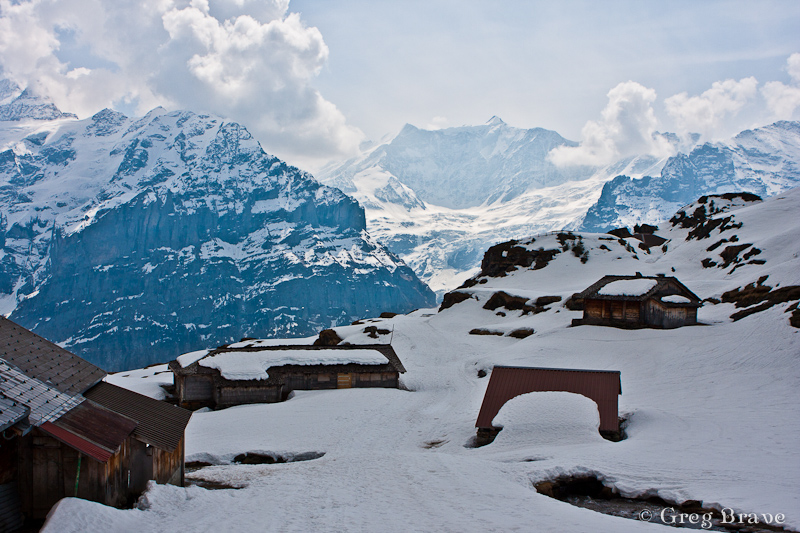
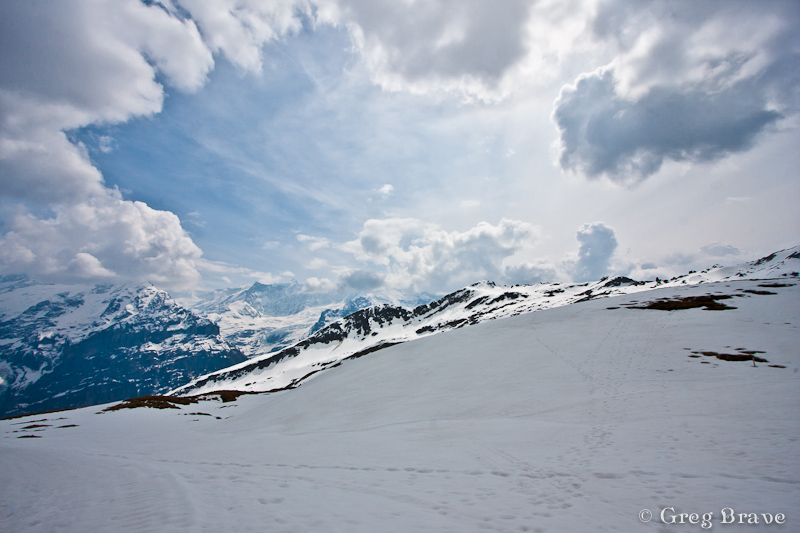
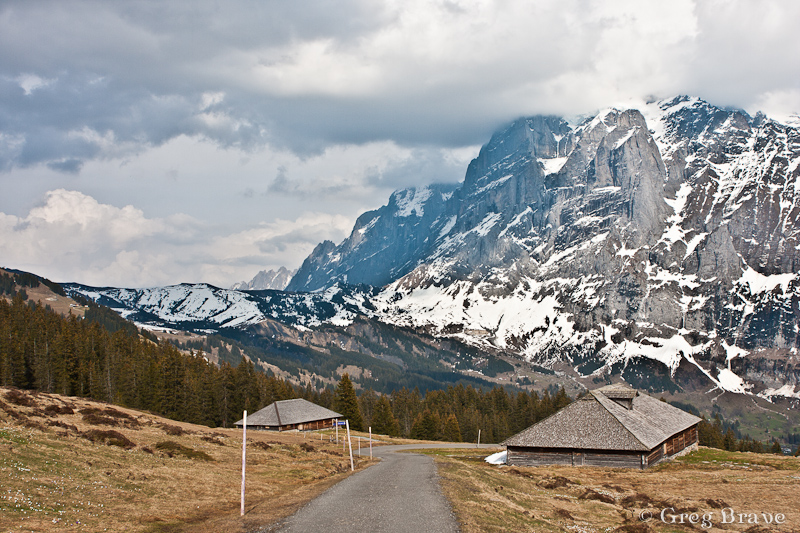
Photographs by Greg Brave. Click on the photo to enlarge.
After two days in Grindelwald area we went to another area near town named Hintergoldingen, also with mountains but they were lower so there was almost no snow there. The next photo is from that area. The wast green fields are breathtaking! At the end of this article I will put some more photos from here.
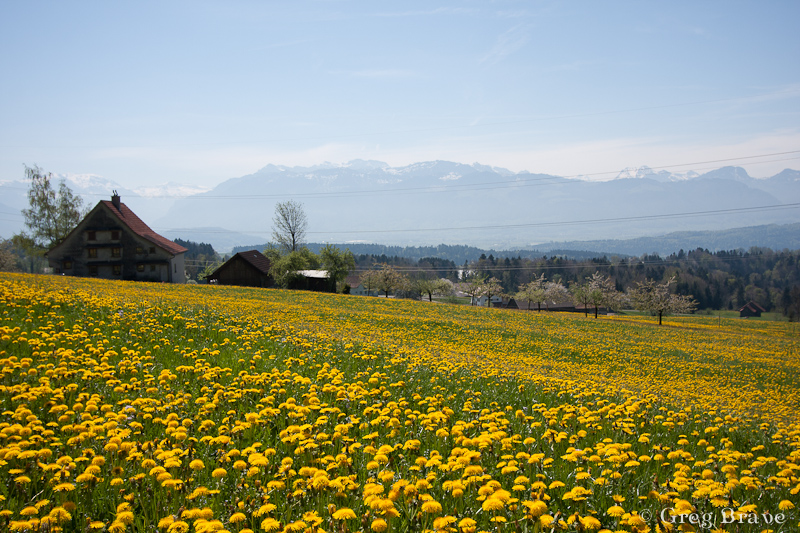
Photograph by Greg Brave. Click on the photo to enlarge.
And finally on our last day, on the way to the Zurich airport, we stopped in Rapperswill – a small town located near Zurich lake. This tree caught my attention as light was hitting its leaves making them shine beautifully.

Photograph by Greg Brave. Click on the photo to enlarge.
I also tried to capture the slow pace of this place, where locals and tourists relax and don’t hurry anywhere.
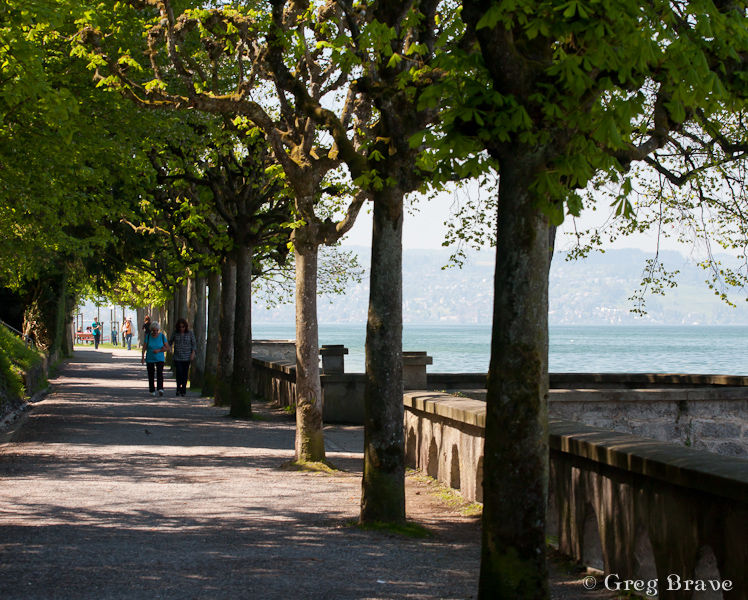
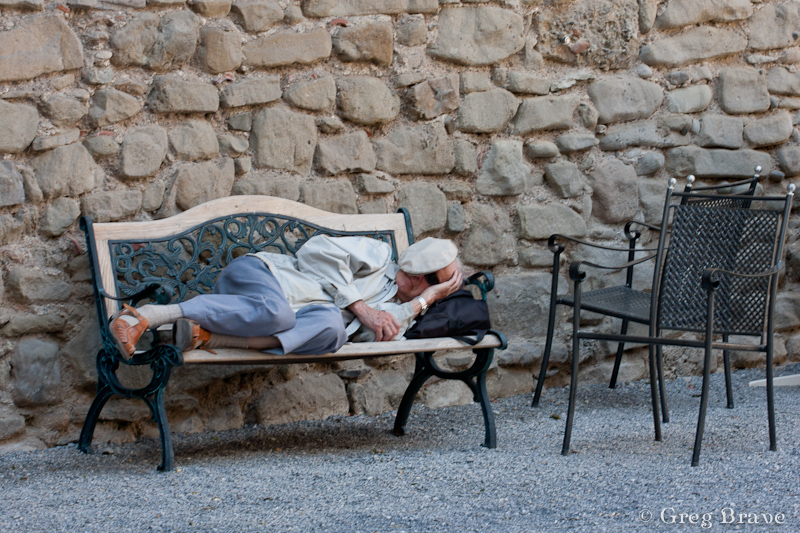
Photographs by Greg Brave. Click on the photo to enlarge.
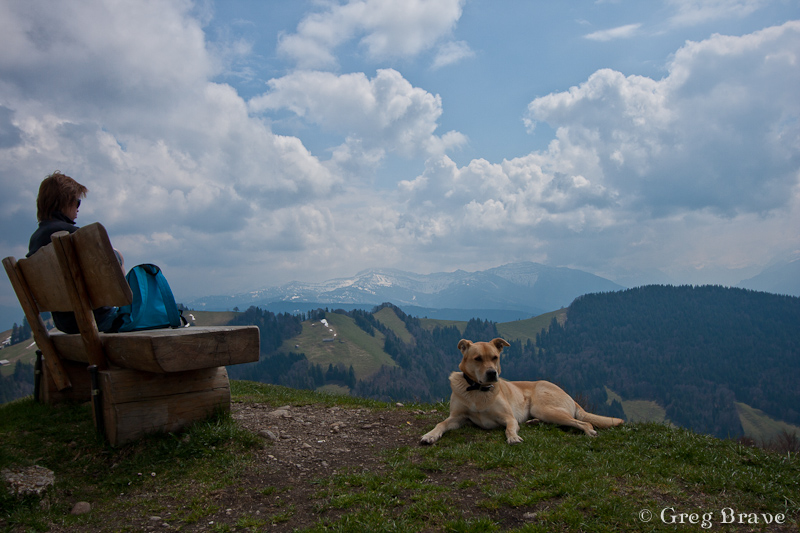
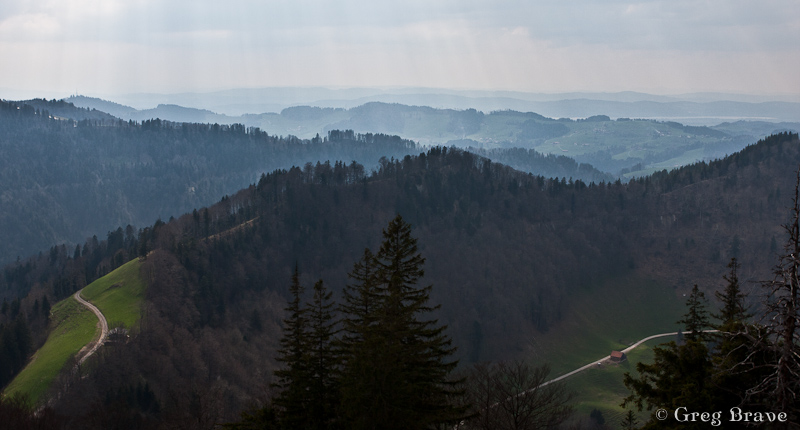
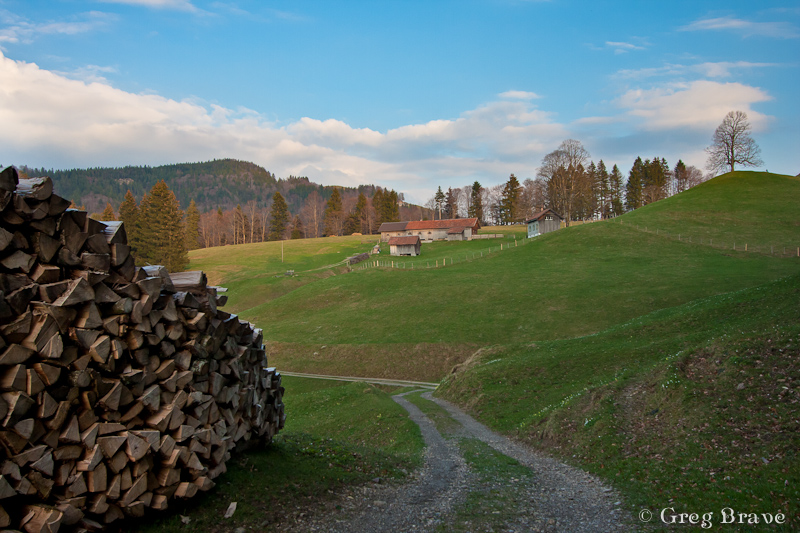
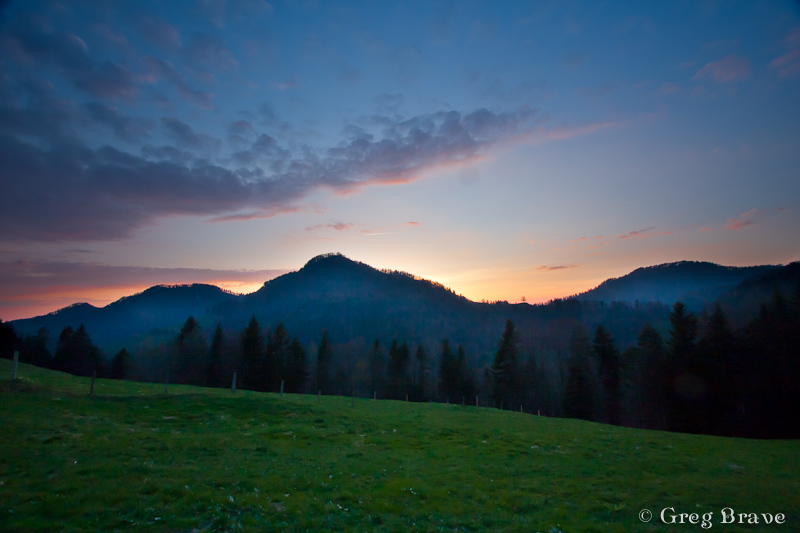
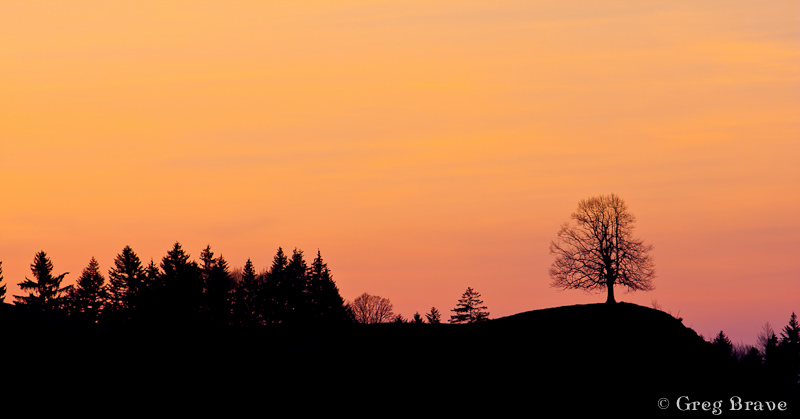
Photographs by Greg Brave. Click on the photo to enlarge.
We had a great time on our trip and I hope I succeeded in showing it in my photographs. I bought a backpack for my photographic equipment especially for this trip, it was a “CompuRover” from Lowepro. I was very satisfied with it and I am planning to write a detailed review on it in the near future, so stay tuned if you are interested!
This is it for now, and until next time take care!
Greg.
Anyone who finds a site about photography probably asks himself – who is the guy that writes this stuff ? What does he/she shoots? I think that these are very legitimate questions. You wouldn’t take a legal advice from a taxi driver, would you?
In order to provide an answer for such questions regarding myself I created a website where I display my photographic works, and here I will make a short tutorial around my website.
As I wrote in my About page, I am relatively new to photography and I started my “PhotoPathway” from photographing nature, plus the fact that I currently live in Israel – and there you have it: IsraNature.
Most of this website is dedicated to the Nature of Israel, but there are also a few albums from my trips abroad, and I imagine there will be more of them in the future. Most of the albums are named after different places in Israel that I photographed, and some of them have general names like “Nature of Galilee Region”. In such albums I put photos that there are not enough of them to create designated album for the specific place.
In the album named Artistic Impressions I put my artistic works that I like the most. Here is an example:
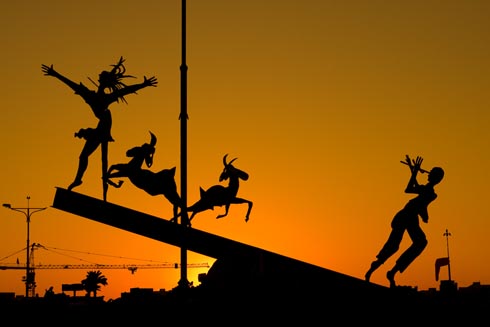
If you like my photographs and want to see new photos that I add to my site, you can just visit the homepage of my site. There will always be my latest photographs.
You can also reach IsraNature from the thumbnails on the sidebar of this blog and from the top menu. I will appreciate any comments on my photographs. I am always looking for other people’s opinion on my work.